

On this page
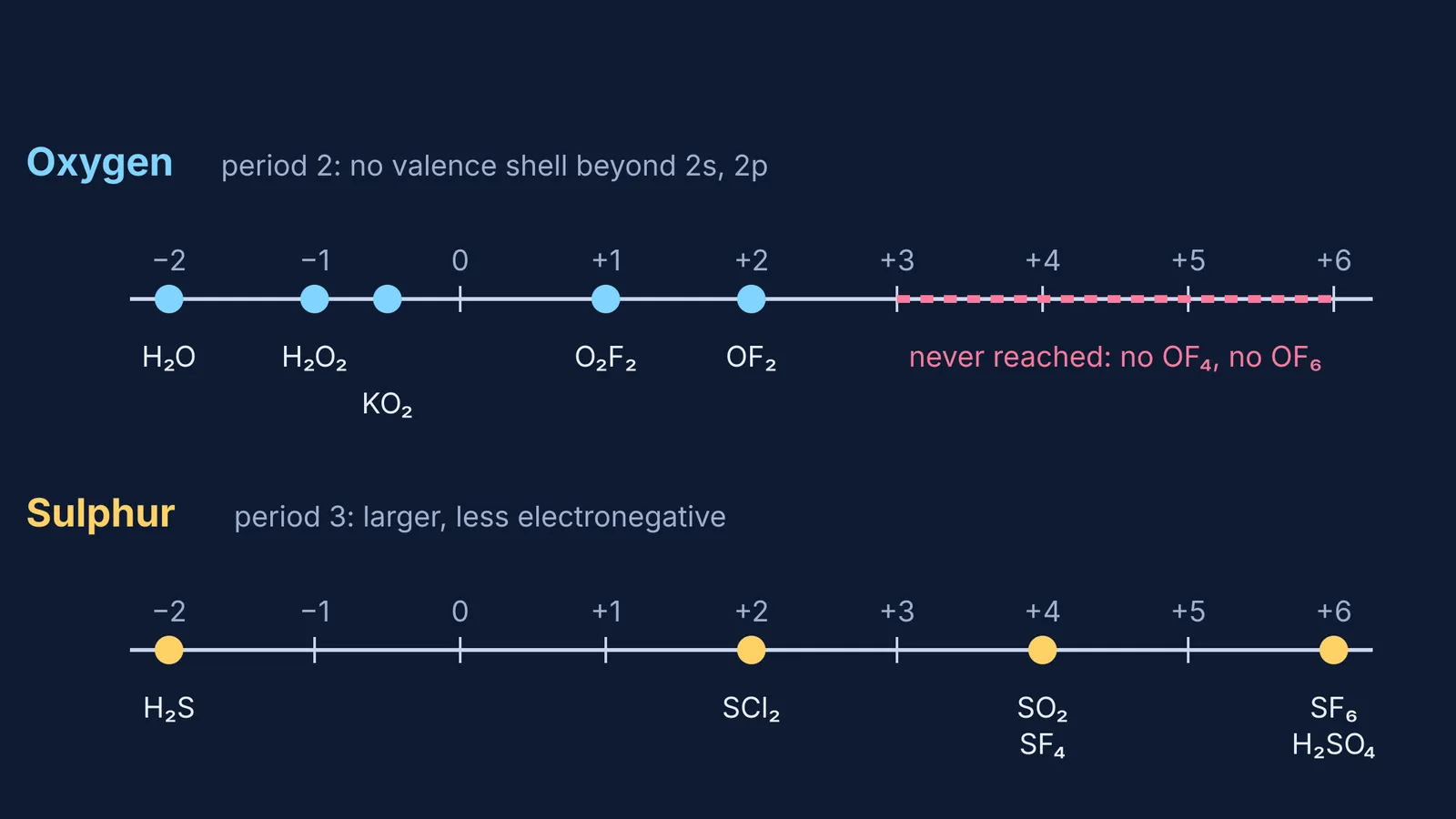
Oxygen and sulphur sit one above the other in group 16. Both have six valence electrons, and both show −2 in their hydrides, H₂O and H₂S. After that they part ways. Sulphur forms SO₂ and SF₄ (+4) and SO₃, SF₆ and H₂SO₄ (+6). Oxygen never goes above +2, which it reaches only in OF₂. Here is why.
What oxidation states do oxygen and sulphur show?
Oxygen is −2 in almost all its compounds. The exceptions are few, and each one has a reason:
−1 in peroxides such as H₂O₂ and Na₂O₂
−½ in superoxides such as KO₂
+1 in O₂F₂
+2 in OF₂
Why oxygen takes these unusual values in OF₂, H₂O₂ and KO₂ is worked through in oxidation number of oxygen in OF₂, H₂O₂ and KO₂, so this post does not repeat it. The point here is the ceiling. Oxygen's highest oxidation state is +2.
Sulphur shows −2, +2, +4 and +6 as its common states:
−2 in H₂S and metal sulphides such as Na₂S
+2 in SCl₂
+4 in SO₂, SF₄, H₂SO₃ and the sulphites
+6 in SO₃, SF₆, H₂SO₄ and the sulphates
Why can't oxygen show positive oxidation states like sulphur?
There are two separate reasons, and you need both.
1. Only fluorine is more electronegative than oxygen. An oxidation number is assigned by giving the shared electrons to the more electronegative atom. Oxygen (about 3.5 on the Pauling scale) loses that contest only to fluorine (about 4.0). Bonded to H, C, S, N or any metal, oxygen takes the electrons and is negative. So oxygen can be positive only in its fluorides. Sulphur (about 2.5) is less electronegative than both O and F, so in SO₂, SO₃ and SF₆ the electrons are counted on O or F, and sulphur ends up positive.
2. Oxygen cannot form more than about four bonds. Even with fluorine as partner, a +4 or +6 oxygen would need four or six O–F bonds. Oxygen is a period 2 atom. Its valence shell has only four orbitals (one 2s and three 2p), so it can hold at most eight electrons. In OF₂ it already has two bond pairs and two lone pairs, a full octet. NCERT makes the same point: oxygen's covalency is limited to four.
Sulphur has neither problem. It is less electronegative, so it can be positive with O and F, and it is larger (covalent radius about 104 pm against about 66 pm for O), so six fluorine atoms fit around it.
Does sulphur really use its 3d orbitals in SF₆?
NCERT's explanation is that sulphur has vacant 3d orbitals, promotes electrons into them and forms sp³d (SF₄) or sp³d² (SF₆) hybrids. That is the answer you should write in a board exam, but it is an oversimplification.
Sulphur's 3d orbitals are high in energy, and calculations on SF₆ show they take very little part in the bonding. Two facts explain it better:
Size. A larger atom has room for six neighbours without them crowding each other.
Polarity. S–F and S–O bonds are strongly polar. A lot of electron density sits on the F or O atoms, so sulphur does not actually carry twelve electrons around it in the way a Lewis structure suggests. Chemists describe this with three-centre bonds that need no d orbitals at all.
This is why highly electronegative partners matter. SF₆ exists, but SH₆ and SCl₆ do not. The same logic explains why SiF₆²⁻ exists but CF₆²⁻ does not: carbon, like oxygen, is a small period 2 atom.
Worked example: oxidation states in OF₂, SO₂, SF₆ and H₂SO₄
The oxidation numbers add up to the charge on the species. Take F as −1, H as +1 and O as −2.
OF₂. Two F at −1 give −2. For a neutral molecule, O + (−2) = 0, so O = +2. This is the only common compound where oxygen is positive.
SO₂. Two O at −2 give −4. S + (−4) = 0, so S = +4.
SF₆. Six F at −1 give −6. S + (−6) = 0, so S = +6.
H₂SO₄. 2(+1) + S + 4(−2) = 0, so 2 + S − 8 = 0 and S = +6.
Now check the ceiling. A group 16 atom has six valence electrons, so +6 is the highest possible oxidation state for both elements. Sulphur reaches it. For oxygen to reach +4 it would need OF₄, and for +6, OF₆.
Why OF₄ does not exist. Oxygen has six valence electrons. Four O–F bonds use four of them and add four from fluorine, giving eight bonding electrons. The remaining two stay as a lone pair. That is ten electrons around oxygen, which a 2s–2p valence shell cannot hold.
Why OF₆ does not exist. Six O–F bonds put twelve electrons around oxygen. Even if the octet problem were ignored, six fluorine atoms cannot pack around an atom as small as oxygen.
So oxygen stops at +2 in OF₂, while sulphur goes on to SF₄ and SF₆.
What other anomalous properties of oxygen does NCERT list?
The same three causes (small size, high electronegativity, no d orbitals in the valence shell) explain the other ways oxygen differs from the rest of group 16.
Physical state. Oxygen is a diatomic gas because the small O atom forms a strong pπ–pπ double bond. Sulphur atoms are too large for good side-on overlap, so they form single bonds in an S₈ ring and sulphur is a solid. The full argument is in why oxygen exists as O₂ but sulphur as S₈.
Hydrogen bonding. The O–H bond is very polar and the oxygen atom is small, so water molecules hydrogen bond to each other. H₂O is a liquid that boils at 100 °C, while H₂S, with no significant hydrogen bonding, is a gas that boils at about −60 °C.
Covalency. Oxygen's maximum covalency is four. Sulphur, selenium and tellurium can exceed four, as in SF₆, SeF₆ and TeF₆.
If you want to see these group trends side by side, the Concept Library covers the p-block elements one idea at a time.
Common mistakes in this topic
Writing +6 as the maximum oxidation state of oxygen because it is in group 16. The group gives the theoretical limit, not what oxygen actually shows.
Calling +2 in OF₂ "unusual valency". It is an unusual oxidation state; oxygen's covalency in OF₂ is still two.
Saying oxygen "has no d orbitals" as if sulphur's d orbitals were the whole story. Size and electronegativity matter just as much.
Quick checklist
Oxygen: −2 usually, −1 in peroxides, −½ in superoxides, +1 in O₂F₂, +2 in OF₂. Never higher.
Sulphur: −2, +2, +4 and +6, with +4 and +6 seen with O and F.
Oxygen is positive only with fluorine, because only fluorine is more electronegative.
Period 2 atoms hold at most eight valence electrons, so OF₄ and OF₆ cannot form.
NCERT credits sulphur's 3d orbitals; size and bond polarity are the better reasons.
The same causes explain O₂ vs S₈ and liquid H₂O vs gaseous H₂S.


