

On this page
In inorganic chemistry, comparing carbon and silicon illustrates how moving down Group 14 alters bonding capacity. Both elements share the same valence electron configuration of ns² np². When silicon reacts with fluoride sources, it readily forms the hexafluorosilicate dianion, [SiF6]²⁻. In contrast, the corresponding carbon analogue, [CF6]²⁻, does not exist under standard conditions.
Why does [SiF6]²⁻ form while [CF6]²⁻ cannot exist?
According to the NCERT Class 11 Chemistry textbook, the primary electronic restriction is valence orbital availability. Carbon belongs to the second period (n = 2), possessing only one 2s and three 2p orbitals in its valence shell. Because it lacks 2d orbitals, carbon cannot exceed 8 valence electrons under the octet rule. Its maximum covalency is strictly 4.
Silicon belongs to the third period (n = 3) and possesses accessible, vacant 3d orbitals. These orbitals allow silicon to expand its coordination number to 6 through sp³d² hybridisation. A classic quantum chemical study by Alan E. Reed and Paul v. R. Schleyer in the Journal of the American Chemical Society showed that hypervalency in main-group fluorides is stabilized by polar three-centre four-electron bonding and ligand charge dispersal.
For students mastering hybridisation and orbital rules, this difference defines the structural boundary between second-period and third-period p-block chemistry. When reviewing complex bonding concepts, the Fermi Concept Library offers structured lessons mapping each idea across science.
How does atomic radius create severe steric hindrance?
The absence of d-orbitals is only part of the explanation; physical space creates an equally severe barrier. According to structural data compiled by Cordero and colleagues in Dalton Transactions, carbon's covalent radius is 76 pm, while silicon's reaches 111 pm. The NCERT Class 11 Chemistry tables similarly list carbon at 77 pm and silicon at 118 pm, marking a 53% increase in atomic radius down the group.
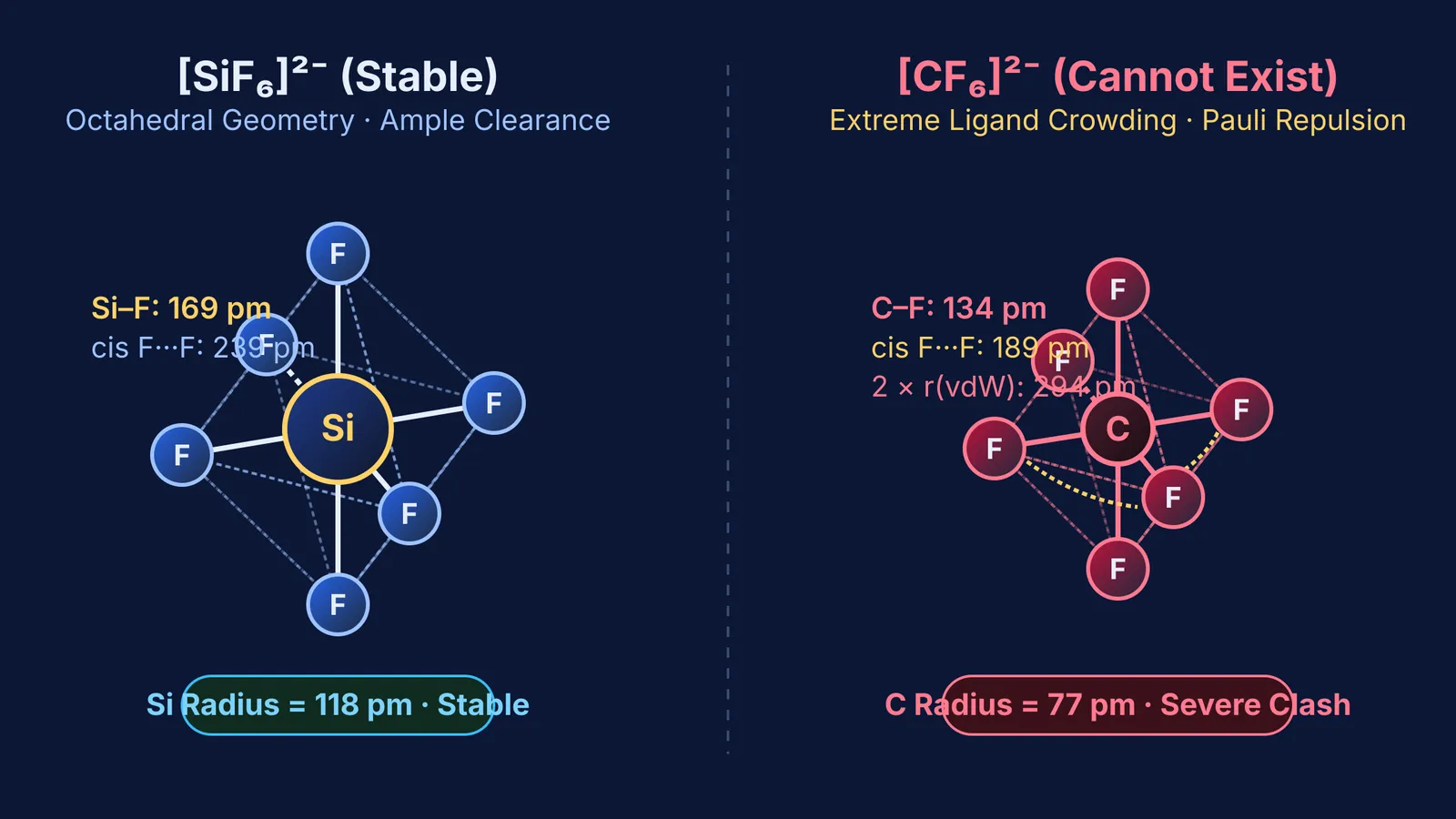
Because carbon is so compact, six surrounding fluorine atoms experience severe crowding. In carbon tetrafluoride (CF4), the standard C-F bond length is 133 pm. In an octahedral geometry, adjacent cis-ligands sit at √2 times the bond length. Placing six fluorines around carbon at 134 pm forces adjacent fluorine atoms just 189 pm apart.
According to A. Bondi's structural compilation in The Journal of Physical Chemistry, fluorine's van der Waals radius is 147 pm. Two non-bonded fluorine atoms require a separation of 294 pm (2 × 147 pm) to avoid intense repulsion. Forcing them to 189 pm causes over 100 pm of steric overlap, triggering intense Pauli repulsion between their electron clouds.
In [SiF6]²⁻, silicon's 118 pm radius allows an experimental Si-F bond length of 169 pm. The adjacent non-bonded F···F distance expands to √2 × 169 pm ≈ 239 pm, providing sufficient clearance for stable bonding.
Why does [SiCl6]²⁻ also fail to form despite vacant d-orbitals?
To confirm that steric crowding is a decisive physical barrier, chemists look at another classic question in the NCERT Class 11 Chemistry curriculum: why does [SiF6]²⁻ exist, while [SiCl6]²⁻ does not?
Silicon has vacant 3d orbitals, yet [SiCl6]²⁻ fails to form under standard conditions. The reason is chlorine's size. According to Dalton Transactions, chlorine's covalent radius is 102 pm, compared to 57 pm for fluorine. Furthermore, the ionic radius of chloride (181 pm) far exceeds that of fluoride (133 pm).
Packing six bulky chloride ions around a single silicon atom generates severe steric clash, making [SiCl6]²⁻ unstable. This demonstrates that vacant orbitals are necessary but not sufficient; the central atom must also provide spatial clearance. This balance governs structural trends from interhalogen geometries to the inert pair effect across p-block groups.
Forcing carbon into hexacoordination requires extraordinary molecular cages. In the Journal of the American Chemical Society, Torahiko Yamaguchi and co-workers isolated a hexacoordinate carbon compound using a rigid anthracene scaffold that physically held four chelating oxygen atoms in place.
How do you solve coordination and covalency questions in exams?
In competitive exams like JEE Main and NEET-UG, questions about [SiF6]²⁻ versus [CF6]²⁻ test whether you understand both electronic configurations and steric effects. As outlined in the NCERT Class 11 Chemistry syllabus, use this 3-step decision checklist:
Check the principal quantum number (n): Second-period elements (n = 2) have no d-orbitals and obey a strict maximum covalency of 4. Third-period elements (n = 3) can expand their octet.
Check ligand radius: Small ligands like F⁻ fit into expanded coordination shells, whereas bulky ligands like Cl⁻ produce severe steric crowding.
Separate coordination number from covalency: Coordination number counts bound ligands (6 in [SiF6]²⁻), while covalency measures shared electron pairs contributed by the central atom.
When practicing problems, the Fermi Problem Library provides worked problems with a step-by-step solver that explains the reasoning rather than printing an answer.


