

On this page
This set follows our first Oscillations and Waves JEE Main practice set and covers what set 1 skipped: periodic functions, phase, kinetic energy over time, springs in series, a vertical spring, a pendulum bob's top speed and friction during SHM. Six are MCQs and two are numerical (Q5, Q8), each with its most tempting trap.
What does this set cover from the JEE Main syllabus?
Unit 10 of NTA's Syllabus for JEE (Main) - 2027, linked from the JEE Main website, lists for oscillations: time period, frequency, displacement as a function of time, periodic functions, SHM and its equation, phase, spring oscillations with restoring force and force constant, kinetic and potential energy in SHM, and the simple pendulum. The matching NCERT text, Reprint 2026-27, is Chapter 13, Oscillations. Every question stays inside that list.
How should you use this set?
Cover the answers; allow two minutes per question, three for Q7 and Q8.
Draw the x-t curve for any question about time or direction.
Read every trap.
New to the chapter? Start with our guide on how to prepare Oscillations for JEE Main.
Easy: periodic functions, energy and springs
Q1 (easy). The position of a particle is x = 6 sin(πt) + 8 cos(πt), with x in cm and t in s. What are its amplitude and period?
(A) 14 cm, 2 s (B) 10 cm, 2 s (C) 10 cm, 1 s (D) 14 cm, 1 s
Answer: (B). A sin ωt + B cos ωt is one SHM of the same ω with amplitude √(A² + B²) (NCERT Eq. 13.3c). Here √(36 + 64) = 10 cm, and ω = π rad/s gives T = 2π/ω = 2 s.
Trap: (A) adds 6 and 8.
Q2 (easy). A block on a horizontal spring oscillates with a period of 0.80 s. How often does its kinetic energy repeat its value?
(A) 0.80 s (B) 1.60 s (C) 0.40 s (D) 0.20 s
Answer: (C). KE = ½mω²A² cos²ωt = ¼mω²A²(1 + cos 2ωt). It varies at 2ω, so its period is T/2 = 0.40 s.
Trap: (A) assumes energy repeats with the motion. KE peaks twice per cycle.
Q3 (easy). Springs of force constant 400 N/m and 1200 N/m are joined end to end. A block on a smooth floor oscillates on the combination with amplitude 4.0 cm. What is the largest elastic potential energy stored in the 400 N/m spring?
(A) 0.06 J (B) 0.12 J (C) 0.18 J (D) 0.32 J
Answer: (C). In series, 1/k = 1/400 + 1/1200, so k = 300 N/m. At an extreme both springs carry the same force, kA = 300 × 0.040 = 12 N. The 400 N/m spring stores F²/2k₁ = 144/800 = 0.18 J (the stiffer one stores 0.06 J).
Trap: (D) puts the whole 4.0 cm stretch in the 400 N/m spring. In series the softer spring takes 3.0 cm and the stiffer one 1.0 cm.
Medium: phase, a pendulum and a hanging spring
Q4 (medium). A particle moves as x = 5 sin(10πt + π/3), with x in cm and t in s. What is its speed at t = 0?
(A) 157 cm/s (B) 136 cm/s (C) 78.5 cm/s (D) 0
Answer: (C). v = dx/dt = 50π cos(10πt + π/3). At t = 0, v = 50π × 0.5 = 25π = 78.5 cm/s.
Trap: (B) uses sin(π/3) instead of cos(π/3).
Q5 (medium, numerical). A simple pendulum 1.6 m long swings with an angular amplitude of 0.10 rad. Take g = 10 m/s². Find the bob's maximum speed in cm/s.
Answer: 40. For small swings the bob moves in SHM along its arc with amplitude Lθ₀ = 0.16 m and ω = √(g/L) = 2.5 rad/s. So v_max = Lθ₀ω = 0.16 × 2.5 = 0.40 m/s = 40 cm/s.
Trap: θ₀ω = 0.25 is the bob's largest angular speed in rad/s, not its speed. Multiply by L.
Q6 (medium). A block hung from a light spring stretches it by 2.5 cm at rest. It is pulled down a further 1.0 cm and released. Take g = 9.8 m/s². What is its frequency?
(A) 4.98 Hz (B) 19.8 Hz (C) 2.66 Hz (D) 3.15 Hz
Answer: (D). At equilibrium kx₀ = mg, so k/m = g/x₀ = 9.8/0.025 = 392 s⁻². ω = 19.8 rad/s and f = ω/2π = 3.15 Hz.
Trap: (A) puts the 1.0 cm pull in place of the 2.5 cm static extension. (B) is ω, not f.
Hard: starting phase and friction in SHM
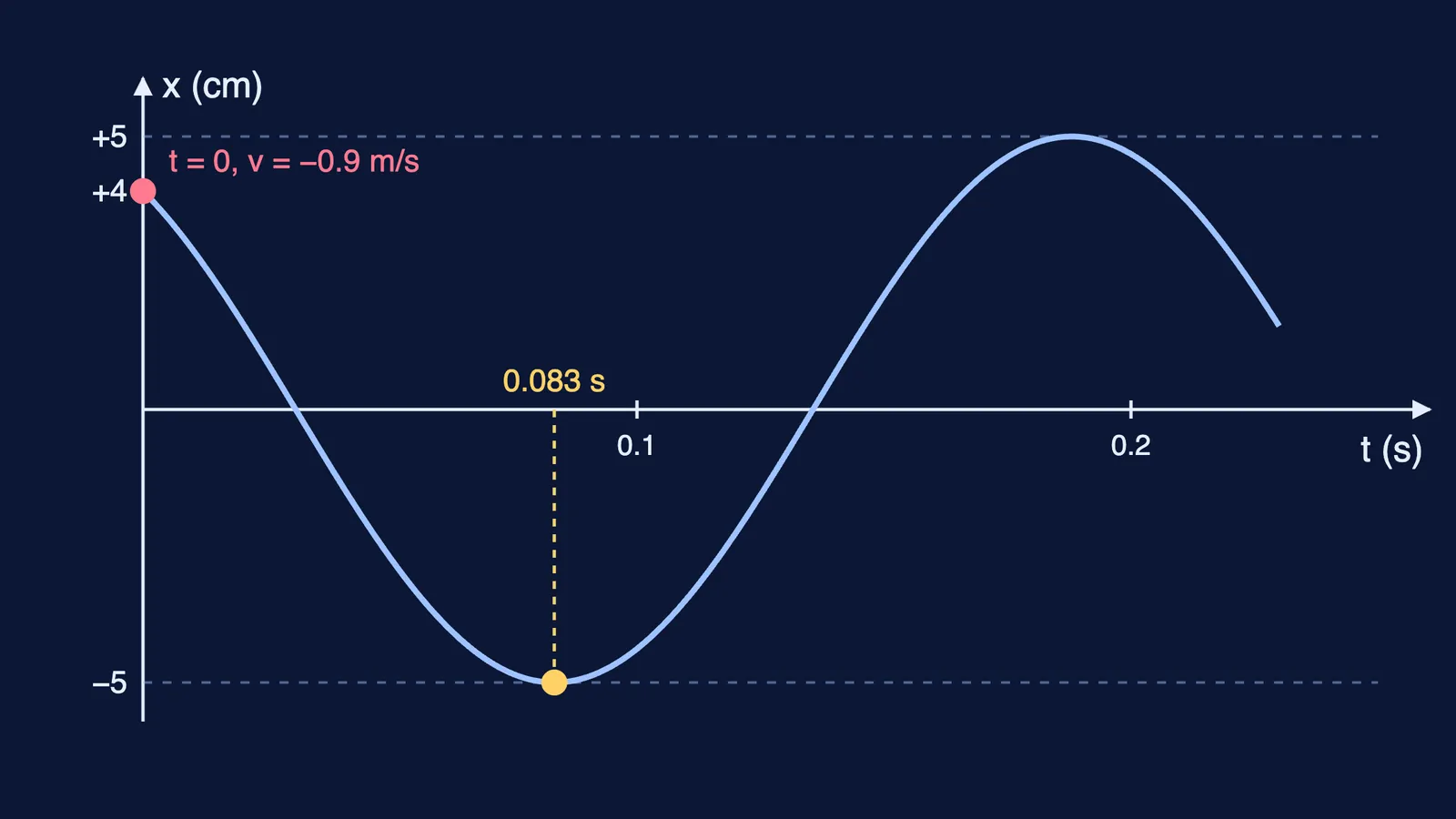
Q7 (hard). A 0.20 kg block on a smooth floor oscillates on a spring of force constant 180 N/m. At t = 0 it is 4.0 cm right of the mean position, moving left at 0.90 m/s. When does it first come to rest?
(A) 0.021 s (B) 0.052 s (C) 0.083 s (D) 0.105 s
Answer: (C). ω = √(180/0.20) = 30 rad/s. A = √(4.0² + (90/30)²) = 5.0 cm. Write x = 5 cos(30t + φ) with cos φ = 0.8, so φ = 0.644 rad; moving towards the mean means it next stops at x = −5 cm, when 30t + φ = π. So t = (π − 0.644)/30 = 0.083 s.
Trap: (A) is 0.644/30, the time it would take to reach +5 cm if it were moving away from the mean.
Q8 (hard, numerical). A 3.0 kg block on a smooth floor is attached to a horizontal spring of force constant 200 N/m. A 1.0 kg block rests on it, with static friction coefficient 0.25 between the blocks. Take g = 10 m/s². Find the largest amplitude, in cm, for which the top block does not slip.
Answer: 5. Both blocks move together with ω² = k/(M + m) = 50 s⁻². The top block's largest acceleration, ω²A, must come from friction, at most μg = 2.5 m/s². So A = 2.5/50 = 0.05 m = 5 cm.
Trap: using only the lower block's 3.0 kg gives ω² = 66.7 s⁻² and 3.75 cm.
What should you do after this set?
Tag each miss: formula slip, sign error or wrong setup. Our list of common SHM mistakes in JEE and NEET groups the usual ones. If a trap caught you, the Fermi Problem Library has worked problems with a step-by-step solver that explains the reasoning rather than printing an answer.


