On this page
This chapter feels obvious, which is the trap: an almost-right option slips through. The NCERT Class 12 Biology chapter, Organisms and Populations (Reprint 2026-27) falls under Ecology and Environment (Unit 10) in the NMC NEET (UG) 2026 syllabus. Below are eight beliefs many students hold here, each with the NCERT section that corrects it, an original check and a habit. For the whole unit, start with our guide to ecology questions for NEET.
Does an individual or a population evolve?
"A single plant or animal evolves new traits to cope with a changed environment."
Why it sticks: everyday speech says an animal "adapted", so the single organism gets the credit.
What NCERT says (11.1.1, and the chapter summary): the individual is indeed the one that has to cope when its surroundings change, but traits are evolved by natural selection acting on the population, not on one organism.
Check: a long drought hits a grassland. Which copes with the dry season, and which can come to carry drought-tolerant traits: one grass plant, or the grass population?
Habit: write "copes" next to individual and "evolves" next to population.
Which numbers go into the growth equation?
"Any animal that moves into the habitat counts as immigration."
Why it sticks: "immigration" sounds like arrivals of any kind.
What NCERT says (11.1.2): immigration counts only individuals of the same species that come in from elsewhere during the period; emigration likewise counts members of the population that leave.
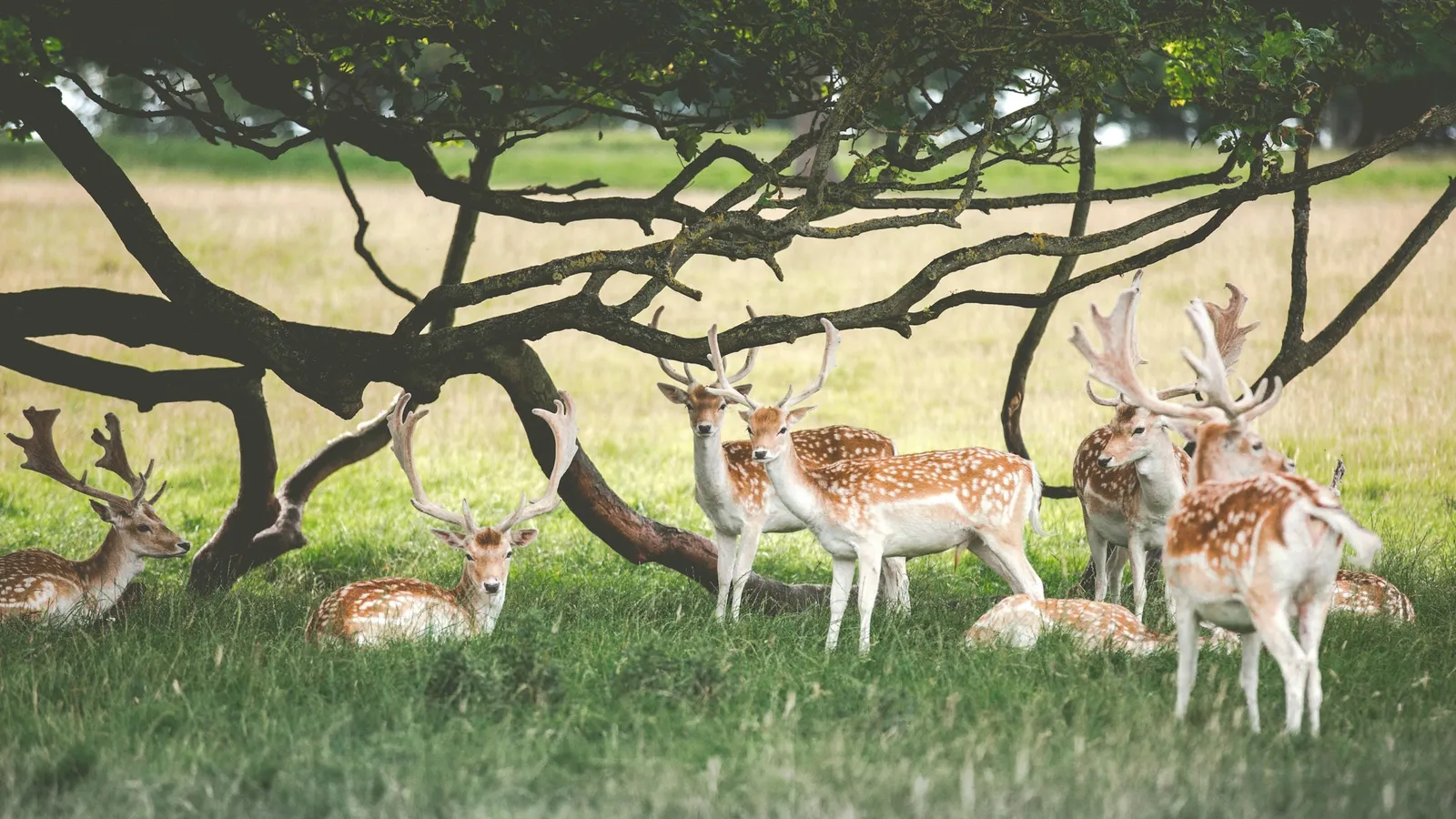
Check: a sanctuary holds 120 spotted deer. In a year, 15 fawns are born, 5 deer die, 10 deer walk in from a nearby forest and 6 leopards move in. Using Nt+1 = Nt + [(B + I) - (D + E)], the deer count is 140, not 146.
Habit: before adding I or E, ask "same species?"
"Birth rate is births divided by the population at the end."
Why it sticks: the final count is the newest number on the page.
What NCERT says (11.1.1): birth and death rates are per capita, worked out against the members already present. NCERT's lotus example divides the new plants by last year's count, not this year's.
Check: a patch of 150 neem saplings gains 30 new ones and ends at 180. The birth rate is 30/150 = 0.2 per sapling per year; 30/180, about 0.17, is the slip.
Habit: circle the starting number before you divide.
"A high birth rate means a fast-growing population."
Why it sticks: births are the most visible part of growth.
What NCERT says (11.1.2): the intrinsic rate of natural increase is r = b - d, per capita births minus per capita deaths, so growth depends on the gap, not on b alone.
Check: Town P has b = 0.03 and d = 0.01; Town Q has b = 0.05 and d = 0.045. Town P has r = 0.02 and Town Q only 0.005, so the town with the lower birth rate is growing faster.
Habit: never judge growth until you have subtracted d.
What do the growth curves really say?
"Exponential growth adds the same number every year."
Why it sticks: steady growth is pictured as a straight line.
What NCERT says (11.1.2): in dN/dt = rN, the increase each moment is proportional to N, so a bigger population adds more; plotted against time, N gives a J-shaped curve.
Check: with r = 0.1 per year and N = 500, dN/dt is 50 a year at that moment. At N = 5,000 it is 500 a year. After 10 years Nt = 500 × e^(0.1 × 10), about 1,359, while adding 50 a year gives only 1,000.
Habit: if N is on the right-hand side, the step size changes.
"A population in nature on a J-curve can keep rising without limit."
Why it sticks: dN/dt = rN contains no K, so nothing in the equation seems to stop it.
What NCERT says (11.1.2 and the chapter summary): the exponential model assumes unlimited resources, and natural populations never have those. The J-curve lasts only while resources are not limiting; in either pattern, carrying capacity sets the final limit.
Check: a bacterial culture doubles steadily for its first few hours. Can the same dish keep that J-curve going indefinitely?
Habit: read "exponential" as "while resources last".
Which interactions and strategies get misjudged?
"A parasite has to feed on the host's body, so a bird that lays eggs in another's nest is not one."
Why it sticks: lice, ticks and liver flukes all take food straight from the host.
What NCERT says (11.1.4 iii): brood parasitism in birds is presented as a case of parasitism; the parasitic bird leaves its eggs in the host's nest for the host to incubate, and those eggs have evolved to look like the host's own.
Check: a bird never touches the host's body but has its eggs hatched by another species. Which interaction does NCERT file it under, and which species carries the minus sign?
Habit: classify by who gains and who pays, not by whether blood or tissue is taken.
"Breeding many times in a lifetime always means higher fitness than breeding once."
Why it sticks: more breeding seasons sound like more offspring.
What NCERT says (11.1.3): populations evolve the reproductive strategy that works best under their own selection pressures, and life history traits reflect the limits set by their habitat. NCERT lists organisms that breed only once beside those that breed many times, without ranking them.
Check: a plant flowers once after many years, sets a huge seed crop and dies. Is that a sign of low Darwinian fitness?
Habit: judge fitness by reproductive success in that habitat, not by the number of breeding events.
A 60-second self-check before you mark
Is the trait being evolved by a population, not one organism?
Did I add only same-species arrivals as immigration?
Did I divide by the starting count?
Did I subtract d before judging growth?
Does my growth step scale with N?
Have I treated the J-curve as lasting only while resources last?
Did I classify the interaction by its signs?
Did I judge fitness by success in that habitat?
Test these habits on our statement and match-the-list questions for this chapter.
Which slip is yours? Fermi's AI tutor works out what you already know and builds a plan for the session.