On this page
Operations with Integers is Chapter 2 of Ganita Prakash, Part II, NCERT's Class 7 mathematics book (code gegp2, First Edition October 2025). It teaches you to multiply and divide positive and negative numbers.
What does Operations with Integers cover in Class 7?
The chapter PDF runs from page 24 to page 46. The foreword calls it "Integers — Multiplication and Division"; the contents page uses "Operations with Integers".
CBSE publishes no separate 2026-27 curriculum for Classes 6 to 8 (its 2026-27 curriculum page starts at Class IX); these classes follow the NCERT book, and the chapter is assessed by the school.
The chapter's order:
A recap: a number puzzle, a carrom coin on a number line, and the Class 6 green and red tokens (one of each makes a zero pair).
Multiplication with tokens, patterns that give the sign rules, then 1 × a = a, −1 × a = −a and the commutative property.
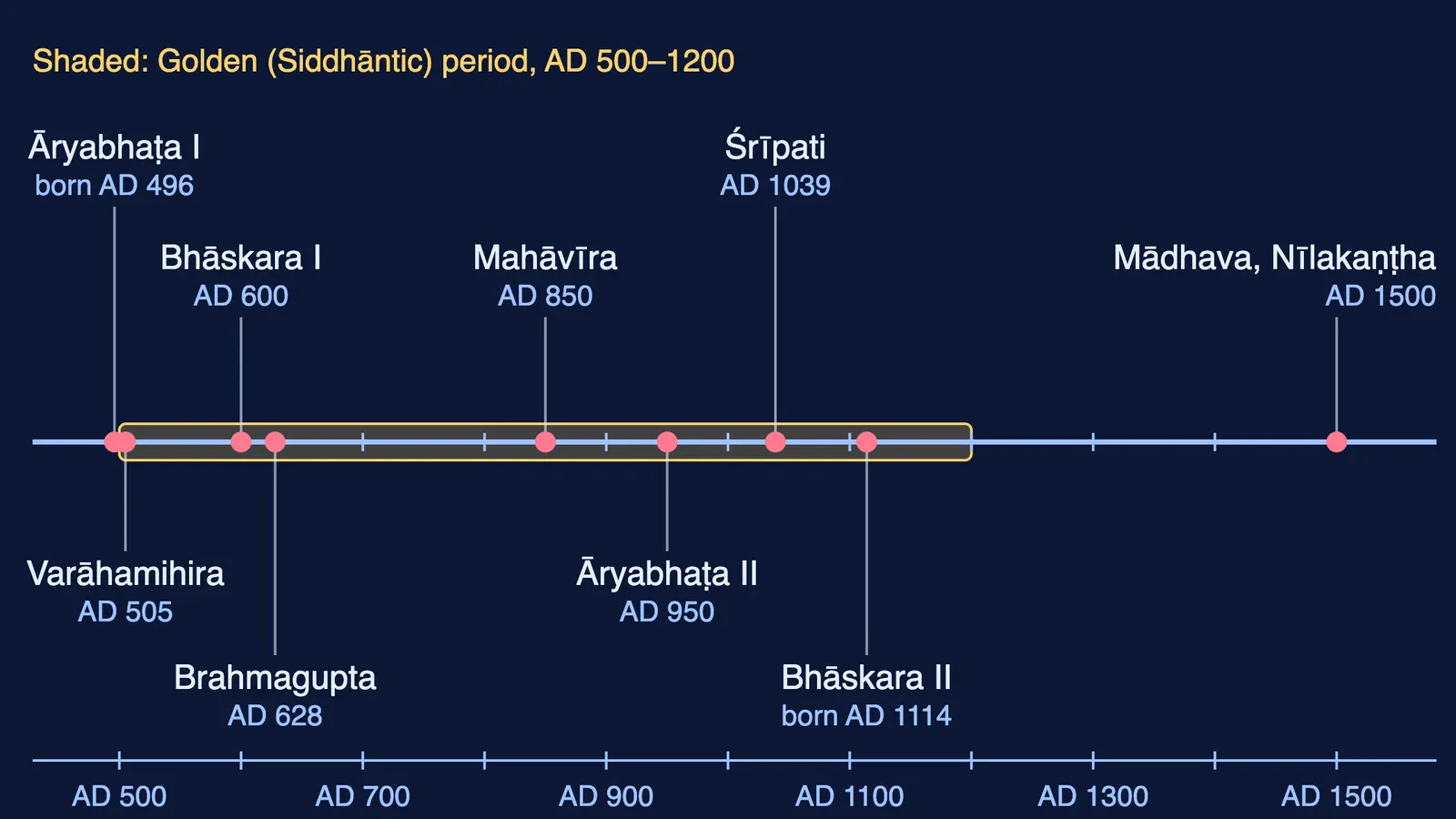
Brahmagupta's rules from his Brāhmasphuṭasiddhānta (628 CE), in terms of fortunes (dhana) and debts (ṛṇa).
Division, read as multiplication in reverse.
The associative property, the sign of a long product, then the distributive property.
A summary, then Terhüchü, a board game from Assam and Nagaland.
Shaky on Class 6? Start with our guide to integers in Class 6 and the token model.
How does the token model explain multiplying negative integers?
Every multiplication starts with an empty bag. A positive multiplier means put tokens in that many times; a negative one means take tokens out. The multiplicand says which tokens and how many.
With our own numbers, 2 and 6:
2 × (−6): put 6 reds in, twice: −12.
(−2) × 6: take 6 greens out, twice. The bag is empty, so add 6 zero pairs first each time. 12 reds remain: −12.
(−2) × (−6): add zero pairs again, but remove 6 reds each time. 12 greens remain: +12.
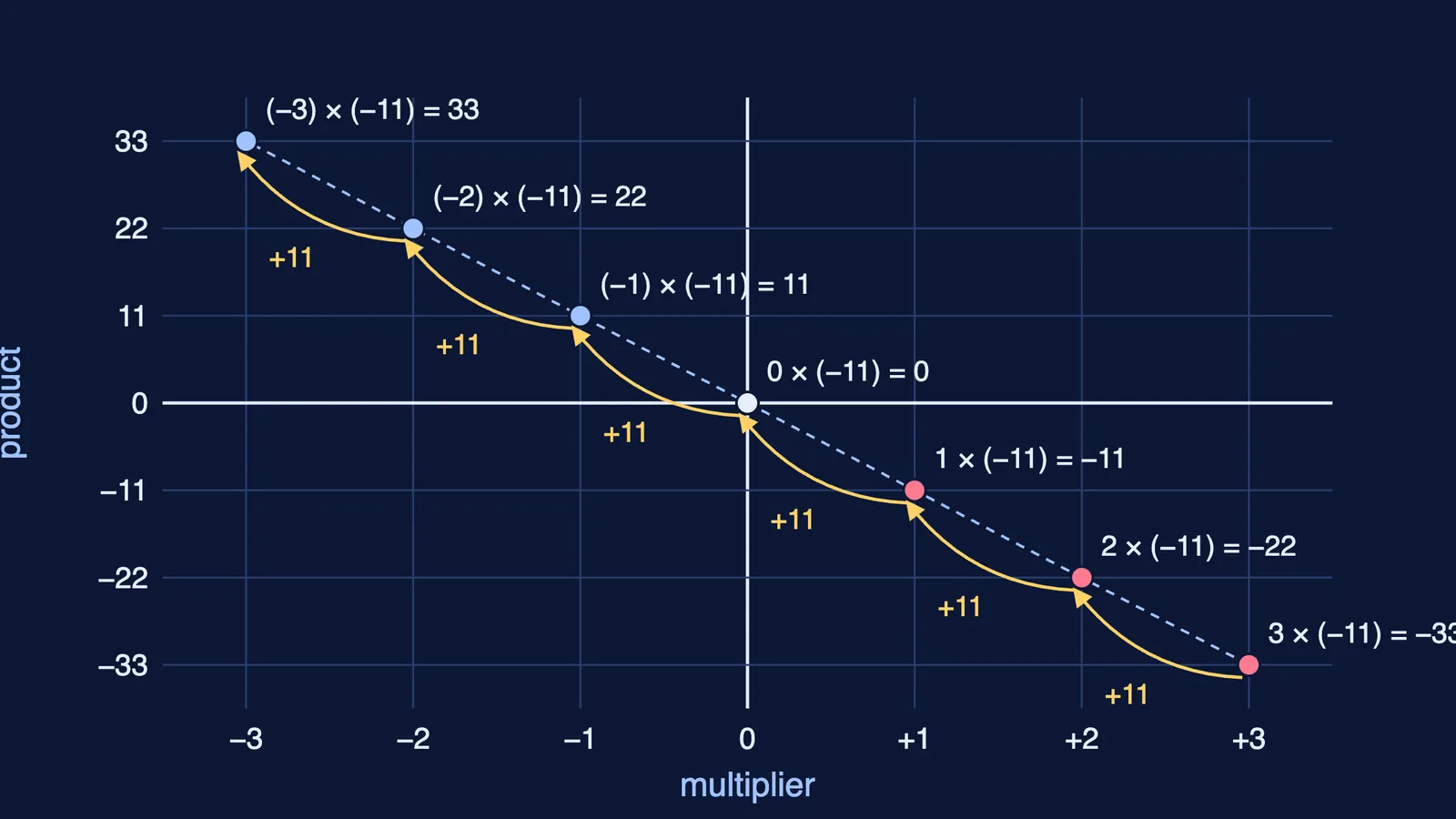
Patterns confirm it. In our diagram the multiplicand is −11: each time the multiplier drops by 1, the product rises by 11, even past zero: 1 × (−11) = −11, 0 × (−11) = 0, (−1) × (−11) = 11.
What are the sign rules for multiplying and dividing integers?
Same signs give a positive product; different signs a negative one. Signs never change the size of the answer.
Division follows the same rule, read as a missing-number multiplication. (−91) ÷ 7 asks "7 times what is −91?" Since 7 × (−13) = −91, the answer is −13.
Integer multiplication is commutative, a × b = b × a; associative, a × (b × c) = (a × b) × c; and distributive over addition, a × (b + c) = (a × b) + (a × c).
In a long product, count the negative factors: an even count gives a positive product, an odd count a negative one.
Worked example: a cold-storage room
A cold-storage room is at 13 °C. Its cooling unit lowers the temperature by 4 °C every hour.
(a) What is the temperature after 7 hours? With −4 per hour: 13 + 7 × (−4) = 13 + (−28) = −15 °C.
(b) After how many hours does it reach −23 °C? The change needed is −23 − 13 = −36, and (−36) ÷ (−4) = 9. Check: 13 + 9 × (−4) = −23. It takes 9 hours.
Practice questions on operations with integers
Mark values are our suggestion.
(1 mark) Without multiplying, give the sign of (−4) × (−1) × (−11) × (−1) × (−2). Then find its value.
(2 marks) Find (−144) ÷ (−16) and 95 ÷ (−19), with a multiplication check for each.
(2 marks) Use tokens to explain why (−2) × 8 = −16.
(2 marks) Find (−8) × (15 + (−6)) in two ways.
(3 marks) A quiz gives +6 for a correct answer and −3 for a wrong one. (a) Riya gets 18 right and 7 wrong. What is her score? (b) Arjun gets 14 right, skips none and scores 54. How many did he get wrong?
Answers: 1. Five negatives, so negative; −88. 2. 9, since (−16) × 9 = −144; −5, since (−19) × (−5) = 95. 3. Add 8 zero pairs and remove 8 greens, twice; 16 reds remain. 4. (−8) × 9 = −72, and (−120) + 48 = −72. 5. (a) 108 − 21 = 87. (b) 84 − 54 = 30, and 30 ÷ 3 = 10 wrong.
How does this chapter connect to the rest of the book?
Part I's chapter on arithmetic expressions in Class 7 built expressions from terms; now terms can be negative products. In Part II, Chapter 4, Another Peek Beyond the Point, applies multiplication and division to decimals, and Chapter 7, Finding the Unknown, moves on to algebra and solving simple equations.
Not sure which rule trips you up? Fermi's AI tutor works out what you already know and builds a plan for the session.