

On this page
Heat a nitrile, R–C≡N, with water and an acid or a base, and it turns first into an amide and then into a carboxylic acid with the same number of carbons. Because the nitrile carbon usually comes from cyanide, this is one of the standard ways to add one carbon to a chain in JEE and NEET conversion questions. This post covers the overall equations in acid and in base, the mechanism at JEE level, how to stop at the amide, and two worked conversions.
What does nitrile hydrolysis give in acid and in base?
Hydrolysis happens in two stages: nitrile to amide, then amide to acid. The nitrogen ends up as ammonia or the ammonium ion.
In acid (dilute HCl or H₂SO₄, heat): R–C≡N + 2H₂O + H⁺ → RCOOH + NH₄⁺
In base (aqueous NaOH, heat): R–C≡N + H₂O + OH⁻ → RCOO⁻ + NH₃
In base you get the carboxylate salt, and ammonia gas is given off. To get the free acid, acidify afterwards: RCOO⁻ + H⁺ → RCOOH.
The two stages, written separately for the acid route:
R–C≡N + H₂O → R–CONH₂ (amide)
R–CONH₂ + H₂O + H⁺ → RCOOH + NH₄⁺
Add them and you get the overall equation above. Both routes end in a step that cannot easily reverse. In acid, the NH₃ released is trapped as NH₄⁺, which is not a nucleophile. In base, the acid is trapped as RCOO⁻, which water and OH⁻ do not attack.
What is the mechanism of acid hydrolysis of a nitrile?
The C≡N carbon is electrophilic because nitrogen pulls electron density towards itself, but neutral water is a weak nucleophile. Acid makes the carbon much more electrophilic.
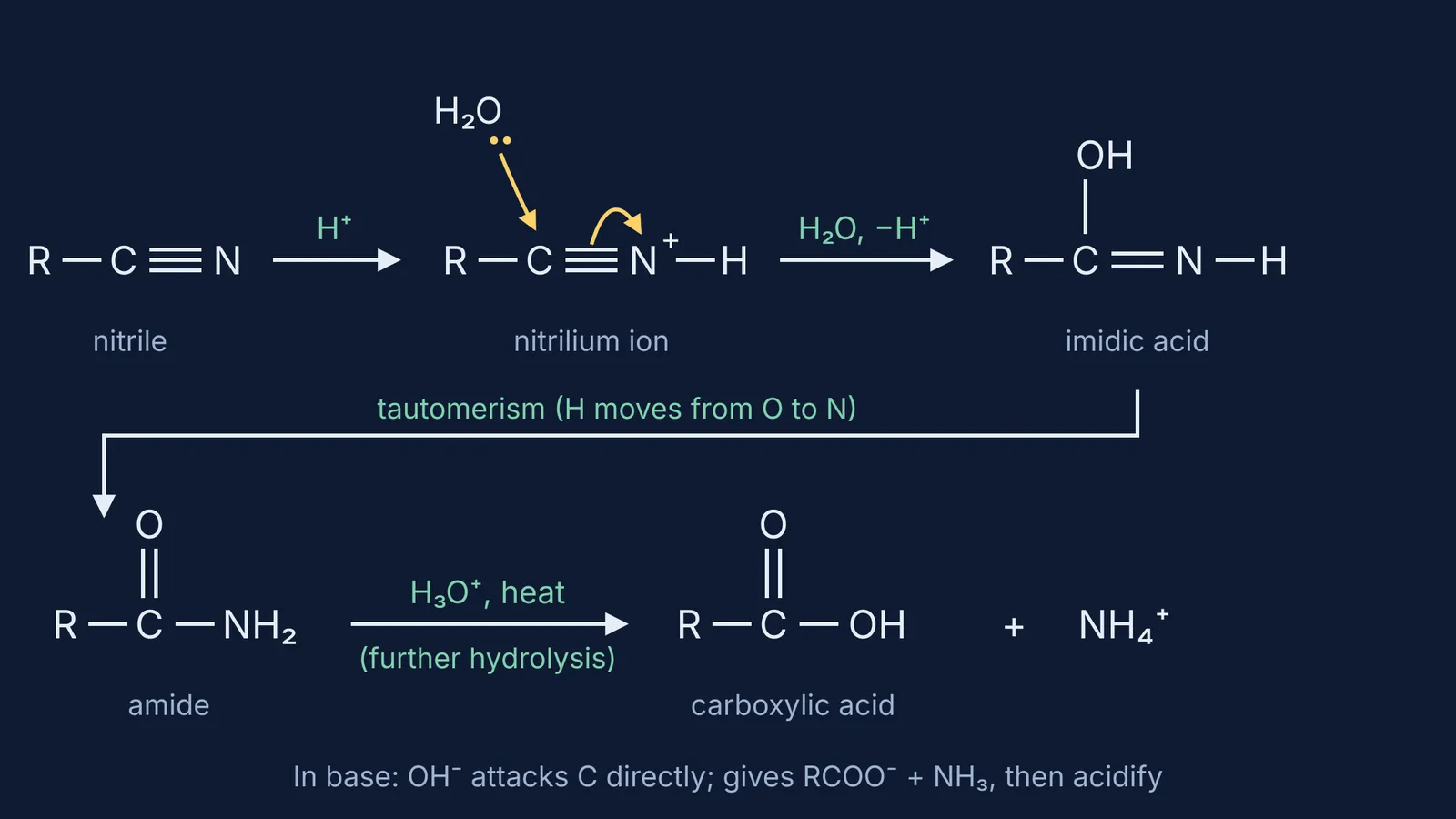
Protonation of nitrogen. H⁺ adds to the lone pair on N, giving the nitrilium ion R–C≡N⁺–H. The positive charge makes the carbon strongly electrophilic.
Water attacks the nitrile carbon. A lone pair on the O of H₂O forms a bond to C, and one π bond of C≡N moves onto N. This gives R–C(=NH)–OH₂⁺.
Loss of a proton. The OH₂⁺ group loses H⁺, giving the imidic acid R–C(OH)=NH.
Tautomerism. The imidic acid is the less stable tautomer. A proton moves from O to N and the C=N double bond becomes C=O, giving the amide R–CO–NH₂. This works like keto-enol tautomerism, with C=O favoured over C=N.
The amide then hydrolyses under the same conditions: the carbonyl O is protonated, water attacks the carbonyl carbon, a tetrahedral intermediate forms, the nitrogen is protonated, and NH₃ leaves (and is immediately protonated to NH₄⁺), giving RCOOH.
How does nitrile hydrolysis work in basic conditions?
OH⁻ is a strong nucleophile, so the nitrile needs no activation.
OH⁻ attacks the nitrile carbon, and a π bond moves onto N, giving the anion R–C(OH)=N⁻.
Water protonates the nitrogen, giving the imidic acid R–C(OH)=NH.
Tautomerism gives the amide R–CO–NH₂, exactly as in acid.
OH⁻ attacks the amide carbonyl carbon, NH₂ is expelled (picking up a proton to leave as NH₃), and the acid formed is deprotonated by base to RCOO⁻.
How do you stop the hydrolysis at the amide?
NCERT notes that nitriles are hydrolysed to amides and then to acids with H⁺ or OH⁻ as catalyst, and that mild conditions stop the reaction at the amide. In practice this means lower temperature, shorter reaction time or controlled amounts of reagent, so that the second stage does not go to completion.
A standard reagent for this is alkaline hydrogen peroxide (H₂O₂ with NaOH). The hydroperoxide ion attacks the nitrile carbon and the reaction gives the primary amide:
R–C≡N + 2H₂O₂ → R–CONH₂ + O₂ + H₂O (in the presence of OH⁻)
Stopping at the amide is useful because amides lead on to other reactions, such as Hofmann bromamide degradation to an amine with one carbon fewer.
How does nitrile hydrolysis add one carbon to a chain?
For a wider map of where nitriles lead, including amines and ketones, see reactions of nitriles: making acids, amines and ketones. Here the focus stays on the hydrolysis step.
The nitrile carbon is a new carbon brought in by cyanide. So the sequence
R–X → R–CN → R–COOH
turns an alkyl halide into an acid with one more carbon. The first step uses ethanolic KCN or NaCN, an SN2 substitution. That brings two limits:
Primary halides work well, secondary less well. With a tertiary halide, SN2 is blocked by crowding and CN⁻ acts as a base, so elimination wins: (CH₃)₃C–Br with KCN gives mainly the alkene (CH₃)₂C=CH₂.
Aryl halides such as chlorobenzene do not undergo SN2 with KCN. Benzonitrile is made from a diazonium salt with CuCN instead.
The same idea works with carbonyl compounds. HCN adds to an aldehyde or ketone to give a cyanohydrin, and hydrolysis turns the CN into COOH, giving an α-hydroxy acid. For example:
CH₃CHO + HCN → CH₃CH(OH)CN → (H₃O⁺, heat) → CH₃CH(OH)COOH (lactic acid)
For the aromatic version with full exam working, see benzaldehyde to mandelic acid by the cyanohydrin route.
Worked example: two one-carbon conversions
(a) Convert bromoethane to propanoic acid. Bromoethane has 2 carbons, propanoic acid has 3, so you need to add one carbon.
CH₃CH₂Br + KCN (ethanolic) → CH₃CH₂CN + KBr. Product: propanenitrile, by SN2.
CH₃CH₂CN + 2H₂O + H⁺ (dilute H₂SO₄, heat) → CH₃CH₂COOH + NH₄⁺. Product: propanoic acid.
If you start with 5.45 g of bromoethane (M = 108.97 g mol⁻¹), that is 0.0500 mol, so the theoretical yield of propanoic acid (M = 74.08 g mol⁻¹) is 0.0500 × 74.08 = 3.70 g.
(b) Convert benzyl chloride to phenylacetic acid. C₆H₅CH₂Cl is a primary, benzylic halide, so SN2 with cyanide works well.
C₆H₅CH₂Cl + KCN → C₆H₅CH₂CN + KCl. Product: phenylacetonitrile (benzyl cyanide).
C₆H₅CH₂CN + H₂O + OH⁻ (aqueous NaOH, heat) → C₆H₅CH₂COO⁻ + NH₃.
Acidify: C₆H₅CH₂COO⁻ + H⁺ → C₆H₅CH₂COOH. Product: phenylacetic acid.
From 6.33 g of benzyl chloride (0.0500 mol), the theoretical yield is 0.0500 × 136.15 = 6.81 g of phenylacetic acid.
If you get stuck choosing the order of steps in multi-step conversions like these, the Fermi Problem Library has a step-by-step solver that explains the reasoning behind each reagent.
How is nitrile hydrolysis different from Stephen reduction and DIBAL-H?
All three start from R–C≡N, but they do different jobs:
Hydrolysis (H₃O⁺ or OH⁻, heat) adds water and gives the amide, then the carboxylic acid. No reducing agent is involved.
Stephen reduction (SnCl₂ and HCl, then hydrolysis of the imine) gives an aldehyde, RCHO. Read the Stephen reaction and how it was found.
DIBAL-H at low temperature, followed by water, also gives an aldehyde.
LiAlH₄ reduces the nitrile all the way to a primary amine, RCH₂NH₂.
If the question gives water and acid or base with heat, the answer is an acid (or amide). If it gives a reducing agent, think aldehyde or amine.
Quick checklist before the exam
Acid: R–CN + 2H₂O + H⁺ → RCOOH + NH₄⁺.
Base: R–CN + H₂O + OH⁻ → RCOO⁻ + NH₃, then acidify.
Acid mechanism: protonate N, water attacks C, lose H⁺, imidic acid tautomerises to amide, amide hydrolyses.
Mild conditions or alkaline H₂O₂ stop at the amide.
R–X → R–CN → RCOOH adds one carbon; works for primary halides, fails for tertiary (elimination) and aryl halides.
Cyanohydrin hydrolysis gives an α-hydroxy acid.
Hydrolysis gives acids; Stephen and DIBAL-H give aldehydes; LiAlH₄ gives amines.


