

On this page
You have probably met a question like "convert ethyl bromide into propanoic acid" and wondered where the extra carbon comes from. Very often the answer is a nitrile. Turn the halide into a nitrile first, and from there three reagents take you to three different products: a carboxylic acid, a primary amine or a ketone.
What is a nitrile and how do you make one from a halide?
A nitrile is an organic compound with a carbon–nitrogen triple bond, written R–C≡N. The simplest way to make one is an SN2 reaction of cyanide ion with a primary or secondary alkyl halide, according to OpenStax Organic Chemistry. Tertiary and aryl halides cannot be used for this reaction, as the LibreTexts chapter on the chemistry of nitriles notes.
The cyanide carbon joins the chain, and that is the whole trick. Whatever you make from the nitrile carries at least one more carbon than the halide you started with. If you mix up which cyanide salt gives a nitrile and which gives an isocyanide, read our explainer on KCN vs AgCN as ambident nucleophiles.
What do nitriles turn into: acids, amines or ketones?
Three reactions cover most textbook conversion questions.
Hydrolysis gives a carboxylic acid. Heating with aqueous acid or base first gives an amide, which goes on to the carboxylic acid. OpenStax calls cyanide displacement followed by hydrolysis a good way to make a carboxylic acid from an alkyl halide, and notes that the product acid has one more carbon than the starting alkyl halide.
Reduction gives a primary amine. Lithium aluminium hydride (LiAlH4) adds two hydrides to the nitrile carbon, and water then gives RCH2NH2. OpenStax says this two-step route converts an alkyl halide into a primary alkylamine having an additional carbon atom. It is the mirror image of Hofmann bromamide degradation, which loses one carbon.
A Grignard reagent gives a ketone. The Grignard adds to the nitrile carbon to form an imine anion, and water at workup hydrolyses it to a ketone. The OpenStax nitrile chapter uses benzonitrile with ethylmagnesium bromide, which gives propiophenone.
Why does the Grignard not add a second time? The LibreTexts chapter explains that the negative charge on the imine anion prevents any further nucleophilic addition.
For everything else Grignard reagents make, see Grignard reagents: what they make and the common exam traps.
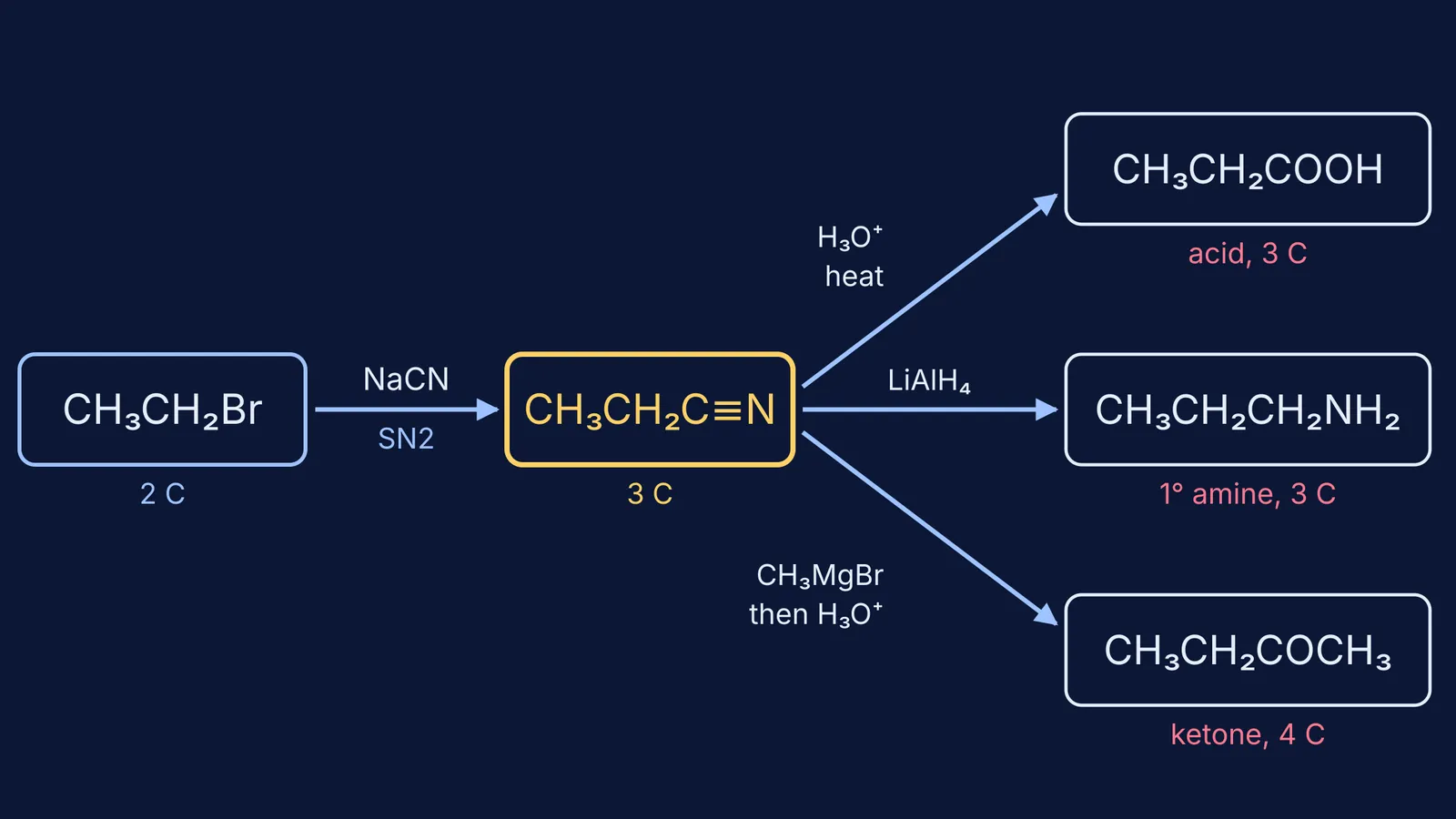
Worked example: one halide, three products
Start with bromoethane, CH3CH2Br, which has two carbons.
Step 1: NaCN by SN2 gives propanenitrile, CH3CH2C≡N, with three carbons.
Route A: H3O+ and heat give propanoic acid, CH3CH2COOH.
Route B: LiAlH4, then water, gives propan-1-amine, CH3CH2CH2NH2.
Route C: CH3MgBr, then H3O+, gives butan-2-one, CH3CH2COCH3, with four carbons.
Look at route C closely. The ketone's two groups come from two places: the ethyl group from the nitrile and the methyl group from the Grignard. So butan-2-one could equally come from acetonitrile (CH3CN) and ethylmagnesium bromide. When a question asks for a ketone, split it at the C=O and ask which half could be a nitrile and which a Grignard.
In your answer, write each arrow with its reagent above and the intermediate named below: "amide" on the hydrolysis route, "imine anion" on the Grignard route. Whoever marks it can then follow your reasoning, even if one step goes wrong.
How do you spot a nitrile step in a conversion question?
Run this check before you write anything:
Count the carbons in the starting compound and the target. One extra carbon, with a halide at the start, usually points to cyanide.
Read the target's functional group. COOH means hydrolyse, CH2NH2 means reduce, a ketone means add a Grignard.
Check the halide. Primary or secondary works; a tertiary or aryl halide will not do the SN2 step, as LibreTexts states. For an aromatic acid such as benzoic acid, OpenStax shows a Grignard reagent reacting with carbon dioxide instead.
One carbon fewer points to Hofmann degradation, and the same count suggests you may not need a nitrile step at all.
If you keep reaching for the wrong reagent at one step, the Fermi Problem Library has worked problems with a step-by-step solver that explains the reasoning rather than printing an answer. If the SN2 step itself feels shaky, the Fermi Concept Library gives each concept its own lesson and shows its place in the map.
Next time a question asks for one more carbon, draw the nitrile in the middle of your page and branch from there.


