On this page
If you are in Class 12, you probably know the Stephen reaction as one line in a list of ways to make aldehydes. That line has a person behind it, and a four-page paper from 1925. Knowing what Stephen actually found, and why the reaction behaves the way it does, makes it much easier to recognise in an exam question.
Who was Henry Stephen?
Leonard Henry Nelson Stephen was born in Manchester on 10 July 1889 and studied chemistry at the Victoria University of Manchester under Chaim Weizmann, according to his Wikipedia biography). He earned his DSc there in 1920 and stayed on as a senior lecturer. That year he and J. E. Myers were made OBE for a faster process for making mustard gas during the First World War, a reminder that chemistry in that era was closely tied to war work.
In 1926 he moved to the University of the Witwatersrand in Johannesburg, where he was professor of chemistry until 1954. From 1957 he lived in Oxford and co-edited the journal *Tetrahedron* until his death on 6 July 1965, the same biography) records.
What did Stephen publish in 1925?
The paper is "A new synthesis of aldehydes", by Henry Stephen alone, in the *Journal of the Chemical Society, Transactions*, volume 127, pages 1874–1877, as listed in the Crossref record for the paper (DOI 10.1039/CT9252701874). Crossref's database links 108 later works that cite it, and that count only covers publications Crossref can match, so the real number is higher.
The idea was simple: start with a nitrile, a carbon triple-bonded to nitrogen, and stop the reduction halfway, at the aldehyde, instead of going all the way to an amine.
How does the Stephen reaction turn a nitrile into an aldehyde?
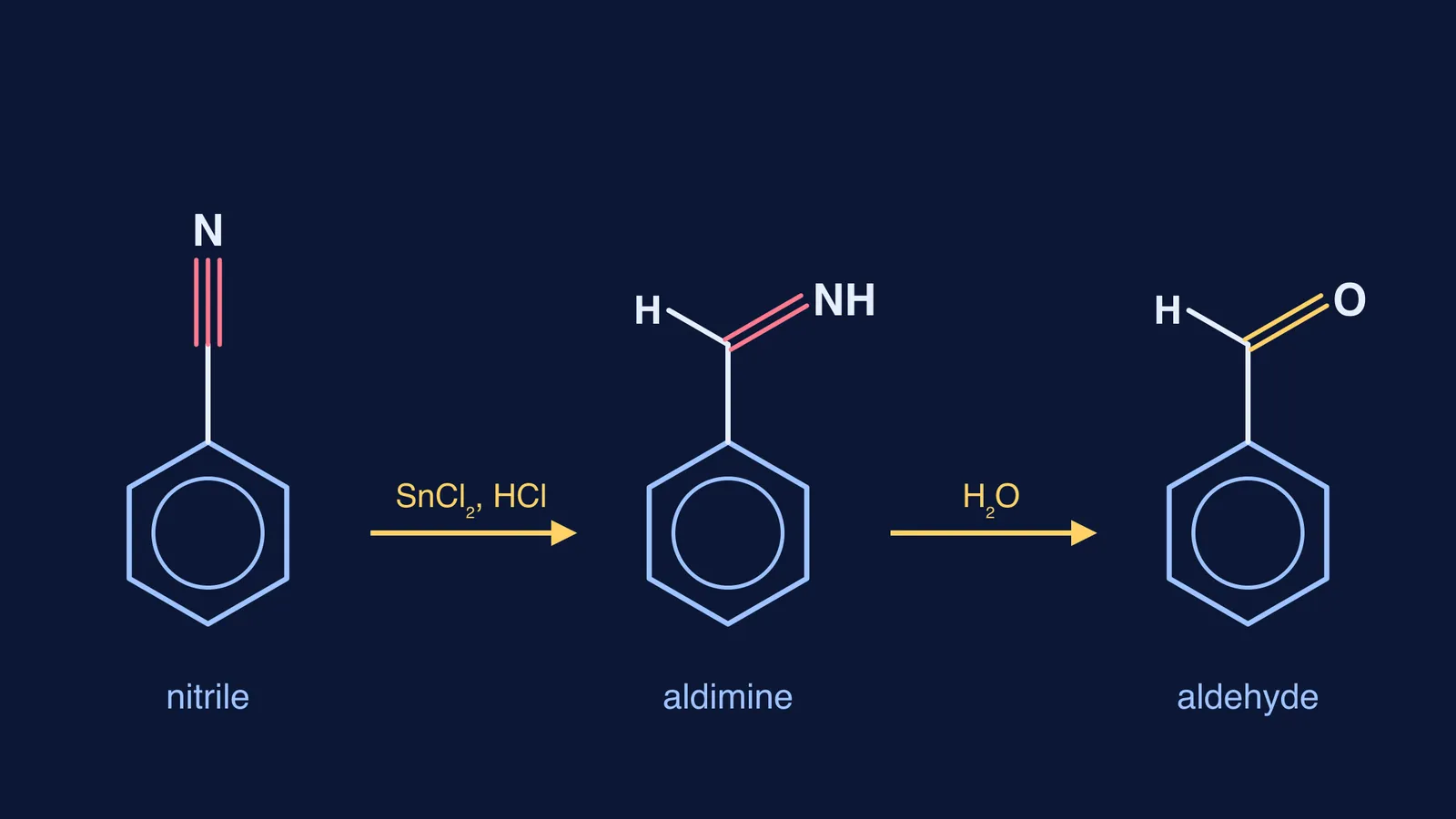
The Wikipedia article on the Stephen aldehyde synthesis describes three stages:
The nitrile reacts with hydrogen chloride to form a salt.
Tin(II) chloride (stannous chloride, SnCl₂) reduces that salt, giving an aldimine–tin chloride complex that precipitates out of solution.
Water hydrolyses the complex, through a hemiaminal intermediate, to the aldehyde.
Your NCERT textbook puts it in one line: RCN + SnCl₂ + HCl gives RCH=NH, which on hydrolysis (H₃O⁺) gives RCHO. It appears in section 8.2.2 of the Class 12 chapter Aldehydes, Ketones and Carboxylic Acids.
How does benzonitrile become benzaldehyde?
Take benzonitrile, C₆H₅CN (molecular formula C₇H₅N).
Find the functional group: –C≡N on a benzene ring.
Apply SnCl₂ and HCl: the C≡N becomes C=NH, giving C₆H₅CH=NH (held as a tin complex).
Hydrolyse: C=NH becomes C=O, giving C₆H₅CHO, benzaldehyde (C₇H₆O).
Check the carbons: 7 before, 7 after. The nitrile carbon becomes the aldehyde carbon, so the chain neither grows nor shrinks.
That last step is worth making a habit. If a question's product has one carbon more or fewer than the starting material, the Stephen reaction is not the answer.
Why does it work better for aromatic nitriles?
The same article notes that the reaction is more efficient with aromatic nitriles than with aliphatic ones. Electron-donating groups on the ring help the aldimine form, while electron-withdrawing groups push the reaction towards an amide chloride instead. A reference summary of named reactions at DrugFuture goes further and says the method is practically applied only to aromatic aldehydes. Exam questions still often write a general R–CN, so learn the general equation, but remember where it works best in a real lab.
How do you tell Stephen apart from Rosenmund and DIBAL-H?
The NCERT chapter lists these three ways to make aldehydes side by side, and they are easy to mix up. Use this check on any question:
Starting material is an acyl chloride (R–COCl), reagent is H₂ over Pd–BaSO₄: Rosenmund reduction.
Starting material is a nitrile (R–CN), reagents are SnCl₂ and HCl, then H₃O⁺: Stephen reaction.
Starting material is a nitrile or an ester, reagent is DIBAL-H, then water: diisobutylaluminium hydride reduction.
NCERT's DIBAL-H example is worth noticing: it reduces a nitrile that also contains a C=C double bond, and the double bond survives in the aldehyde product.
If you keep getting the reagent right but the product wrong, the step that slips is usually the hydrolysis, or the carbon count. Working a few reactions slowly in the Fermi Problem Library helps, because its step-by-step solver explains the reasoning rather than printing an answer. If it is the idea of reduction itself that feels shaky, the Fermi Concept Library has a lesson for each chemistry concept, with its place in the wider map.
A man who studied under Weizmann in Manchester and taught for nearly three decades in Johannesburg left behind one clean idea: stop the reduction halfway. Next time you see SnCl₂ and HCl next to a nitrile, you will know whose name is on it, and why.