

On this page
A nitric acid plant burns ammonia over a hot platinum–rhodium gauze to make nitric oxide, NO. About 95% of the ammonia goes the way the textbook says. A small share goes somewhere else, and one of those places is nitrous oxide, N₂O, the "laughing gas" you meet as a neutral oxide. It is also a greenhouse gas that lasts more than a century in the air. In a plant without abatement, that trickle of N₂O can be the largest climate cost of the whole process. Oxidation numbers explain where it comes from, and kinetics explains how plants get rid of it.
What side reactions happen in the Ostwald process?
The first step of the Ostwald process is 4NH₃ + 5O₂ → 4NO + 6H₂O, run at around 900 °C over Pt–Rh gauze with a contact time of around a millisecond or less. Our post on Haber and Ostwald process conditions covers why those conditions are chosen and notes that a side reaction wastes some ammonia. Here are the side reactions by name:
Ammonia to nitrogen: 4NH₃ + 3O₂ → 2N₂ + 6H₂O
Ammonia to nitrous oxide: 2NH₃ + 2O₂ → N₂O + 3H₂O
Some N₂O also forms when unreacted ammonia meets NO on or near the gauze. Either way, nitrogen that should have reached +2 stops at +1 or 0.
How do oxidation numbers tell the three routes apart?
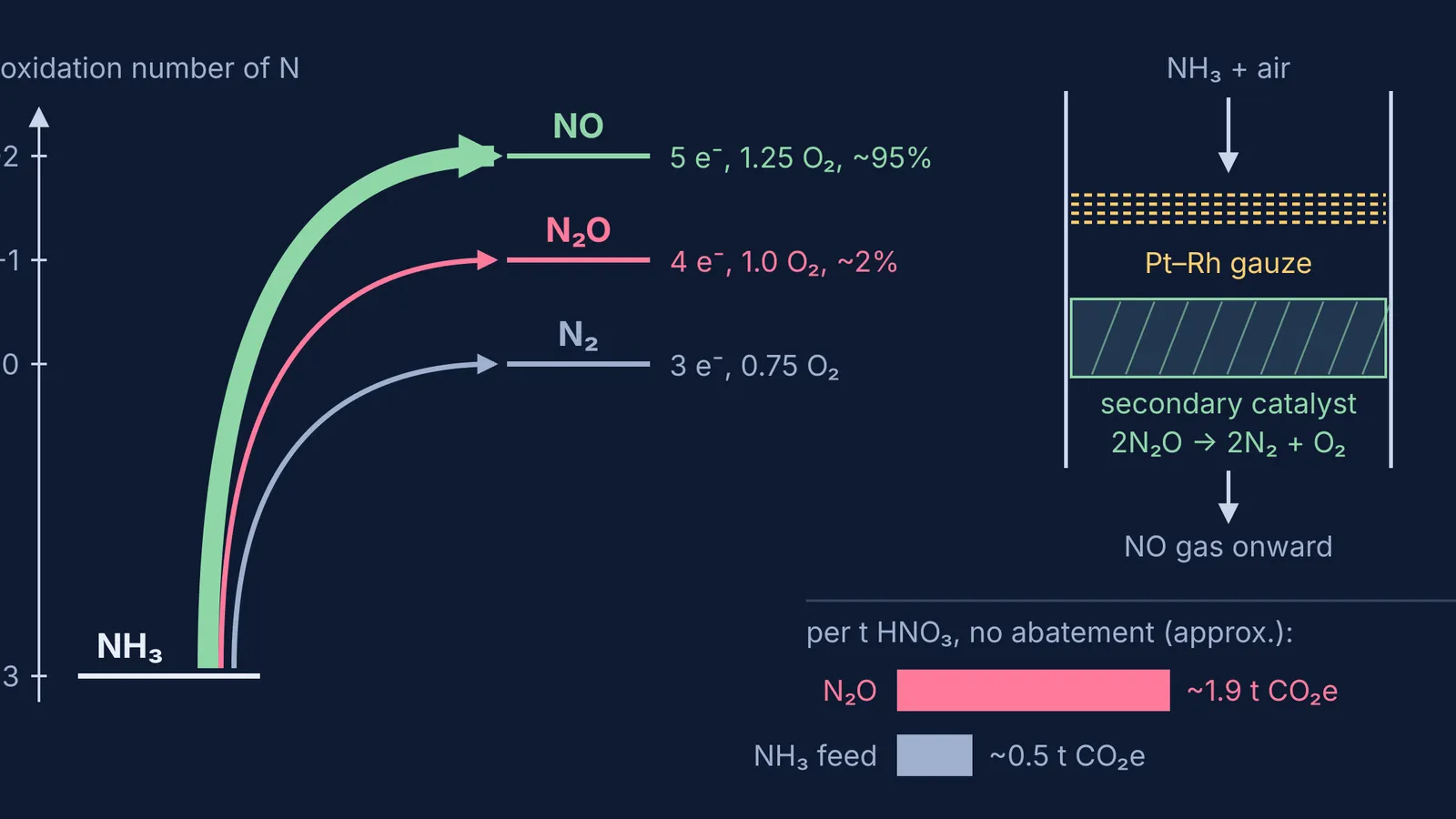
Every route starts from nitrogen at −3 in NH₃. What changes is how far up the ladder it climbs, and so how many electrons each nitrogen gives to oxygen. Each O₂ molecule accepts 4 electrons (two O atoms going from 0 to −2).
To NO (+2): 5 e⁻ per N, so 5/4 = 1.25 O₂ per NH₃.
To N₂O (+1): 4 e⁻ per N, so 4/4 = 1.0 O₂ per NH₃.
To N₂ (0): 3 e⁻ per N, so 3/4 = 0.75 O₂ per NH₃.
This is a quick way to balance all three equations without trial and error, and it shows that NO is the most oxygen-hungry product.
Worked example: N₂O from one tonne of nitric acid
Part (a): balance the three routes by electron count.
NH₃ → NO: 5 e⁻ lost per NH₃. O₂ gains 4 e⁻. Lowest common multiple 20: 4NH₃ + 5O₂. Hydrogen: 12 H gives 6H₂O. Result: 4NH₃ + 5O₂ → 4NO + 6H₂O. Check O: 10 = 4 + 6.
NH₃ → N₂O: 4 e⁻ per NH₃, so NH₃ and O₂ are 1 : 1. N₂O needs 2 N, so 2NH₃ + 2O₂ → N₂O + 3H₂O. Check O: 4 = 1 + 3.
NH₃ → N₂: 3 e⁻ per NH₃. LCM of 3 and 4 is 12: 4NH₃ + 3O₂ → 2N₂ + 6H₂O. Check O: 6 = 6.
Part (b): how much ammonia ends up as N₂O?
Moles of HNO₃ in a tonne: 1 000 000 ÷ 63.01 = 15 870 mol. Overall, NH₃ + 2O₂ → HNO₃ + H₂O, so each HNO₃ needs one N.
If 95% of ammonia goes to NO, ammonia fed = 15 870 ÷ 0.95 = 16 700 mol, which is 0.284 t of NH₃.
The IPCC 2006 Guidelines give default emission factors from about 2 kg N₂O per t HNO₃ (plants with abatement) to 9 kg (high-pressure plants without it). Take the medium-pressure default, 7 kg per t HNO₃.
7000 g ÷ 44.01 g/mol = 159 mol N₂O, which holds 2 × 159 = 318 mol of N.
Share of the ammonia nitrogen: 318 ÷ 16 700 = 1.9%.
Part (c): what is it worth in CO₂? The IPCC Sixth Assessment Report (AR6) gives N₂O a 100-year global warming potential of 273 and an atmospheric lifetime of about 109 years.
7 kg × 273 = 1911 kg, about 1.9 t CO₂e per tonne of nitric acid.
For comparison, the ammonia feed. A modern natural-gas ammonia plant emits roughly 1.7 to 2 t CO₂ per tonne of NH₃ (approximate; the IPCC default for such plants is about 1.7, and coal- or oil-based plants emit more). 0.284 t × 1.7 to 2 = about 0.5 to 0.6 t CO₂.
So under 2% of the ammonia nitrogen, leaving as N₂O, carries three to four times the climate cost of making all the ammonia.
If you use the older AR5 value of 265, the N₂O figure is 1.86 t. Say which set you used.
Why can N₂O be destroyed so easily, yet survive in the air?
N₂O is thermodynamically unstable. Its ΔfH° is about +82 kJ/mol, so 2N₂O → 2N₂ + O₂ releases about 164 kJ. Yet at room temperature it does not decompose, because the reaction has a high activation energy. That makes it kinetically stable, the same split you see in why ozone and nitric oxide are unstable but long-lived. Nothing in the lower atmosphere breaks it down; it is destroyed mainly by ultraviolet light high in the stratosphere, which is why its lifetime runs past a century.
Thermodynamics allows decomposition, so a catalyst can make it fast. That is the whole trick behind abatement.
How do nitric acid plants cut N₂O?
There are two common places to put the catalyst.
Secondary abatement: a bed of a second catalyst, usually a metal oxide, sits just below the platinum gauze in the burner. The gas there is still hot, so N₂O decomposes to N₂ and O₂ before it can travel on. Removal of roughly 70 to 90% is commonly reported, depending on the catalyst and how long it has run.
Tertiary abatement: a catalyst in the tail gas at the end of the plant, sometimes with a reducing agent, removes N₂O (and often NOₓ) after the acid has been absorbed.
Run the example again with 80 to 90% removal: N₂O drops from about 1.9 t to about 0.2 to 0.4 t CO₂e per tonne of acid. Add the 0.5 t from ammonia, and the total falls from about 2.4 t to under 1 t, more than halved.
This is not the same job as AdBlue in trucks. Selective catalytic reduction with urea targets NO and NO₂, not N₂O, which needs its own catalyst.
N₂O from nitric acid is a reported category in national greenhouse inventories, including the reports India submits to the UNFCCC. For a specific plant, use its own published figures, not the default factor.
To see why one route wins over another on a catalyst surface, the Concept Library places selectivity, activation energy and oxidation numbers in one map. For more redox balancing practice, the Fermi Problem Library has a step-by-step solver that explains the reasoning.
Quick checklist
Wanted: 4NH₃ + 5O₂ → 4NO + 6H₂O (N: −3 to +2, 5 e⁻, 1.25 O₂ per NH₃).
Side reactions: 2NH₃ + 2O₂ → N₂O + 3H₂O (4 e⁻) and 4NH₃ + 3O₂ → 2N₂ + 6H₂O (3 e⁻).
IPCC default for a medium-pressure plant: 7 kg N₂O per t HNO₃, about 1.9% of the ammonia nitrogen.
GWP of N₂O: 273 (AR6, 100-year), lifetime about 109 years.
N₂O is thermodynamically unstable but kinetically stable, so a catalyst under the gauze can destroy most of it.


