

On this page
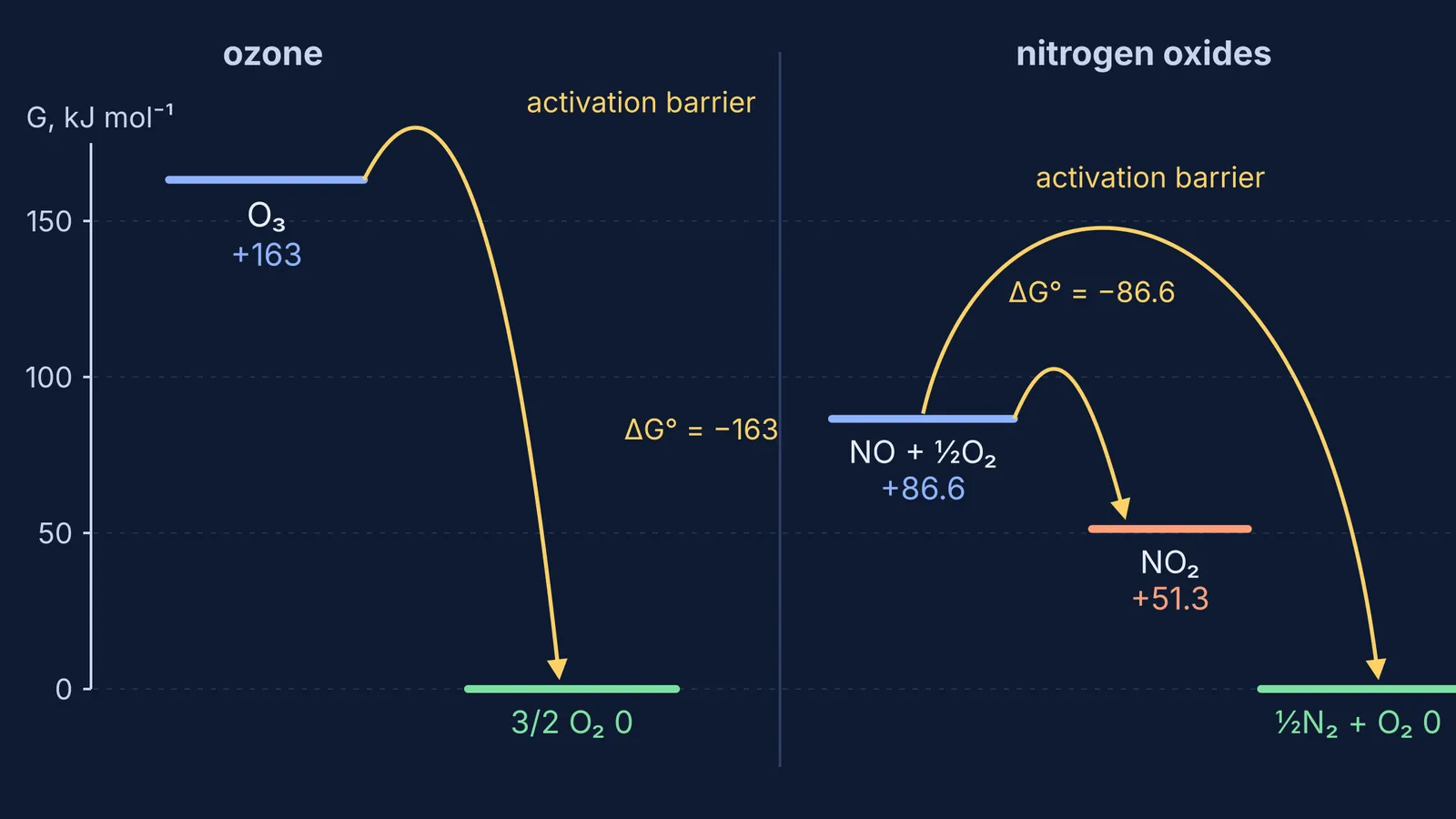
Ozone and nitric oxide have something awkward in common. Both sit uphill of the elements they are made from, so thermodynamics says both should fall apart. Yet the ozone layer has been there for a very long time, and NO comes out of every car exhaust and lingers in city air. Two NCERT Class 11 thermodynamics exercises ask you to show the first half of this story with numbers. This post works both, fixes one place where the usual answer is loose, and then explains the second half: why these molecules last.
How do you find ΔG° for ozone formation from Kp?
NCERT gives the reaction 3/2 O₂(g) → O₃(g) with Kp = 2.47 × 10⁻²⁹ at 298 K, and asks for ΔG°.
Write the relation. ΔG° = −2.303RT log Kp.
Take the log carefully. log(2.47 × 10⁻²⁹) = log 2.47 − 29 = 0.393 − 29 = −28.61. The log is negative because Kp is far below 1.
Work out 2.303RT. 2.303 × 8.314 J K⁻¹ mol⁻¹ × 298 K = 5706 J mol⁻¹.
Multiply, minding both minus signs. ΔG° = −5706 × (−28.61) = +1.632 × 10⁵ J mol⁻¹.
Convert and read it. ΔG° ≈ +163 kJ mol⁻¹. Positive, so forming ozone from oxygen is not spontaneous under standard conditions.
Now check it against a data table. The tabulated standard Gibbs energy of formation of ozone, ΔfG°(O₃), is +163.2 kJ mol⁻¹. That is not a coincidence. The reaction as written makes exactly one mole of O₃ from oxygen in its standard state, so its ΔG° is the definition of ΔfG°(O₃).
Turn it round to see how far ozone is from equilibrium. For 2O₃(g) → 3O₂(g), the reaction is reversed and doubled, so ΔG° = −2 × 163 = −326 kJ mol⁻¹ and K = (1 / 2.47 × 10⁻²⁹)² ≈ 1.6 × 10⁵⁷. At equilibrium essentially no ozone would be left. If moving between ΔG° and K still feels mechanical, see how to calculate K from ΔG°.
Is nitric oxide thermodynamically stable?
NCERT's second exercise gives two enthalpies and asks you to comment on the thermodynamic stability of NO(g):
½N₂(g) + ½O₂(g) → NO(g), ΔrH = +90 kJ mol⁻¹
NO(g) + ½O₂(g) → NO₂(g), ΔrH = −74 kJ mol⁻¹
The expected answer is that NO is unstable, because its formation is endothermic, and NO₂ is stable, because its formation from NO is exothermic. That is the right direction, but two points need tightening.
First, judge stability with ΔG, not ΔH. Enthalpy alone can mislead when entropy changes a lot. Here the Gibbs energies agree with the enthalpies. ΔfG°(NO) is about +86.6 kJ mol⁻¹, so NO lies 86.6 kJ above its elements. For 2NO(g) → N₂(g) + O₂(g), ΔG° = −173.2 kJ mol⁻¹, and K = e^(173200 / (8.314 × 298)) ≈ 2 × 10³⁰. Nitric oxide is thermodynamically unstable with respect to its elements.
Second, "NO₂ is stable" means stable relative to NO + O₂. For NO + ½O₂ → NO₂, ΔG° = 51.3 − 86.6 = −35.3 kJ mol⁻¹, so NO does run downhill to NO₂. But NO₂ itself has ΔfH° ≈ +33.2 kJ mol⁻¹ and ΔfG° ≈ +51.3 kJ mol⁻¹. It is still above N₂ and O₂. Calling NO₂ "stable" without saying relative to what is wrong.
One more detail: standard tables give the NO → NO₂ enthalpy as about 33.2 − 90.3 = −57 kJ mol⁻¹, not −74. Use the number the question gives you; the sign, and the conclusion, are the same either way.
Why doesn't ozone decompose if ΔG° is so negative?
A negative ΔG° says a reaction can go. It says nothing about how fast. To turn O₃ into O₂ an O–O bond must break first, and that needs energy. That energy is the activation barrier. At the low temperatures of the stratosphere, few molecules have enough energy to cross it, so the uncatalysed breakdown of ozone is slow. This is the same split between thermodynamic and kinetic stability that keeps diamond from turning into graphite.
Kinetics is only half the reason the ozone layer persists. Ozone in the stratosphere is not sitting still. Ultraviolet light keeps splitting O₂ into atoms, which join other O₂ molecules to make new O₃, while other reactions destroy it. The amount you measure is a steady state between making and breaking, not an equilibrium. Anything that lowers the barrier to destruction speeds up the breaking side. In the lab, ozone decomposes quickly over a catalyst such as MnO₂. In the stratosphere, NO and chlorine atoms act as catalysts, as shown in the reactions in ozone's structure and oxidising action.
Why does nitric oxide survive in car exhaust?
Look at what temperature does to the formation reaction N₂ + O₂ → 2NO. ΔH° is about +180.5 kJ mol⁻¹ and ΔS° about +24.8 J K⁻¹ mol⁻¹. Treating both as constant:
At 298 K, ΔG° = +173.2 kJ mol⁻¹ and K ≈ 4 × 10⁻³¹.
At 2000 K, ΔG° ≈ 180.5 − 2000 × 0.0248 = +130.9 kJ mol⁻¹ and K ≈ 4 × 10⁻⁴.
An endothermic reaction has a K that rises with temperature, so the hot gas in an engine cylinder makes a measurable amount of NO. Then the exhaust cools in a fraction of a second. Thermodynamics now wants the NO gone, but its decomposition back to N₂ and O₂ has a high activation barrier, so the NO is frozen in as the gas cools.
That is why cars carry catalytic converters. The catalyst surface gives NO a lower-barrier path to N₂, reacting it with CO and unburnt fuel in the exhaust. Without a catalyst, the downhill step NO actually takes in air is the one in NCERT's second equation: slow oxidation to brown NO₂.
For practice on ΔG°, K and sign questions like these, the Fermi Problem Library has a step-by-step solver that explains the reasoning at each step.
What does "unstable" mean for ozone and NO?
Keep two separate questions apart.
Thermodynamic: which way is downhill? Look at the sign of ΔG° for the decomposition. For both ozone and NO it is negative, so both are thermodynamically unstable.
Kinetic: how fast does it go? Look at the activation barrier. For both, the uncatalysed decomposition is slow at ordinary temperatures, so both are kinetically persistent.
"Kinetically stable" does not mean ΔG° > 0. It means the barrier is high, whatever the sign of ΔG°. And "unstable" does not mean "unreactive": ozone is a strong oxidising agent towards other substances, which is a separate question from how fast it breaks down on its own. If the barrier picture is the part that does not stick, the Concept Library places activation energy and Gibbs energy side by side as connected concepts.
Quick checklist
3/2 O₂ → O₃: log Kp = −28.61, so ΔG° = +163 kJ mol⁻¹, equal to ΔfG°(O₃).
2O₃ → 3O₂: ΔG° = −326 kJ mol⁻¹, K ≈ 1.6 × 10⁵⁷.
NO is 86.6 kJ mol⁻¹ uphill of its elements; NO₂ is 51.3 kJ mol⁻¹ uphill.
NO₂ is stable only relative to NO + ½O₂.
Judge thermodynamic stability with ΔG, not ΔH alone.
Both molecules persist because their decompositions have high activation barriers.


