

On this page
Counting atoms in a unit cell tells you how many atoms belong to the cell. Counting neighbours answers a different question: how many atoms surround one chosen atom, and how far away is each group? JEE questions ask for the number of nearest neighbours, the second-nearest neighbours and their distances, often for bcc and fcc metals. Once you know where to look in the cube, every answer follows from Pythagoras.
What does "nearest neighbour" mean in a crystal?
Pick any atom in the lattice. Its nearest neighbours are the atoms at the shortest distance from it. Their number is the coordination number. The next-nearest (second) neighbours are the atoms at the next shortest distance, and so on. Each group at one distance is called a shell.
In a cubic lattice every atom is equivalent, so it does not matter which atom you pick. The trick is to put your chosen atom at a convenient spot, usually a corner or the body centre, and imagine the cells around it as well as the one you drew.
The first shell is the one where atoms touch, which is how the edge length–radius relations are found. That part is covered in edge length and atomic radius in simple cubic, bcc and fcc. This post goes further out.
How many neighbours does an atom have in simple cubic?
Put the atom at a corner. Eight cubes meet at that corner, so look in all directions.
First shell: 6 at a. One step along each edge direction: ±x, ±y, ±z.
Second shell: 12 at a√2. Across a face diagonal. Each of the three planes (xy, yz, zx) gives 4 such atoms.
Third shell: 8 at a√3. Across a body diagonal, one into each of the 8 cubes that share the corner.
So in simple cubic the second shell is √2 ≈ 1.41 times farther than the first.
What are the nearest and next-nearest neighbours in bcc?
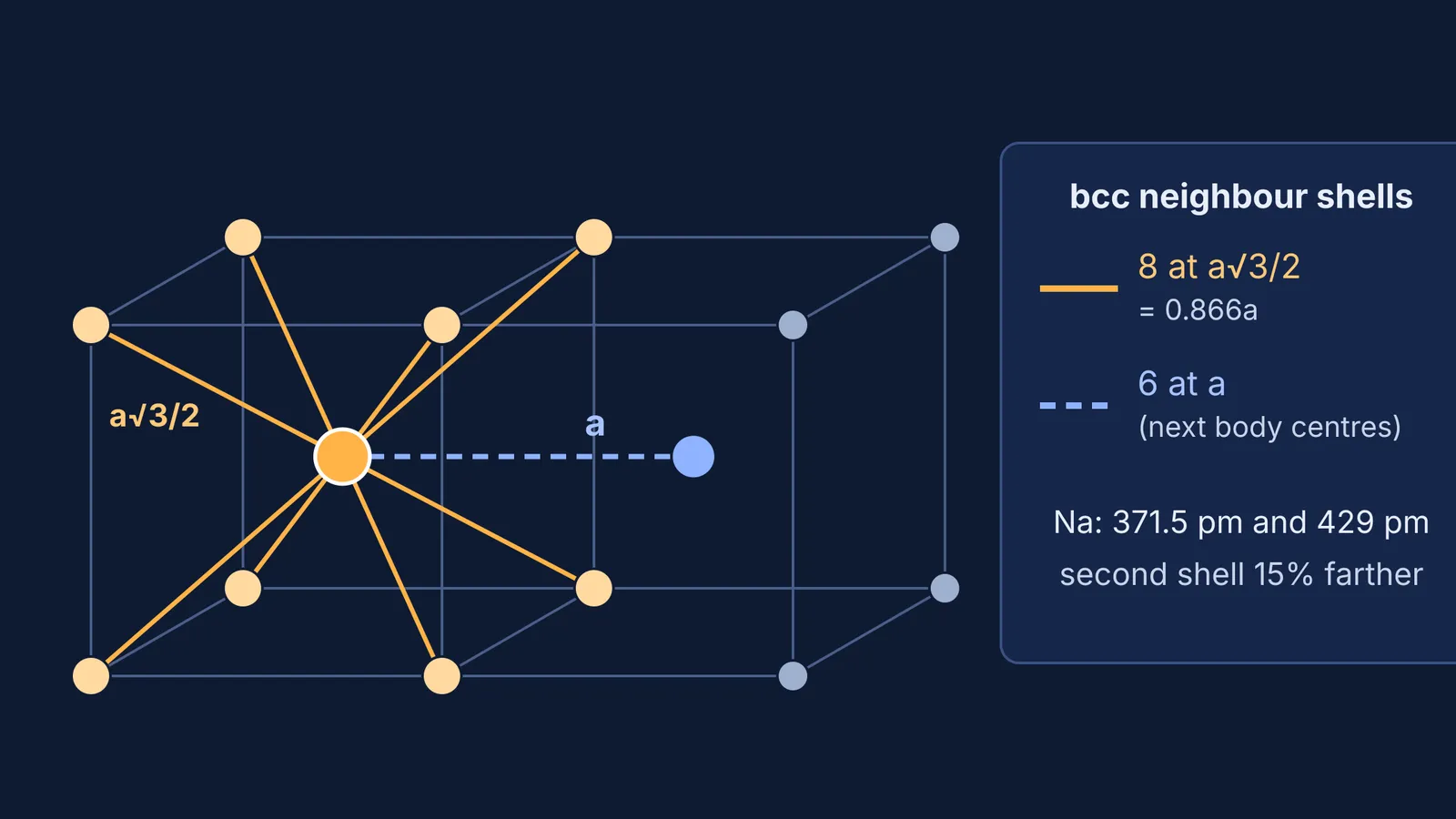
Put the atom at the body centre. Now the closest atoms are the corners of its own cube.
First shell: 8 at a√3/2 ≈ 0.866a. The distance from the centre to any corner is half the body diagonal, ½ × a√3.
Second shell: 6 at a. These are the body-centre atoms of the 6 cubes that share a face with this one. Going from one body centre to the next means moving one full edge length along x, y or z.
Third shell: 12 at a√2. The body centres of cubes that share only an edge.
The second shell is only a/(a√3/2) = 2/√3 ≈ 1.155 times farther than the first, just 15% more. That is why bcc is sometimes described as having "8 + 6" neighbours, and why some books give an effective coordination of 14 for bcc metals.
What are the neighbour shells in fcc?
Put the atom at a corner. Its nearest neighbours are face-centre atoms.
First shell: 12 at a/√2 ≈ 0.707a. Half a face diagonal. Each of the 3 planes through the corner contains 4 such face centres, so 3 × 4 = 12.
Second shell: 6 at a. Other corner atoms, one edge away along ±x, ±y, ±z.
Third shell: 24 at a√(3/2) ≈ 1.225a. These are atoms at positions like (a, a/2, a/2). Count them: choose which coordinate is the full a (3 ways), then a sign for each of the three coordinates (2 × 2 × 2 = 8). That gives 3 × 8 = 24. This count is the one most often got wrong, so check it with the sign argument rather than by trying to spot atoms in a drawing.
In fcc the second shell is √2 ≈ 1.41 times farther than the first, much more separated than in bcc.
Here is everything in one place:
sc: 6 at a, 12 at a√2, 8 at a√3
bcc: 8 at a√3/2, 6 at a, 12 at a√2
fcc: 12 at a/√2, 6 at a, 24 at a√(3/2)
Worked example: neighbours in sodium and copper
Sodium is bcc with a = 429 pm.
Nearest-neighbour distance = a√3/2 = 429 × 0.8660 = 371.5 pm. There are 8 such atoms.
Next-nearest distance = a = 429 pm. There are 6.
Ratio = 429 / 371.5 = 1.155, so the second shell is about 15% farther.
Since sodium atoms touch along the body diagonal, 2r = 371.5 pm and r ≈ 186 pm.
Third shell: 12 atoms at a√2 = 607 pm.
Copper is fcc with a = 361 pm.
Nearest-neighbour distance = a/√2 = 361 / 1.414 = 255 pm. There are 12.
Next-nearest distance = a = 361 pm. There are 6.
Third shell: 24 atoms at a√(3/2) = 361 × 1.225 = 442 pm.
Atoms touch along the face diagonal, so 2r = 255 pm and r ≈ 128 pm.
To check a and Z from density instead, see the density of a unit cell, d = ZM/(a³N_A).
How do you count neighbours in an ionic crystal like NaCl?
In an ionic crystal you must say which neighbours you mean: the oppositely charged ions or ions of the same kind.
In rock salt, Na⁺ sits at the edge centres and body centre of an fcc Cl⁻ lattice (or the other way round). Take a Na⁺ ion, with a ≈ 564 pm:
Nearest: 6 Cl⁻ at a/2 ≈ 282 pm. These are the unlike-ion neighbours, which is why NaCl is called 6:6 coordination.
Next: 12 Na⁺ at a/√2 ≈ 399 pm. The Na⁺ ions form their own fcc lattice, so like-ion neighbours follow the fcc first-shell rule.
Then: 8 Cl⁻ at a√3/2 ≈ 488 pm. Across the body diagonal of the small cube of side a/2.
In CsCl (simple cubic arrangement of each ion, one inside the other), Cs⁺ has 8 Cl⁻ at a√3/2 and then 6 Cs⁺ at a. Why NaCl and CsCl choose these arrangements in the first place is explained in the radius ratio rule for NaCl, CsCl and ZnS structures.
How can you picture the shells without getting lost?
Most mistakes come from looking at only one cube. Draw, or imagine, the cubes on every side of your chosen atom, then work outward along edges, face diagonals and body diagonals. If it helps to rotate a lattice and watch the shells light up, the Simulation Lab has interactive simulations for ideas that are easier to see than read.
Quick checklist
Put the chosen atom at a corner (sc, fcc) or body centre (bcc), and look into all neighbouring cells.
sc: 6, 12, 8 at a, a√2, a√3.
bcc: 8 at a√3/2, then 6 at a, only 15% farther.
fcc: 12 at a/√2, 6 at a, 24 at a√(3/2).
Count the fcc third shell by signs: 3 × 8 = 24.
In ionic crystals, separate unlike-ion and like-ion neighbours.
Nearest distance = 2r only for identical touching atoms.


