

On this page
A morsing in a Carnatic concert gives a twanging, buzzing rhythm that sometimes carries a tune. That is surprising: its one steel tongue vibrates at one fixed frequency. The melody comes from the mouth, not the steel. The player reshapes the mouth so that it reinforces one harmonic of the tongue's sound at a time, and those harmonics happen to land on the notes of a scale. This post works out which harmonics give which swaras.
What is a morsing and how is it played?
The morsing is the South Indian name for the jaw harp, an instrument found across Asia and Europe. In Rajasthan the same instrument is called the morchang. It has a horseshoe-shaped iron frame and a thin steel tongue riveted to the frame at one end. The free end is bent so it can be flicked.
The player presses the frame against the front teeth, with the lips slightly apart, and plucks the tongue with a finger. The tongue swings through the gap in the frame, in front of the open mouth. In Carnatic music the morsing is a percussion instrument that plays rhythm alongside the mridangam, but skilled players also bring out short melodic phrases.
A morsing has to match the concert's Sa, and its tongue cannot be retuned during a piece, so a player needs an instrument at each pitch they perform at. In this post, assume a tongue frequency of 110 Hz. That is a round illustrative value, chosen to make the arithmetic easy, not a measured standard.
Why does a fixed-pitch tongue give a whole series of harmonics?
A tongue clamped at one end is a cantilever bar. Its own natural overtones are not harmonic: for a uniform cantilever, the second mode is about 6.27 times the frequency of the first, not 2 times. So where do whole-number harmonics come from?
The key is that the sound repeats exactly once per swing of the tongue. Each time the tongue passes through the narrow gap in the frame, the air near the mouth gets a sudden push, so the pressure wave is a sharp, repeating pattern rather than a smooth sine wave. Any periodic wave with period T can be split into sine waves at f₁, 2f₁, 3f₁ and so on, where f₁ = 1/T. That is Fourier's theorem, and it holds whatever the exact shape of each pulse. So a 110 Hz tongue gives a sound with components at 110, 220, 330, 440 Hz and upwards, all exact multiples.
For why these are called harmonics and how they differ from overtones, see overtones and harmonics in open and closed pipes. Harmonic content is also what makes two instruments sound different on the same note. The morsing is unusual because the player changes the harmonic content on purpose, note by note.
How does the mouth pick out one harmonic?
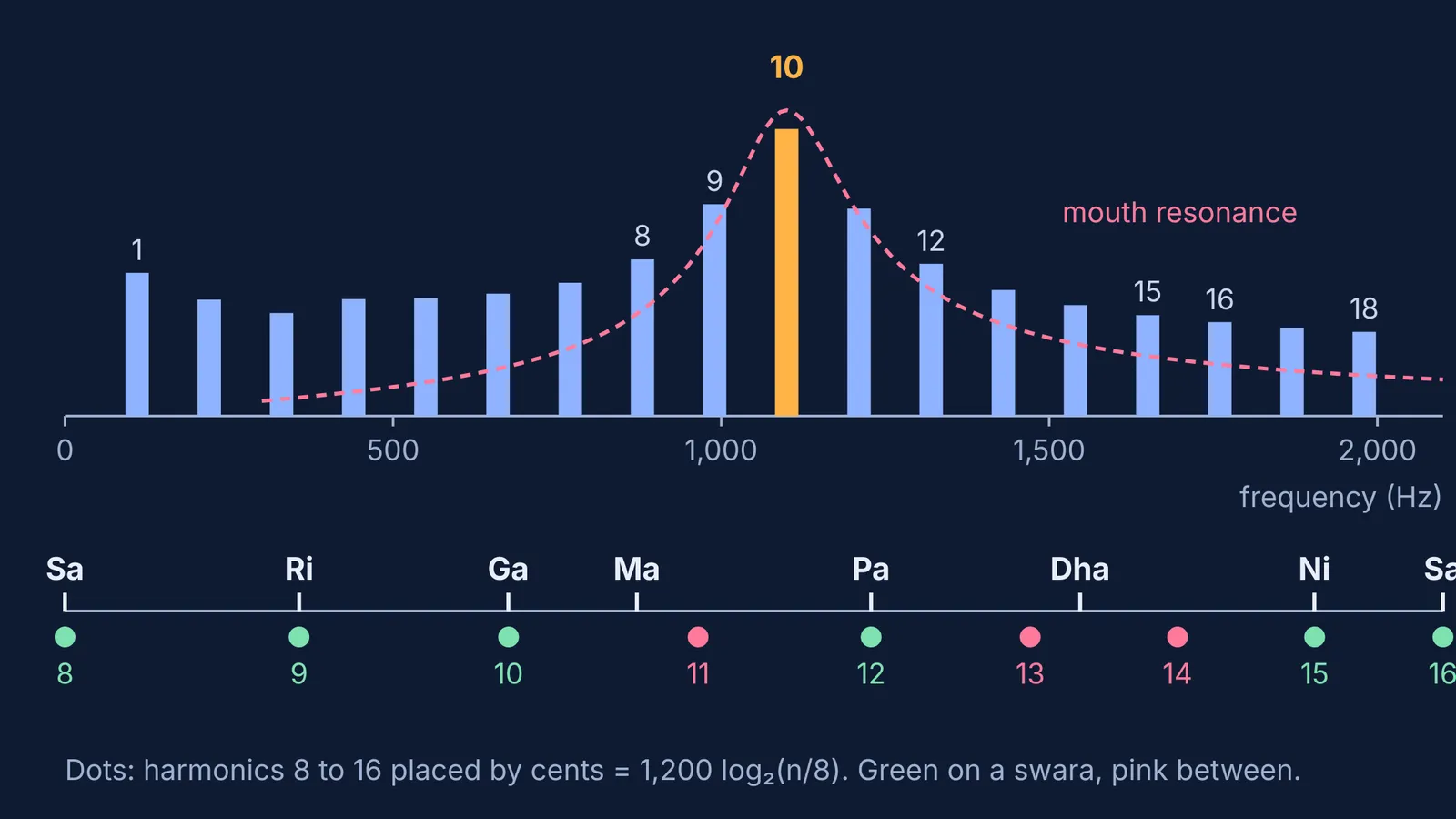
The air in your mouth is a resonator whose resonant frequency you change by moving your tongue, jaw and lips, as when you say different vowels. A harmonic close to that resonance is reinforced; the rest stay quieter. You hear the reinforced harmonic as a melody note riding on the steady buzz.
Kathleen Schlesinger's entry on the jew's harp in the 1911 Encyclopaedia Britannica describes the sound as "a fundamental and its harmonics" and says that "by using the cavity of the mouth as a resonator, each harmonic in succession can be isolated and reinforced", with the player shaping the mouth "as though intending to pronounce the various vowels" (Schlesinger, Encyclopaedia Britannica, 1911). The same entry notes that the lowest harmonics cannot be picked out, because the mouth cavity is too small to resonate that low.
Suppose the mouth's resonance can be moved over roughly 400 to 2,000 Hz (a round illustrative range; real values vary from person to person). With a 110 Hz tongue, that reaches from the 4th harmonic (440 Hz) up to the 18th (1,980 Hz).
Which harmonics match Sa, Ri, Ga and Pa?
Musicians measure pitch intervals in cents. One octave, a frequency ratio of 2, is 1,200 cents, so the interval between frequencies f and f′ is:
cents = 1,200 × log₂(f′/f)
Worked example: a melody from a 110 Hz morsing
List the harmonics. fₙ = n × 110 Hz. Harmonics 8 to 16 are 880, 990, 1,100, 1,210, 1,320, 1,430, 1,540, 1,650 and 1,760 Hz.
Choose a Sa. Take the 8th harmonic, 880 Hz, as Sa. It is three octaves above the tongue's 110 Hz, so it is the same swara.
Find cents above Sa. For the nth harmonic, cents = 1,200 × log₂(n/8).
9th: 1,200 × log₂(1.125) ≈ 204 cents.
10th: 1,200 × log₂(1.25) ≈ 386 cents.
12th: 1,200 × log₂(1.5) ≈ 702 cents.
15th: 1,200 × log₂(1.875) ≈ 1,088 cents.
16th: exactly 1,200 cents, the upper Sa.
Match to swaras. The ratios 9/8, 5/4, 3/2 and 15/8 are the just-intonation ratios usually given for chatushruti Ri, antara Ga, Pa and kakali Ni, the notes of Shankarabharanam. So harmonics 8, 9, 10, 12, 15 and 16 give Sa, Ri, Ga, Pa, Ni and upper Sa almost exactly.
Check the misfits. The 11th is at 551 cents, between Ma (4/3, about 498 cents) and prati Ma (about 590 cents). The 13th is at 841 cents, between the komal and shuddha Dha (about 814 and 884 cents). The 14th, at 969 cents, is a flat Ni. They sound out of tune.
Get Ma another way. A second morsing tuned a fourth higher has f₁ = 110 × 4/3 ≈ 146.7 Hz. Its 6th harmonic is 880 Hz, the same Sa, and its 8th is about 1,173 Hz, which is 4/3 of 880 Hz, a true Ma. Schlesinger's entry mentions players using two harps a fourth apart for this reason.
Why does the melody live so high up the series?
Look at the gaps. Between neighbouring harmonics n and n + 1, the ratio is (n + 1)/n. From the 4th to the 5th that is 5/4, a whole Ga-sized jump of 386 cents. Only from the 8th upwards is each step 9/8 (204 cents) or smaller, the size of a scale step. Below the 8th, the harmonics give Sa, Ga, Pa and a flat Ni with nothing in between. Above it, the series fills in a scale.
That is why the morsing's tune sits three octaves above its fundamental, and why the player needs a mouth resonance that can be placed precisely: the 10th and 11th harmonics are only 110 Hz apart. A related idea, an air cavity whose resonance changes with its volume, appears in tapping water glasses to change the pitch.
To see how harmonics add up to a complex wave, the Simulation Lab has interactive simulations for ideas that are easier to see than read.
Quick checklist
The morsing's tongue has one fixed pitch; the melody comes from the mouth.
The tongue chops the air once per cycle, so the sound contains exact harmonics nf₁.
The mouth is a tunable resonator that reinforces the harmonic nearest its resonance.
Cents = 1,200 log₂(n/m) for harmonics n and m.
With the 8th harmonic as Sa: 9th Ri, 10th Ga, 12th Pa, 15th Ni, 16th upper Sa.
The 11th, 13th and 14th fall between swaras; a second morsing a fourth higher supplies Ma.


