On this page
Below, the key terms of the NCERT Class 10 Science Chapter 3 text are grouped by topic, each with a plain definition, an example and its look-alike. For the full chapter plan, see our Metals and Non-metals Class 10 chapter guide.
The CBSE 2026-27 Class X Science syllabus covers properties, the reactivity series, ionic compounds, basic metallurgy and corrosion. It also says information in the textbook's boxes "would not be assessed in the year-end examination", so box-only ideas such as aqua regia are left out here.
How are metals and non-metals different physically?
Metallic lustre: the shine of a clean, pure metal surface. Exception: iodine, a non-metal that is also lustrous.
Malleability: a metal's ability to be hammered into thin sheets. Example: gold and silver foil. Don't confuse with: ductility.
Ductility: a metal's ability to be pulled into thin wires. Example: copper wire.
Good conductor: a material that lets heat or electric current pass through easily. Example: silver and copper conduct heat best. Exception: graphite, a non-metal that conducts electricity.
Sonorous: makes a ringing sound when struck on a hard surface. Example: a metal school bell.
Allotrope: one of the different forms the same element can take. Example: diamond (very hard) and graphite (conducts electricity) are both carbon.
Which metals react with oxygen, water and acids?
Basic oxide: an oxide that behaves like a base; most metal oxides are basic. Example: copper(II) oxide, the black coating on heated copper. Don't confuse with: acidic oxide.
Acidic oxide: an oxide that forms an acidic solution in water; most non-metal oxides do this. Example: sulphur dioxide, made by burning sulphur. Some non-metal oxides are neutral instead.
Amphoteric oxide: a metal oxide that acts like a base with acids and like an acid with bases, making a salt and water each time. Example: aluminium oxide and zinc oxide.
Alkali: a base that dissolves in water. Example: sodium oxide dissolves in water to give sodium hydroxide.
Displacement reaction: a more reactive metal pushes a less reactive one out of its salt solution. Example: an iron nail in copper sulphate gets coated with copper.
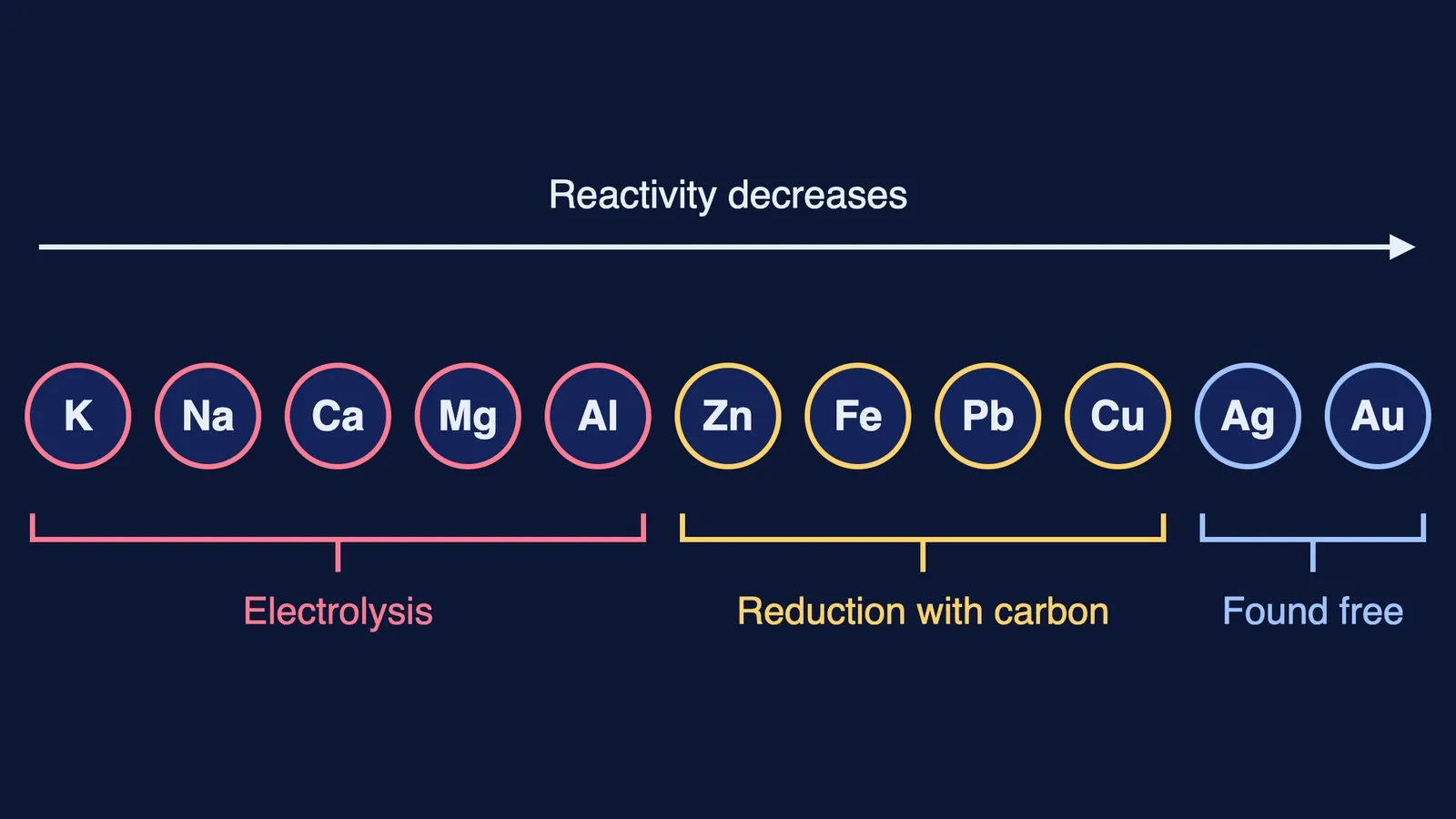
Reactivity series (activity series): metals listed from most to least reactive. Example: K, Na, Ca, Mg, Al, Zn, Fe, Pb, [H], Cu, Hg, Ag, Au. Metals above hydrogen push it out of dilute acids as gas.
Why do ionic compounds have high melting points?
Valence shell and octet: the valence shell is an atom's outermost shell; an octet is eight electrons filling it, as in neon and argon. Atoms react to reach one.
Cation: a positive ion formed when an atom loses electrons. Example: Na becomes Na+. Don't confuse with: anion.
Anion: a negative ion formed when an atom gains electrons. Example: Cl becomes Cl−.
Ionic (electrovalent) compound: a compound made when a metal gives electrons to a non-metal; the positive and negative ions then hold each other tightly. Example: sodium chloride, magnesium chloride.
The strong pull between ions takes a lot of energy to break, which is why sodium chloride does not melt until 1074 K, as listed in NCERT's Table 3.4. Ionic compounds are hard but break easily under pressure, dissolve in water but not kerosene, and conduct electricity only when molten or dissolved, when the ions can move.
What do ore, gangue and roasting mean in metallurgy?
Mineral: any natural element or compound dug out of the earth's crust. Don't confuse with: ore.
Ore: a mineral with enough of one metal to extract it profitably. Example: cinnabar (HgS) for mercury. Every ore is a mineral, not the reverse.
Gangue: the soil, sand and other unwanted material mined with the ore.
Metallurgy: extracting metals from ores and refining them for use. Enrichment is the first step: removing the gangue.
Roasting: heating a sulphide ore strongly in excess air to make the oxide. Example: zinc sulphide to zinc oxide. Don't confuse with: calcination.
Calcination: heating a carbonate ore strongly in limited air to make the oxide. Example: zinc carbonate to zinc oxide.
Reduction: getting the metal back from its oxide, often by heating with carbon (coke), the reducing agent. Example: zinc oxide and carbon give zinc.
Thermit reaction: aluminium takes oxygen away from iron(III) oxide and gives out so much heat that the iron comes out melted. Used to join railway tracks.
Electrolytic reduction: passing electric current through a melted compound to get very reactive metals, which carbon cannot free from their oxides. Example: sodium from molten sodium chloride, deposited at the cathode. Don't confuse with: electrolytic refining.
Electrolytic refining: purifying a metal with an impure anode, a pure-metal cathode and a salt solution of the metal. Example: copper.
Anode mud: the insoluble impurities that settle below the anode during refining.
Our post on extraction of metals puts these steps in order.
What are corrosion, rusting and alloys?
Corrosion: the slow eating away of a metal surface by air, moisture or chemicals. Example: silver turns black; copper gets a green coat.
Rusting: corrosion of iron, which needs both air and water and leaves brown flaky rust. Don't confuse with: corrosion, the wider term; silver and copper corrode but do not rust.
Galvanisation: protecting iron or steel from rust by giving it a thin zinc coat. Don't confuse with: alloying.
Alloy: a metal evenly mixed with another metal or a non-metal, so the mixture is the same all through. Example: stainless steel (iron with nickel and chromium), brass (copper and zinc), solder (lead and tin).
Amalgam: an alloy in which one metal is mercury.
How to learn these terms
Learn in pairs: roasting with calcination, mineral with ore, cation with anion, reduction with refining.
Draw the reactivity series once from memory, then mark which group is extracted by electrolysis, which by carbon, and which is found free.
If one idea stays fuzzy, such as why molten salt conducts but solid salt does not, the Fermi Concept Library gives each chemistry concept its own lesson.