On this page
How hard is it to cut a network in two? Count the weakest points, or count the independent routes: Menger's theorem says the two counts are always equal, which gives you a quick way to prove an answer instead of guessing.
What does Menger's theorem say?
Two definitions, from the standard statement on Wikipedia's Menger's theorem page.
A u–v separator is a set of vertices, not including u or v, whose removal leaves no path from u to v.
Two u–v paths are internally disjoint if they share no vertex other than u and v.
Menger's theorem: in a finite graph with non-adjacent vertices u and v, the minimum size of a u–v separator equals the maximum number of internally disjoint u–v paths (Menger's theorem, Wikipedia).
Karl Menger published the result in 1927 in Fundamenta Mathematicae, in a paper titled "Zur allgemeinen Kurventheorie" (Menger 1927, DOI).
Why non-adjacent? If u and v share an edge, deleting other vertices never separates them, so the vertex version has nothing to count.
One half is easy. Each disjoint path must cross the separator at a vertex no other path uses, so there are never more paths than separator vertices. The real content is the other half: if no small separator exists, enough disjoint paths always do.
If separators and paths are new words, the Fermi Concept Library covers every concept in physics, chemistry, biology, mathematics and computing, so you can fill the gap before the proof.
A worked example: how many vertices separate u from v?
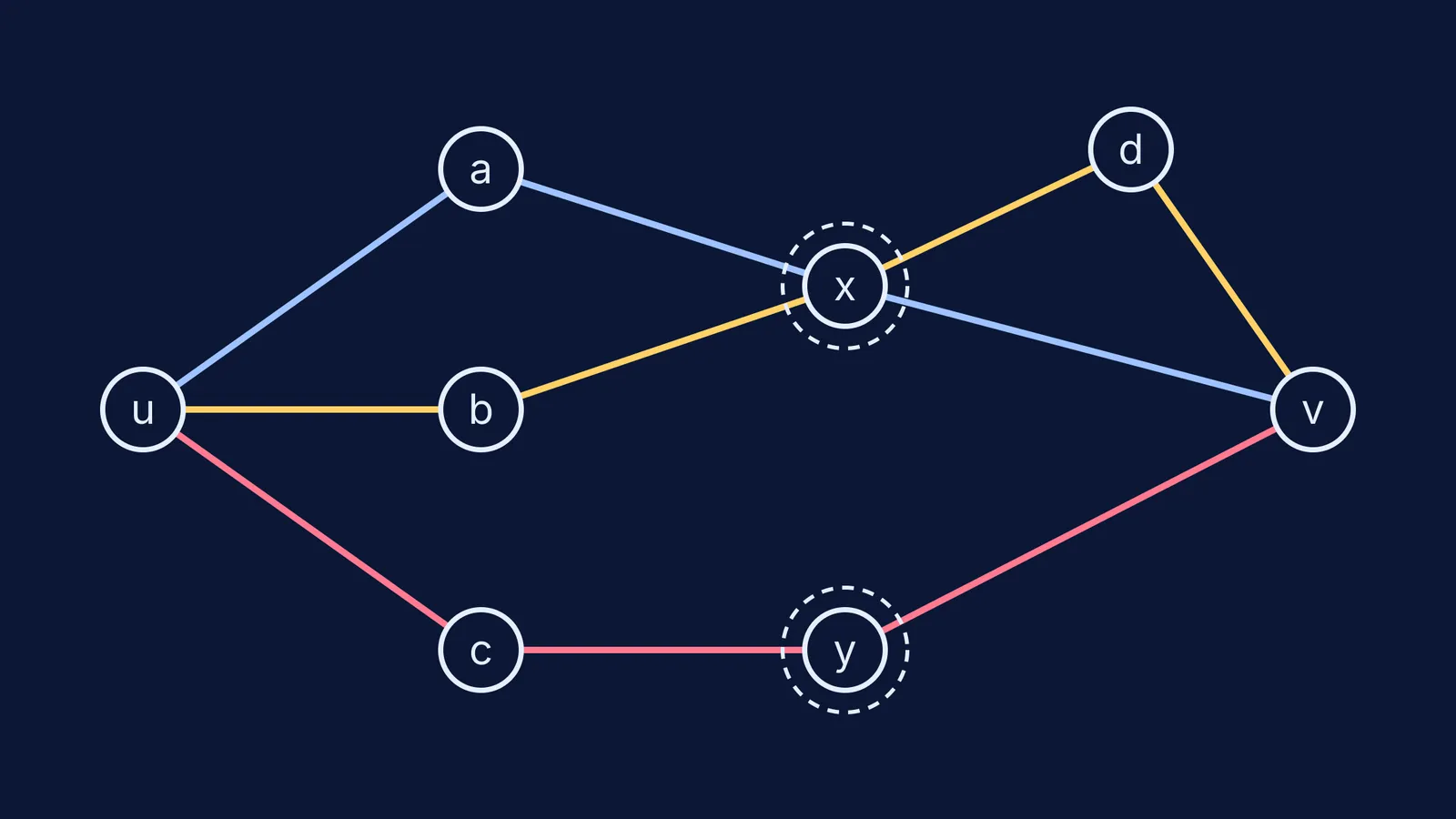
Take eight vertices and ten edges: u–a, u–b, u–c, a–x, b–x, c–y, x–v, x–d, d–v, y–v (the network in the diagram above).
Find disjoint paths greedily: u–a–x–v, then u–c–y–v. That is 2 internally disjoint paths.
Try for a third. It must leave u through b, but b leads only to x, already used. Stuck.
Find the bottleneck. From a and b you can only reach x; from c only y. So every u–v path passes through x or y, and {x, y} is a separator of size 2.
Compare. 2 disjoint paths and a 2-vertex separator: by the easy half, neither count can move. The answer is 2, proved.
What is the edge version of Menger's theorem?
For any two distinct vertices u and v of a finite graph, the minimum number of edges whose removal disconnects u from v equals the maximum number of pairwise edge-disjoint u–v paths (Menger's theorem, Wikipedia). Here u and v may be adjacent.
In the same network, edge-disjoint paths may share vertices, so you find three: u–a–x–v, u–b–x–d–v and u–c–y–v, one colour each in the diagram. Deleting the 3 edges at u disconnects it, so the edge answer is 3.
Why 3 and not 2? Two paths run through x, so deleting x kills both, but no single edge carries both. The vertex count can be strictly smaller than the edge count.
This is how the theorem describes graph connectivity as a whole: a graph with more than k vertices is k-vertex-connected exactly when every pair of vertices is joined by at least k internally disjoint paths, and a graph is k-edge-connected exactly when every pair is joined by k edge-disjoint paths (Menger's theorem, Wikipedia).
How is Menger's theorem related to max-flow min-cut?
L. R. Ford Jr. and D. R. Fulkerson published the max-flow min-cut theorem in 1956, working on a problem posed by T. Harris about a rail network linking two cities through intermediate ones (Ford and Fulkerson 1956, DOI). It says the largest flow from source to sink equals the smallest total capacity of a cut, and it can be used to derive Menger's theorem (max-flow min-cut theorem, Wikipedia).
Here is the translation:
Edge version. Give every edge capacity 1 in each direction. An integer maximum flow of value k splits into k edge-disjoint paths, and a minimum cut is a set of k edges.
Vertex version. Split each inner vertex w into w-in and w-out, joined by one arc of capacity 1, and give the original edges a large capacity. Now cutting an arc means deleting a vertex, so the minimum cut is a vertex separator.
If you want to see the flow side worked out by hand, read our six-node max-flow min-cut example. The same pattern, where the smallest blocking set equals the largest packing, also appears in Dilworth's theorem on chains and antichains.
How do you use Menger's theorem in a problem?
Decide which version you need: vertices (u, v non-adjacent) or edges.
Build disjoint paths greedily and mark what each one uses.
When you are stuck, list the vertices or edges every remaining route must cross.
If the counts match, write both certificates and stop.
If they do not match, reroute one path to free a vertex, then repeat.
To practise, try the problem above with an extra edge a–y and recount both versions. When a step goes wrong, the Fermi Problem Library has a step-by-step solver that explains the reasoning, so you can see where your path count slipped.