

On this page
A good vacuum pump can take a glass vessel down to a fraction of a pascal. A mercury manometer is useless there: at 0.1 Pa the levels differ by less than a thousandth of a millimetre. The McLeod gauge gets round this with one idea. It traps a known volume of the thin gas and squeezes it, thousands of times, into the closed tip of a narrow tube. The squeezed gas is now at a pressure of several millimetres of mercury, which you can read with a ruler, and Boyle's law takes you back to the pressure you started with.
How does a McLeod gauge work?
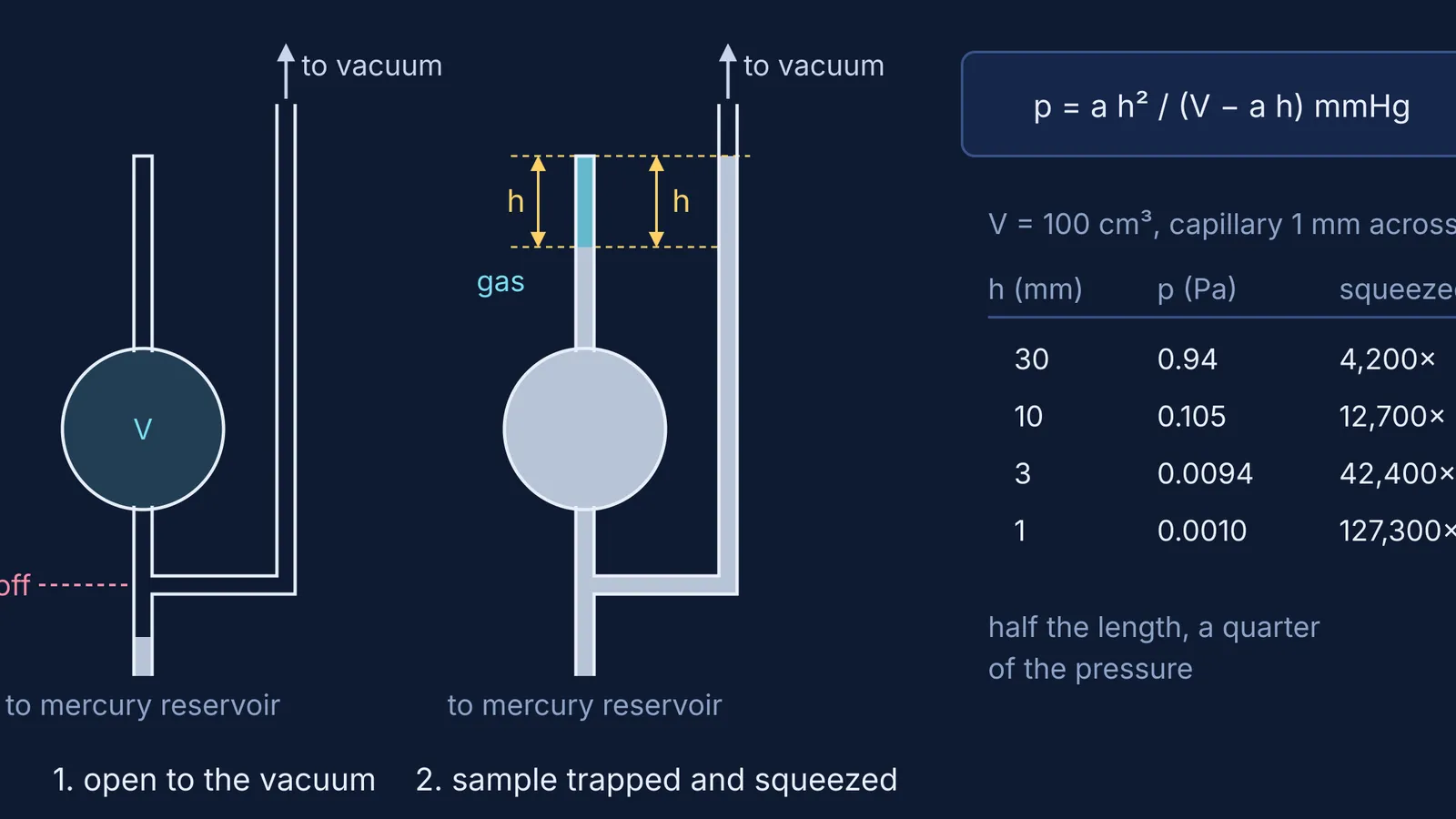
Herbert McLeod described the gauge in 1874 in a paper titled "Apparatus for measurement of low pressures of gas". The usual form has these parts:
A glass bulb of known volume V. On top of it sits a narrow closed capillary, sealed at the top.
A side tube from just below the bulb, connected to the vacuum system. Next to the closed capillary, this side tube rises as an open reference capillary of the same bore.
A mercury reservoir below, which can be raised or lowered.
To take a reading:
With the mercury low, the bulb and capillary fill with gas from the system, at the system pressure p.
Raise the mercury. As soon as it passes the junction below the bulb, the gas in the bulb and closed capillary is cut off from the system. That sample, volume V, is what gets measured.
Keep raising the mercury. It fills the bulb and pushes the trapped gas up into the closed capillary.
Stop when the mercury in the open reference capillary is level with the sealed top of the closed capillary. The gas now fills a length h at the top of the closed capillary, and the mercury in the closed capillary stands h below the mercury in the reference capillary.
A 1966 NASA Tech Brief on the gauge describes the same sequence: the gas "is compressed to a known volume at a known pressure, from which the pressure of the gas sample before compression can be calculated with the aid of Boyle's law."
What is the McLeod gauge formula?
Work in millimetres of mercury for pressure, and in mm and mm³ for lengths and volumes. Let a be the cross-section of the capillary.
Before squeezing: pressure p, volume V.
After squeezing: the gas fills a length h of the capillary, so its volume is a·h. The reference capillary is still open to the system at pressure p, and its mercury stands h higher. So the squeezed gas is at p + h.
The temperature does not change, so Boyle's law applies:
p·V = (p + h)·a·h
Solve for p:
p = a·h² ÷ (V − a·h)
Because a·h is tiny compared with V, this is almost exactly p ≈ a·h² ÷ V. The reading goes as h squared. That is why the scale on a McLeod gauge is not evenly spaced. Doubling h means four times the pressure.
For reading a pressure as a column height, see why a water barometer would be 10 metres tall. The Boyle's law practical with an air column checks the same law at ordinary pressures.
Worked example: what pressure does each reading mean?
Take a bulb of V = 100 cm³ = 1.00 × 10⁵ mm³ and a capillary 1.00 mm across. Use 1 mmHg = 133.3 Pa.
Capillary cross-section. a = π × (0.50 mm)² = 0.785 mm².
Reading h = 10 mm. a·h² = 0.785 × 100 = 78.5 mm³·mm. V − a·h = 100 000 − 7.85 = 99 992 mm³. So p = 78.5 ÷ 99 992 = 7.85 × 10⁻⁴ mmHg. In pascals: 7.85 × 10⁻⁴ × 133.3 = 0.105 Pa.
How hard was the gas squeezed? From 100 000 mm³ to 7.85 mm³, a ratio of about 12 700. The squeezed gas is at p + h ≈ 10 mmHg, easy to read.
Other readings, same gauge:
h = 30 mm: 7.07 × 10⁻³ mmHg, or 0.94 Pa (squeezed about 4 200 times).
h = 3 mm: 9.4 × 10⁻³ Pa.
h = 1 mm: 1.0 × 10⁻³ Pa (squeezed about 127 000 times).
Check units. a·h² is mm⁴ and V is mm³, so p comes out in mm of mercury.
Going from h = 30 mm to h = 1 mm, the length shrinks 30 times but the pressure drops 900 times. A reading error of 0.5 mm at h = 10 mm is a 5% length error and so a 10% pressure error.
Why does a McLeod gauge miss water vapour?
Squeezing a gas thousands of times raises its pressure thousands of times. A permanent gas such as nitrogen or air just gets denser. A vapour such as water condenses once its pressure reaches the saturated vapour pressure, about 24 mmHg for water at 25 °C. In the worked example, a 30 mm reading means the squeezed gas is at about 30 mmHg, already above that.
When the vapour condenses, it no longer adds to the pressure in the capillary, and the gauge reads too low. A National Bureau of Standards report on vacuum gauges (NBS Report 8640, 1965) states this directly: McLeod gauges cannot reliably measure the pressure of vapours if the pressure in the compression tube approaches the condensing pressure, and for that reason the authors did not use one as a reference in tests with water vapour. Pump oil vapour behaves the same way.
Why was the McLeod gauge used to calibrate other vacuum gauges?
The reading depends only on V, a and a length h. These are fixed when the gauge is made, and no electrical or thermal property of the gas comes in. So for permanent gases the McLeod gauge is an absolute gauge: it needs no calibration against another gauge. That made it a natural reference for gauges that do need calibrating. A 1959 paper in the journal Vacuum, for example, describes "the standard McLeod gauge and the calibration of ionization gauges to it"90607-4) at Japan's Electrotechnical Laboratory.
It has real drawbacks too.
It gives one reading at a time, not a continuous trace. The Pirani gauge gives a continuous electrical signal, but its reading depends on the gas.
It contains mercury. Mercury vapour can drift into the system, and the NASA Tech Brief describes an error caused by mercury vapour streaming towards a cold trap. Mercury is toxic, so a McLeod gauge does not belong in a school lab.
For more practice with Boyle's law problems like this one, the Fermi Problem Library has a step-by-step solver that explains the reasoning.
Quick checklist
A McLeod gauge traps a known volume V of gas and squeezes it into a closed capillary.
Boyle's law: p·V = (p + h)·a·h, so p = a·h²/(V − a·h) ≈ a·h²/V in mmHg.
The scale is a square law: half the length, a quarter of the pressure.
For V = 100 cm³ and a 1 mm capillary, h = 10 mm means about 0.1 Pa.
Condensable vapours such as water are missed, so the reading is too low.
It needs no calibration for permanent gases, which is why it served as a reference.


