

On this page
When Evangelista Torricelli invented the barometer in 1643, he used mercury to prove that the air around us has weight. Torricelli took a long glass tube sealed at one end, filled it with mercury, and inverted it into a basin also containing mercury. The column of liquid in the tube fell until it rested at a height of roughly 76 centimetres) above the surface of the basin. The classic physics problem asks: what if he had used water instead? To answer it, we have to look at how atmospheric pressure balances the weight of a liquid column.
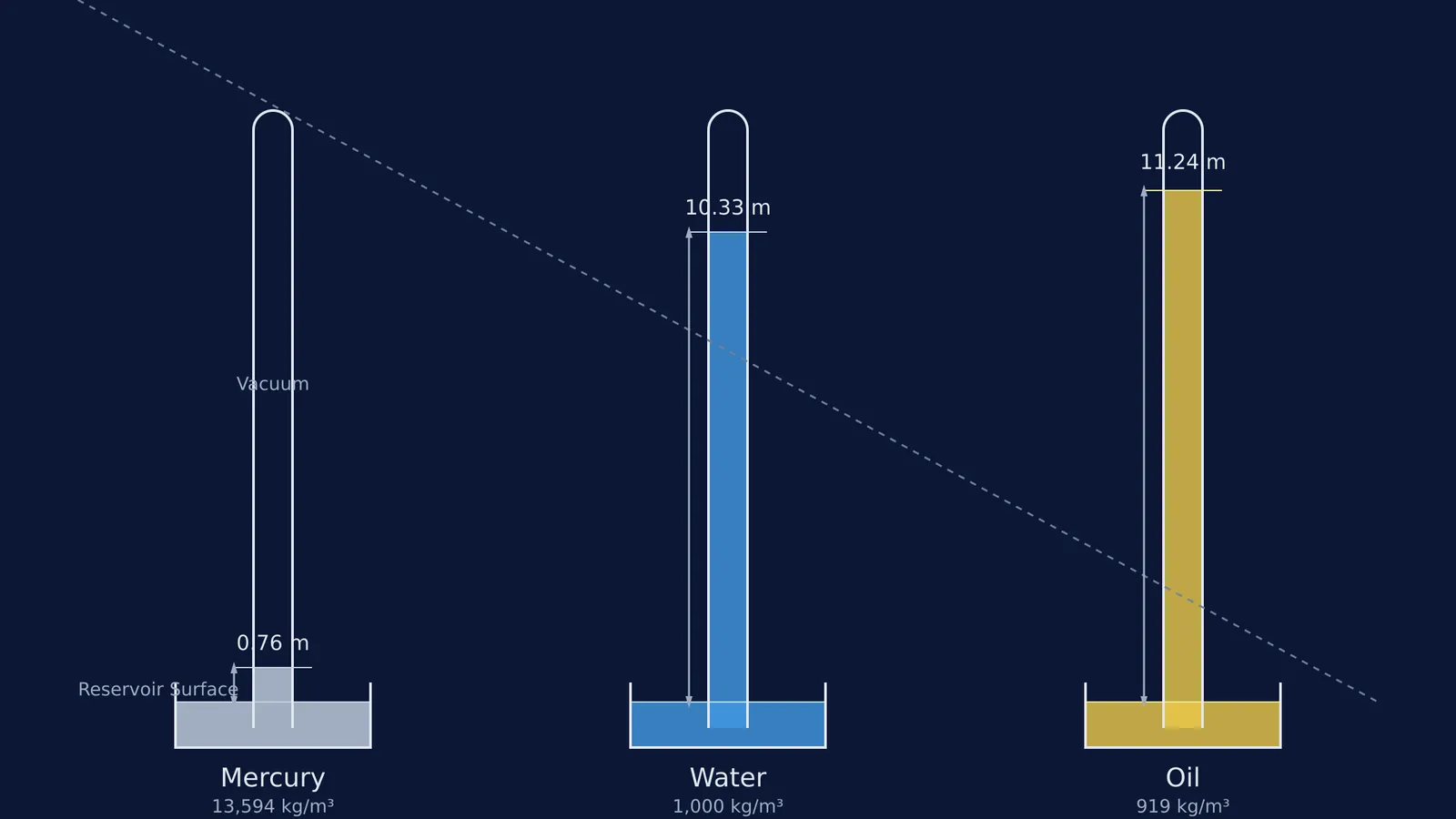
Here is how the density of the liquid dictates the height of a barometer, whether you choose to use mercury, water or common cooking oil.
What determines the height of a barometer?
A barometer works by balancing two opposing forces. The atmosphere pushes down on the open reservoir of liquid, forcing the liquid up into the sealed tube. Meanwhile, the weight of the liquid column inside the tube pushes back down. When these two pressures are perfectly equal, the liquid stops rising or falling. The empty space left at the top of the sealed tube is a vacuum (often called a Torricellian vacuum), meaning there is no air pressure pushing down from the inside.
The pressure exerted by a liquid column depends on three critical factors, connected by the hydrostatic pressure formula P = ρgh:
P is the pressure (measured in pascals).
ρ (rho) is the density of the liquid (measured in kg/m³).
g is the acceleration due to gravity (roughly 9.81 m/s²) on Earth).
h is the height of the liquid column (measured in metres).
Standard atmospheric pressure at sea level is defined as exactly 101,325 Pa). Because the atmospheric pressure (P) we are trying to measure and the pull of gravity (g) are constants, the height of the column (h) becomes inversely proportional to the liquid's density (ρ). In simple terms, a denser, heavier liquid requires a much shorter column to exert the same pressure as a lighter liquid.
Mercury is the only elemental metal that is liquid at standard room temperature, and it is extraordinarily dense. The standard density of mercury is 13,594 kg/m³ at 0 °C).
If we rearrange the hydrostatic formula to solve for the column height (h = P / ρg), we can find exactly how tall a mercury barometer needs to be: h = 101,325 / (13,594 × 9.81) h = 0.760 m (or 760 mm)
This fundamental relationship is why standard atmospheric pressure is still widely referred to in medicine and aviation simply as 760 mmHg.
Why would a water barometer be 10 m tall?
If you decide to replace the mercury in Torricelli's experiment with pure water, the underlying physics remains identical, but the practical numbers change drastically. According to the USGS, water reaches its maximum density of roughly 1,000 kg/m³ at 4 °C.
Because water is about 13.6 times) less dense than mercury, you inevitably need a column that is 13.6 times taller to exert the exact same downward pressure. By plugging the density of pure water into our rearranged formula, we can see the result:
h = 101,325 / (1,000 × 9.81) h = 10.33 m
A glass tube over 10 metres long is taller than a typical three-storey building. While a water barometer is perfectly functional in theory—and early scientists actually built them attached to the sides of their houses—it is entirely impractical to construct, read or house inside a modern laboratory.
If you are studying fluid mechanics for competitive exams, you will frequently need to calculate pressures across different fluids, much like solving problems involving two immiscible liquids in a manometer. If you find yourself stuck on these hydrostatic questions, the Fermi Problem Library has worked problems with a step-by-step solver that explains the reasoning rather than printing an answer.
What about a barometer made of oil?
What happens if we attempt the experiment using an even lighter liquid? Common household cooking oils, such as sunflower seed oil, have a density of roughly 919 kg/m³ at room temperature. Because oil is less dense than water (which is why oil always floats to the top of a puddle), an oil-based barometer would need to be even taller to register atmospheric pressure.
h = 101,325 / (919 × 9.81) h = 11.24 m
The fundamental principle remains beautifully consistent across all fluids. Whether you are attempting to lift a heavy car using Pascal's law in hydraulic machines or calculating the sheer height of a theoretical barometer, the pressure within a fluid always depends heavily on its specific density and its depth.
Visualising these invisible forces in fluids can be exceptionally tricky for students. That is where the Fermi Concept Library helps. It features every concept in physics, chemistry, biology, mathematics and computing, each with its own lesson and its place in the map, so you can immediately see how foundational principles like fluid density and atmospheric pressure connect.


