

On this page
Pump half the air out of a box and the air left inside still conducts heat almost exactly as well as before. Pump out 99% and, across a gap of a few millimetres, it still does. This surprises most students, and it is a genuine result of kinetic theory, first worked out by Maxwell. It also explains how one of the commonest vacuum gauges works. A Pirani gauge is just a thin heated wire in a tube, and it reads pressure only in the range where that rule breaks down.
Why doesn't the thermal conductivity of a gas depend on pressure?
Kinetic theory gives the thermal conductivity of a gas as roughly
k ≈ ⅓ n c v̄ λ
where n is the number of molecules per m³, c the heat capacity per molecule, v̄ the mean speed and λ the mean free path. Each molecule carries energy from a hotter layer to a cooler one, about one mean free path away.
Now halve the pressure at fixed temperature. n halves, so half as many molecules carry energy. But λ = kT/(√2 πd²p) doubles, as explained in the mean free path post, so each molecule carries energy twice as far. The product nλ does not change. v̄ and c depend only on temperature. So k is the same.
For air at 300 K, taking a molecular diameter d = 0.37 nm:
1 atm (101 kPa): λ = 67 nm.
1 kPa (1/100 atm): λ = 6.8 µm.
10 Pa: λ = 0.68 mm.
1 Pa: λ = 6.8 mm.
When does the rule break down?
The argument needs collisions: energy is handed from molecule to molecule across the gap. Once λ is longer than the space the heat has to cross, molecules fly straight from the hot surface to the cold one without hitting anything. Then each molecule carries a fixed amount of energy, and the heat flow is simply proportional to how many molecules arrive per second. That number is proportional to p.
This is the regime that matters for a vacuum flask. Taking "some air out" of the wall does nothing until λ is longer than the wall gap. For a gap of about 5 mm that means below roughly 1 Pa, a hundred-thousandth of an atmosphere. How the flask then stops conduction, convection and radiation together is covered in how a thermos flask keeps tea hot.
Around a very thin wire, the break happens much earlier. Heat leaving the wire must first cross a layer about one mean free path thick, where molecules leave the wire and fly off without collisions. When λ grows to about the wire's own thickness, that layer controls the heat flow, even if the tube is still crowded with gas.
How does a Pirani gauge measure pressure?
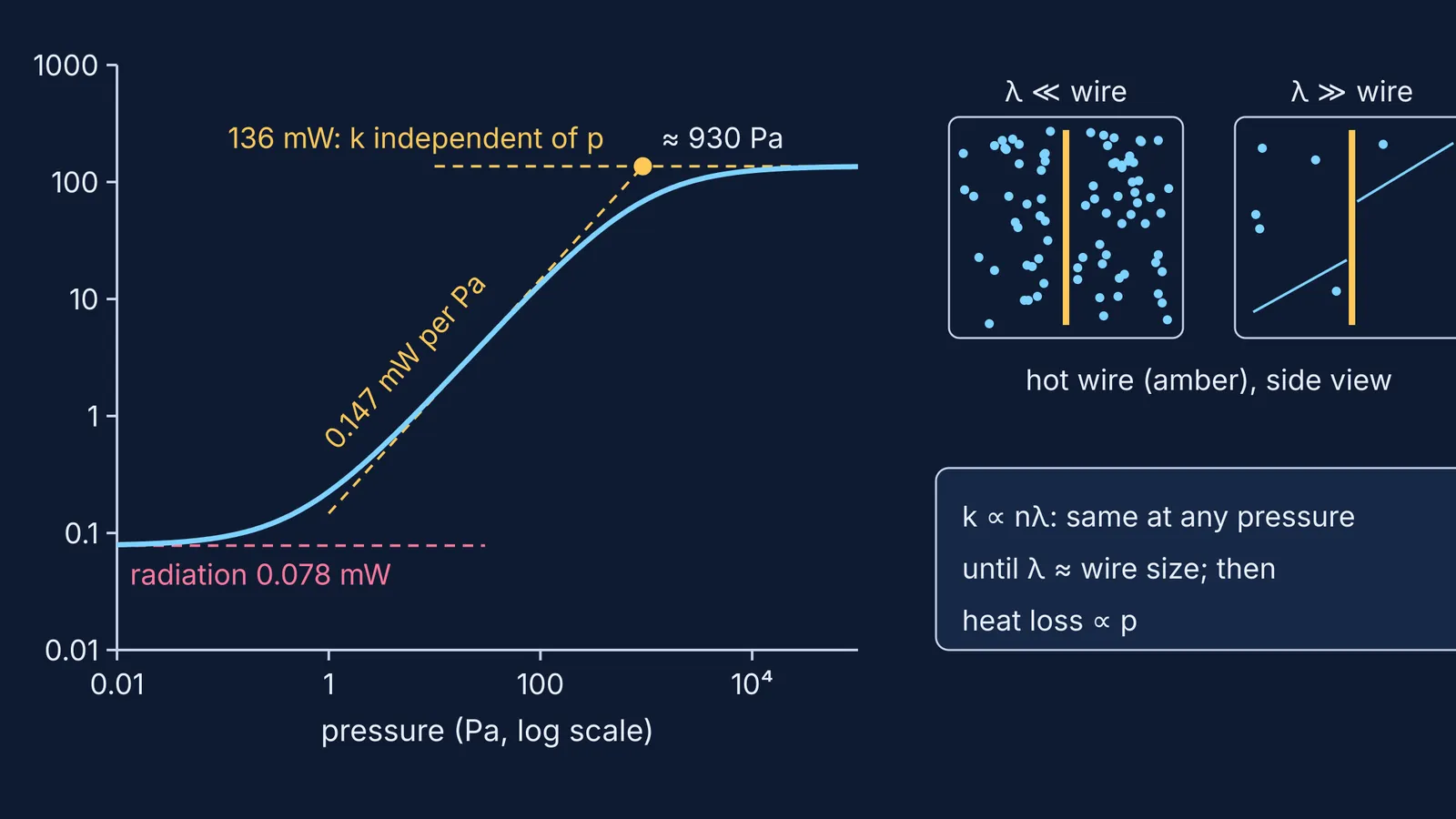
A Pirani gauge holds a fine metal wire at a fixed temperature above its surroundings and measures the electrical power needed to keep it there. That power equals the heat the wire loses. At low pressure the gas loss is proportional to p, so the power reads the pressure. At high pressure the loss stops changing, so the gauge has nothing to read.
Worked example: a hot wire in a tube
Illustrative gauge: a wire 10 µm across (radius a = 5 µm) and 5 cm long, inside a tube of radius b = 5 mm, held 100 K above the tube at 300 K. Air, molecular mass 28.97 u.
High-pressure limit. Heat flows by ordinary conduction through a cylindrical shell: Q = 2πkLΔT/ln(b/a). With k ≈ 0.030 W/m K for air near 350 K, ln(1000) = 6.91, Q = 2π × 0.030 × 0.05 × 100/6.91 = 0.136 W, or 136 mW. This does not depend on p.
Low-pressure limit: molecules hitting the wire. The number striking each m² per second is p/√(2πmkT). For air at 300 K this is 2.83 × 10²² per pascal.
Energy per molecule. A diatomic molecule that leaves the wire warmed by ΔT carries off about 3kΔT (2kΔT from its motion, kΔT from rotation), times an accommodation coefficient, taken as 0.8 for illustration. That is 0.8 × 3 × 1.38 × 10⁻²³ × 100 = 3.31 × 10⁻²¹ J.
Wire area. πdL = π × 10⁻⁵ × 0.05 = 1.571 × 10⁻⁶ m².
Heat loss per pascal. 2.83 × 10²² × 3.31 × 10⁻²¹ × 1.571 × 10⁻⁶ = 1.47 × 10⁻⁴ W, so 0.147 mW per Pa.
Top of the range. The two limits are equal when 0.147 mW × p = 136 mW, so p ≈ 930 Pa. There λ = 7.3 µm, about the wire's thickness, as the argument predicts. Above this the reading flattens.
Bottom of the range. The wire also radiates. With emissivity 0.05, εσ(T₁⁴ − T₀⁴)A = 0.05 × 5.67 × 10⁻⁸ × (400⁴ − 300⁴) × 1.571 × 10⁻⁶ = 0.078 mW. This equals the gas loss at 0.078/0.147 = 0.53 Pa. Below that, the pressure signal is a small change on top of a fixed background.
Check the units in step 5: m⁻² s⁻¹ Pa⁻¹ × J × m² = J/(s Pa) = W/Pa.
So this simple model gives a useful range from about 0.5 Pa to 1 kPa. Real gauges do better at both ends. MKS, a gauge maker, says a Pirani gauge loses accuracy below about 10⁻⁴ Torr (0.013 Pa) and becomes nonlinear from about 10 Torr (1.3 kPa) upward (MKS: thermal conductivity gauge physics). The low end is extended by compensating for radiation, end losses and room temperature. The high end is extended by convection-enhanced designs, which use natural convection in the tube to keep a signal up to atmosphere; INFICON lists 1.3 × 10⁻⁴ to 1333 mbar for nitrogen on its PGE300 (INFICON PGE300 specifications).
If you want to see mean free path change as you pump a chamber down, the Simulation Lab has interactive simulations for ideas that are easier to see than read.
Why does a Pirani gauge read differently in different gases?
The low-pressure heat loss depends on how many molecules hit the wire and how much energy each carries away. Both depend on the gas. Lighter molecules strike more often (the arrival rate goes as 1/√m), and molecules with more internal motion carry more energy each. So helium and argon at the same pressure give different readings. MKS notes that gauges are normally calibrated for nitrogen and need correction curves for other gases. A Pirani reading in an unknown gas is only an estimate.
Quick checklist
k ≈ ⅓ n c v̄ λ, and nλ is constant, so k does not depend on pressure.
That holds while λ is much smaller than the gap or wire size.
When λ is larger, heat flow is proportional to p: the Pirani regime.
Illustrative wire: 136 mW at high pressure, 0.147 mW per Pa at low pressure, crossover near 930 Pa.
Radiation sets the lower floor in the simple model, near 0.5 Pa.
Readings depend on the gas; gauges are calibrated for nitrogen.


