

On this page
Boyle's law is Section B experiment 3 in CBSE's Class 11 physics practicals: "To study the variation in volume with pressure for a sample of air at constant temperature by plotting graphs between P and V, and between P and 1/V" (CBSE Physics curriculum 2026-27). In the exam you perform two experiments worth 7 marks each, and the viva carries 5 of the 30 marks (same CBSE document).
What does a Boyle's law apparatus measure?
Boyle's law states that the pressure of a fixed mass of gas is inversely proportional to its volume when the temperature stays the same (Boyle's law, Wikipedia).
The school apparatus has a closed, graduated tube A holding trapped air and a second tube B, with mercury joining the two, mounted on a vertical wooden board beside a scale. You raise or lower tube B to squeeze or expand the air (BYJU'S practical guide). At each step you take two readings:
Air column length l: from the closed end of tube A to the mercury surface. The bore is uniform, so V = a × l, and l stands in for volume (Newton Classes practical notes).
Pressure head h: the vertical difference between the mercury levels in the two tubes, read with a set square.
Boyle himself used a glass tube full of mercury nearly 2.5 m long, which sometimes broke, and reported his data as columns of complex fractions, not a graph (West, Journal of Applied Physiology, 1999).
How do you calculate pressure from the pressure head?
The trapped air is pressed on by the atmosphere plus any extra mercury above its level. So P = H + h when the mercury in the open tube stands higher than in the closed tube, and P = H − h when it stands lower. H is atmospheric pressure: read the lab barometer at the start and end and use the mean (BYJU'S). Keep everything in cm of mercury; for that unit, see why a water barometer would be 10 metres tall.
Worked example: from readings to a P against 1/V graph
Suppose your barometer reads H = 76.0 cm of Hg. These six readings are sample numbers to show the method, not real lab results (P in cm of Hg, 1/l per cm).
h = −16.0, l = 25.3: P = 60.0, 1/l = 0.0395, P × l = 1518
h = −8.0, l = 22.4: P = 68.0, 1/l = 0.0446, P × l = 1523
h = 0, l = 20.0: P = 76.0, 1/l = 0.0500, P × l = 1520
h = +8.0, l = 18.1: P = 84.0, 1/l = 0.0552, P × l = 1520
h = +16.0, l = 16.5: P = 92.0, 1/l = 0.0606, P × l = 1518
h = +24.0, l = 15.2: P = 100.0, 1/l = 0.0658, P × l = 1520
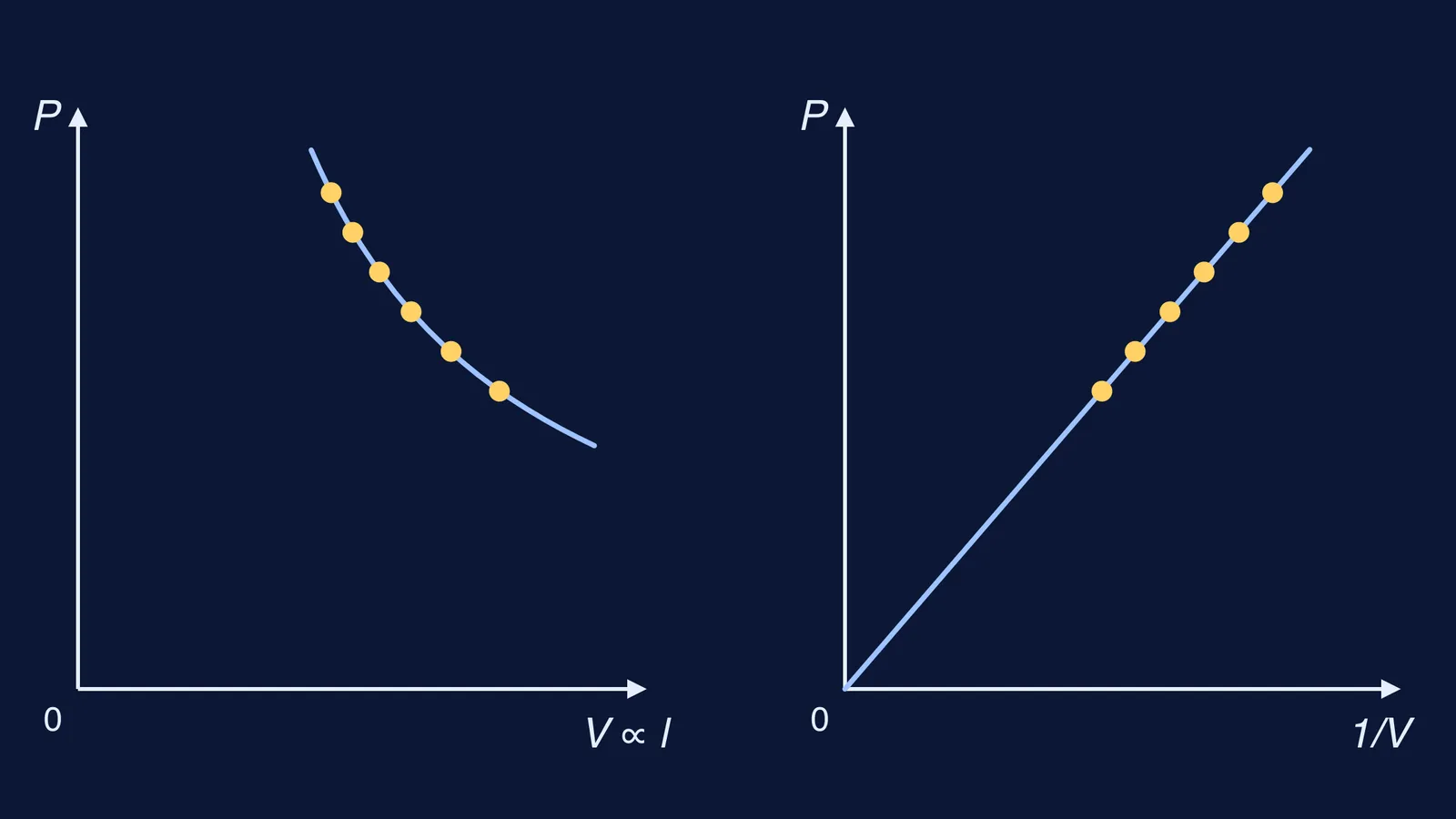
P × l stays within about 3 of 1520, so PV is constant within reading error. Plot P on the y-axis against 1/l: the points fall on a straight line through the origin, and its slope is that same constant. P against l gives a rectangular hyperbola, like the graph of y = 1/x.
Quote 1/l to three significant figures, matching a metre scale reading.
Why does my P against 1/V graph not pass through the origin?
You plotted h instead of P. Since P × l is a constant k, h = P − H = k/l − H, so a graph of h against 1/l is still straight but cuts the vertical axis at −H. That intercept is your atmospheric pressure.
You measured l from the wrong point, such as the outer end of the glass, adding the same length to every reading. That bends the line and pulls it off the origin.
The temperature drifted. Holding tube A or rushing warms the air, so wait a minute after each move. Moist or impure air in tube A is another listed source of error (BYJU'S).
What should you say in the viva?
Why keep temperature constant? The law holds only for a fixed mass of gas at fixed temperature.
Why plot P against 1/V? A straight line is easier to judge by eye than a hyperbola.
Why use length for volume? The bore is uniform, so V = a × l.
Why a set square? To read the mercury level at eye level and avoid parallax.
If signs and units in gas-law numericals still trip you up, the Fermi Problem Library has worked problems with a step-by-step solver that explains the reasoning rather than printing an answer. For the theory behind the law, the Fermi Concept Library gives each physics concept its own lesson and its place in the map.
On practical day: write H atop your table, sign every h, and check P × l before plotting.


