

On this page
Punch a small hole near the bottom of a bottle of water and the jet starts strong, then weakens as the level falls. Now seal the top with a stopper and push an open tube through it, down into the water. The jet runs at one steady rate until the water level reaches the bottom of the tube. This is the Mariotte bottle, and it shows something students often get wrong: the flow is set by the pressure just inside the hole, not simply by how much water is above it.
Why does flow from an open bottle slow down?
Torricelli's law gives the jet speed from a hole a height h below an open water surface: v = √(2gh). The flow rate is Q = C_d a √(2gh), where a is the hole's area and C_d, the discharge coefficient, allows for the jet narrowing just after the hole (about 0.62 for a small sharp-edged hole). As the bottle drains, h falls, so v and Q fall with it. Working out how long that takes, step by step, is covered in the time taken to empty a tank through a small hole.
How does a Mariotte bottle keep the flow steady?
The bottle is sealed except for two openings: the outlet hole near the bottom, and an open tube through the stopper whose lower tip sits a height h above the outlet.
Water leaves. The volume above the water, a pocket of trapped air, grows a little, so its pressure drops below atmospheric.
Air comes in through the tube. Once the pressure at the tube's tip falls just below atmospheric, outside air pushes down the tube and bubbles out of the tip. Each bubble rises into the air pocket.
The tip stays at atmospheric pressure. While bubbles are coming in, the pressure at the level of the tube's tip is P₀, the atmospheric pressure.
The outlet sees a fixed head. The outlet is a depth h below the tip, in still water, so the pressure just inside it is P₀ + ρgh. Outside it is P₀. The jet therefore behaves exactly as if it came from an open tank with water standing h above the hole, whatever the actual water level.
The air pocket does the adjusting. Its pressure is P₀ − ρg(H − h), where H is the height of the water surface above the outlet. When the bottle is full, the pocket is well below atmospheric; as the level drops, the pocket's pressure rises towards P₀.
A paper in The Physics Teacher, measuring hydraulic coefficients with a Mariotte bottle and a smartphone, describes it as a device that delivers a constant flow rate because of the constant pressure inside the bottle. Soil scientists use the same trick to feed water at a steady head into the ground, as in this University of Florida guide to building a Mariotte constant-head infiltrometer.
Worked example: sealed bottle against open bottle
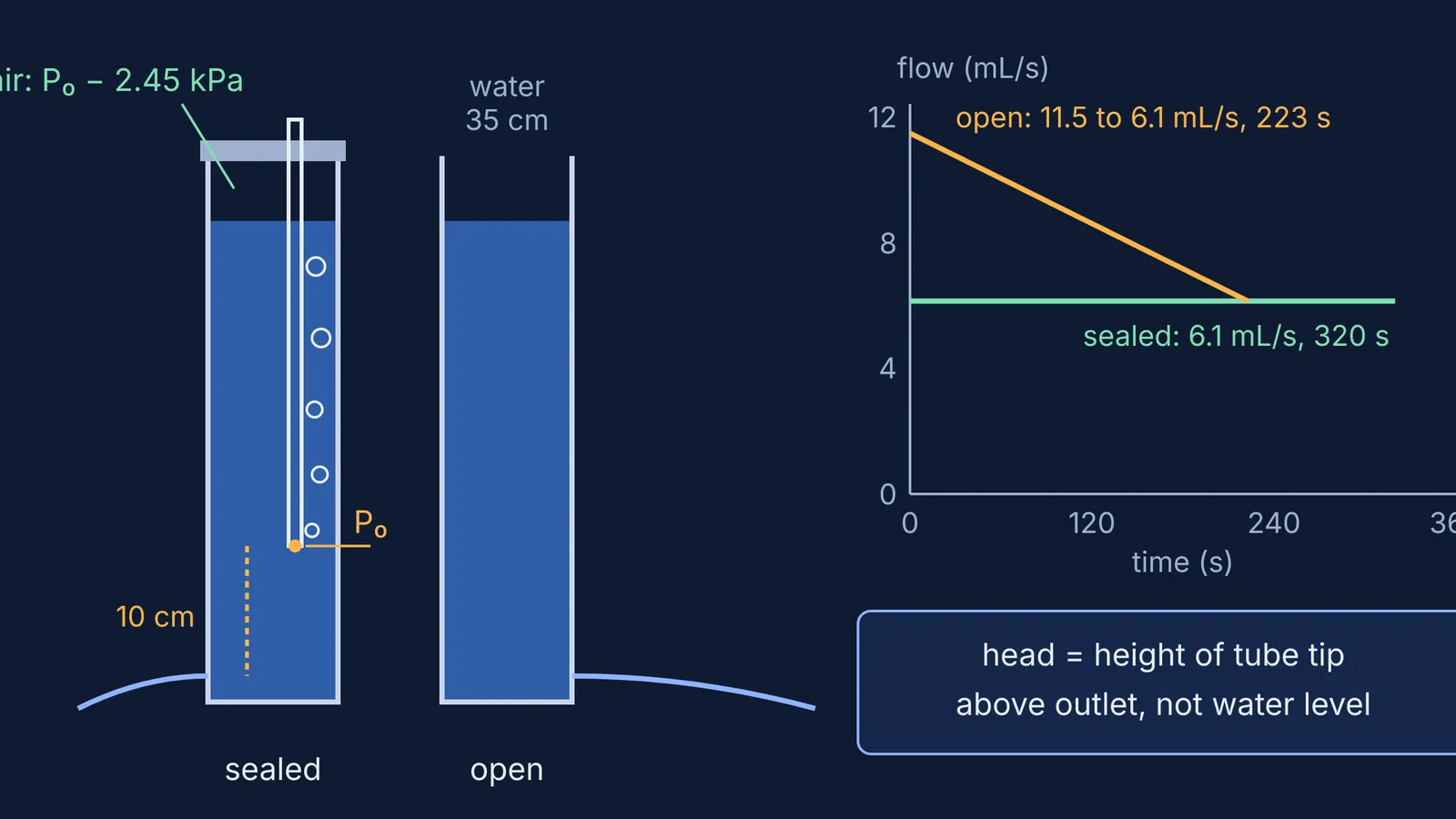
Take a bottle 10 cm across, with a 3 mm hole in its side near the bottom. The water starts 35 cm above the hole and we stop when it is 10 cm above the hole. Use C_d = 0.62 and g = 9.81 m/s².
Areas. Bottle: A = π × 0.05² = 7.85 × 10⁻³ m². Hole: a = π × 0.0015² = 7.07 × 10⁻⁶ m². The bottle is 1,111 times wider in area, so the falling surface moves slowly and we can ignore its speed.
Volume delivered. V = A × (0.35 − 0.10) = 1.96 × 10⁻³ m³ = 1.96 L.
Sealed bottle, tube tip at 10 cm. The head is always 0.10 m. Ideal jet speed √(2 × 9.81 × 0.10) = 1.40 m/s. Flow Q = 0.62 × 7.07 × 10⁻⁶ × 1.40 = 6.14 × 10⁻⁶ m³/s = 6.1 mL/s, from start to finish.
Time for the sealed bottle. 1,963 mL ÷ 6.14 mL/s = 320 s, about 5.3 minutes.
Air pocket at the start. The water surface is 0.25 m above the tube's tip, so the pocket is at P₀ − 1,000 × 9.81 × 0.25 = P₀ − 2.45 kPa.
Open bottle at the start. The head is 0.35 m: Q = 0.62 × 7.07 × 10⁻⁶ × √(2 × 9.81 × 0.35) = 11.5 mL/s.
Open bottle at the end. At 0.10 m it is down to 6.1 mL/s, the same as the sealed one.
Time for the open bottle. Using t = (A ÷ C_d a) × √(2/g) × (√h₁ − √h₂): 1,792 × 0.4515 × (0.5916 − 0.3162) = 223 s, about 3.7 minutes.
The open bottle finishes first, because for most of the time its head is bigger than 0.10 m. Its flow falls from 11.5 to 10.0 mL/s in the first minute, then to 8.6 and 7.2 mL/s after two and three minutes. The sealed bottle is not faster. It is steady, and you set its rate by sliding the tube up or down. Raise the tip to 20 cm and the flow becomes 8.7 mL/s.
When does the trick stop working?
When the water reaches the tip. After that no more air bubbles in at the tip, the air pocket is at P₀, and the bottle drains like an open one, slowing as before.
If the stopper leaks. Air then enters at the top, the pocket stays near atmospheric pressure, and the head is once more the full water level.
Bubbles come in bursts. A bubble forming at a narrow tip has a pressure about 2γ/r above the water around it. For a tip of radius 2 mm and γ = 0.072 N/m, that is 72 Pa, about 7 mm of water. The pressure at the tip wobbles by up to this much as each bubble forms, so the flow pulses a little.
How is this different from an overflow or a pressurised tank?
An ancient water clock kept its head steady another way: water was fed in faster than it left, and the extra spilled over a fixed edge, as in Ctesibius's water clock. That needs a supply. The Mariotte bottle needs none; it holds the head steady by letting the air pressure above the water fall.
A tank with compressed air above the water is the opposite case. There the gas is above atmospheric, which speeds the jet up, as worked out in the speed of efflux from a tank with pressure above the liquid. In the Mariotte bottle the gas is below atmospheric, by exactly enough to cancel the extra water above the tube's tip.
If you want to see how a falling head changes the jet, the Simulation Lab has interactive simulations for fluid ideas that are easier to see than read.
Quick checklist
Open bottle: head = water level, so the flow falls as it drains.
Mariotte bottle: head = height of the air tube's tip above the outlet, so the flow stays steady.
The air pocket sits at P₀ − ρg(H − h); 2.45 kPa below atmospheric for 25 cm of water above the tip.
Q = C_d a √(2gh): 6.1 mL/s for a 3 mm hole under 10 cm, against 11.5 mL/s under 35 cm.
The stopper must be airtight, and the steady flow ends when the water reaches the tip.


