

On this page
Ctesibius of Alexandria (285–222 BC) was a Greek inventor and mathematician whose work turned simple observations of air and water into reliable, automated machines. Living in the intellectual powerhouse of Ptolemaic Egypt, he was likely the first head of the famous Museum of Alexandria. Often called the father of pneumatics, Ctesibius wrote the earliest known treatises on the science of compressed air and its uses in engineering. Although his original texts are lost to history, his two most famous inventions—the regulated water clock and the force pump—survived and laid the groundwork for modern fluid dynamics.
How did Ctesibius improve the water clock?
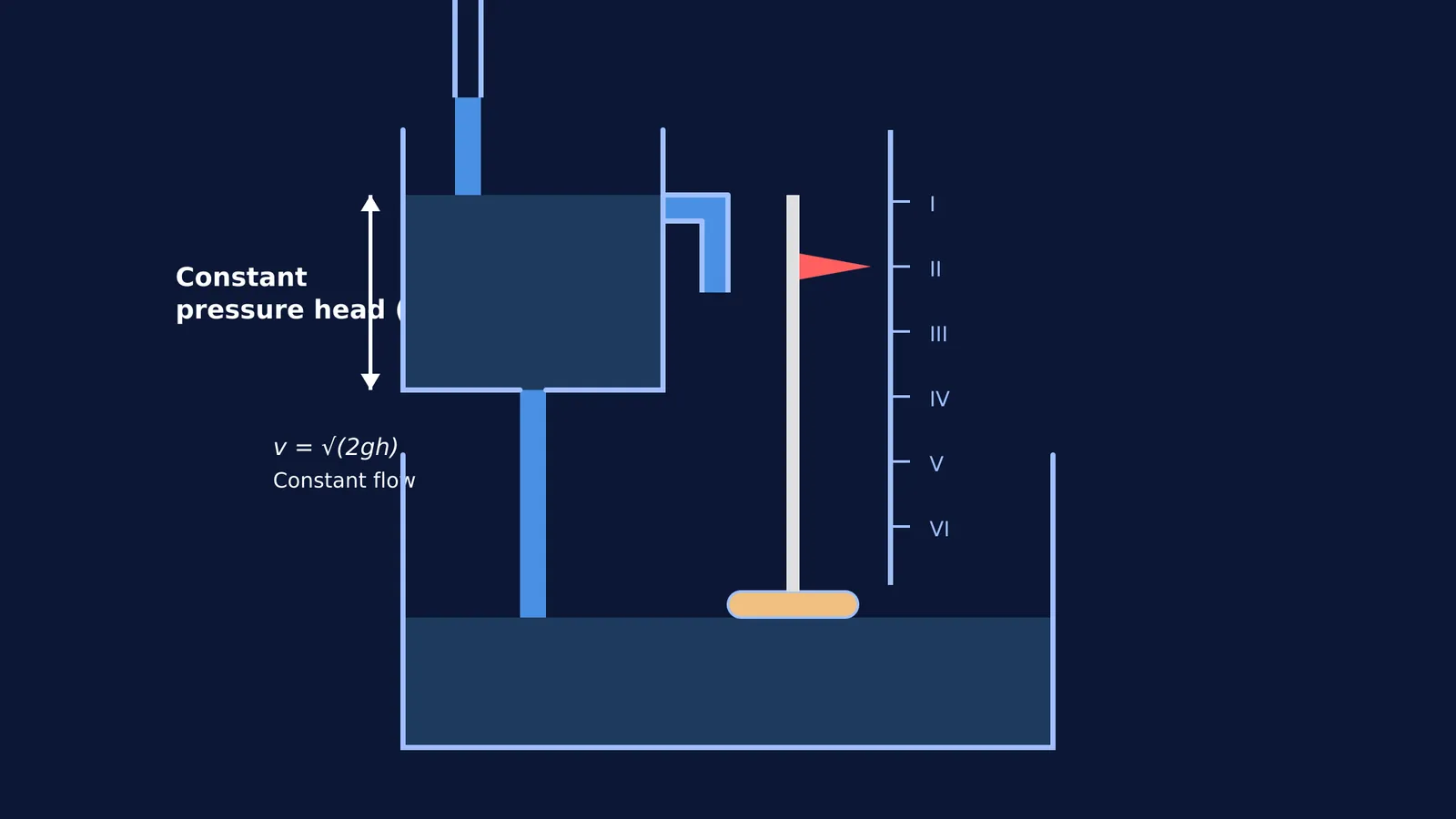
Before Ctesibius, tracking time accurately without the Sun was a difficult problem. The standard tool was a water clock, or clepsydra, which was essentially a bowl with a small hole drilled in the bottom. As the bowl emptied, the water level dropped. Because the pressure at the bottom depends on the height of the fluid above it, this dropping water level meant the water flowed out more and more slowly over time. This non-linear flow made early water clocks inherently poor and frustrating timekeepers.
Ctesibius solved this by introducing the earliest known feedback control system (Wikipedia) . He added an upper reservoir that received a continuous, generous supply of water from a spring or pipe. To prevent the water level from changing, he installed an overflow pipe in the upper reservoir. Because this tank was always completely full and overflowing slightly, the depth of the water (the pressure head) never changed.
This simple but brilliant fix meant the pressure at the bottom hole remained exactly the same, forcing water to drip into a lower, main tank at a perfectly steady, unvarying rate.
To display the time, Ctesibius placed a float made of cork or lightweight wood on the surface of the water in the lower tank. As the lower tank filled at a constant speed, the float rose steadily. The float was connected to a vertical rod equipped with a pointer. This pointer tracked the passing hours by moving along a fixed, vertical scale. Thanks to this constant-flow innovation, Ctesibius's clepsydra remained the most accurate timekeeping device in the world for over 1,800 years, unsurpassed until the invention of the pendulum clock in 1656 (Wikipedia) .
If you find it hard to picture how fluid pressure, liquid height, and flow velocity balance each other out, the Fermi Simulation Lab lets you adjust the pressure head of a liquid tank and watch how the exit flow rate responds in real time.
How does a force pump work?
Beyond tracking time, Ctesibius applied his understanding of pressure to moving liquids, resulting in the invention of the first positive displacement force pump (Wikipedia) . While earlier ancient devices like the Archimedes screw could lift water, they were limited in how high they could push it and relied on open, unpressurised channels.
Ctesibius's force pump used a solid plunger (or piston) that reciprocated inside a tight-fitting hollow cylinder.
The upstroke: As the plunger is pulled upward, it increases the volume inside the cylinder, creating a partial vacuum. This low pressure pulls an inlet valve open, drawing water up from a well or reservoir into the cylinder chamber.
The downstroke: As the plunger is pushed back down, the pressure inside the cylinder spikes. The inlet valve snaps shut under the pressure, while an outlet valve is forced open. The trapped liquid has nowhere to go but out through the discharge pipe.
Because the force pump moves water mechanically by reducing the chamber's volume, it can push liquids to great heights and compress fluids over a wide range of pressures without a drop in flow rate (Wikipedia) . This made it an essential engineering tool for firefighting and deep-well water extraction across the ancient Roman Empire.
The first pipe organ
Ctesibius didn't stop at pumping water; he combined his force pump with his knowledge of pneumatics to invent the hydraulis, the world's first pipe organ. In this instrument, a force pump pushed air into a large chamber partially filled with water. The weight of the water provided a perfectly steady pressure to the air, which was then directed through a keyboard into various pipes to create sound. The hydraulis was the direct ancestor of the modern church organ, demonstrating how beautifully Ctesibius could blend fluid mechanics with musical engineering.
Why does ancient fluid engineering matter today?
The mechanisms Ctesibius developed in the 3rd century BC are still everywhere around us. The float valve that measures water volume to prevent overflowing is the direct ancestor of the mechanism inside every modern toilet tank. Meanwhile, the reciprocating piston in his force pump operates on the exact same thermodynamic principles as the pistons inside modern car engines and industrial compressors.
When students tackle problems involving fluid dynamics, Pascal's law, or the work done by an expanding gas in a cylinder, they are calculating the exact relationships between pressure, volume, and force that Ctesibius first harnessed. If you are struggling to set up these equations or balance the forces, Fermi's AI tutor can work out what you already know and build a plan for the session, guiding you step-by-step through the physics without simply handing you the final answer.
Read more about how later engineers built upon these water-driven mechanisms in Su Song and the water-driven astronomical clock tower, Jang Yeong-sil, Joseon's water clock and the 1441 rain gauge, and the broader principles of enclosed fluids in Pascal's law in hydraulic machines: lifting a car with a small push.


