

On this page
Have you ever noticed that a draining water cooler or a punctured bucket empties quickly at first, but slows to a trickle at the end? The changing rate of flow isn't an illusion. It is a classic problem in kinematics and fluid dynamics.
By combining the physics of a falling object with the geometry of the container, we can predict exactly how long the tank takes to empty.
What is Torricelli's law?
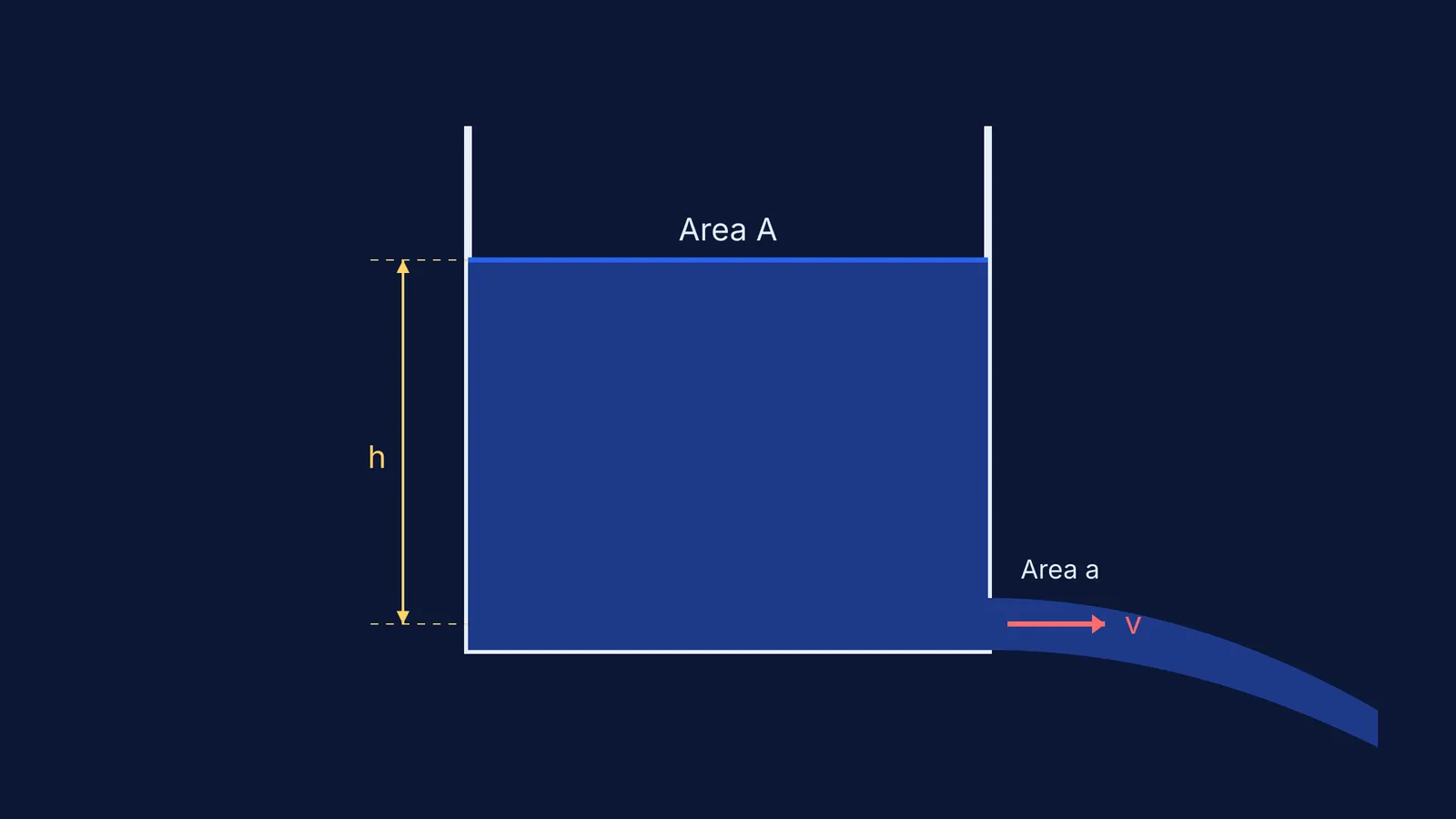
In 1643, Evangelista Torricelli discovered that water leaving a small hole at the bottom of a tank behaves just like an object falling freely through the air. According to Torricelli's theorem, the speed (v) of a fluid flowing out of a small hole is the same as the speed it would reach if it fell from the height of the fluid's surface.
As detailed in OpenStax University Physics, this is a direct result of Bernoulli's equation. Assuming the tank is open to the atmosphere and its top surface area is much larger than the hole, the exit speed is:
v = √(2gh)
Here, g is the acceleration due to gravity (9.80 m/s²) and h is the instantaneous height of the water above the hole.
Because the exit speed depends on the height h, the water flows fastest when the tank is full.
How to calculate the time taken to empty a tank through a small hole?
To find the total time T to empty the tank, we balance the rate at which water leaves the hole with the rate at which the water level drops inside the tank.
Let the tank have a constant cross-sectional area A, and the hole have an area a. If the water level drops by a tiny amount dh in a time interval dt, the volume lost from the tank is A × dh. This must equal the volume flowing out of the hole, which is the hole's area times the flow speed (a × v × dt).
This gives us the continuity equation:
-A × (dh/dt) = a × √(2gh)
To find the time, we separate the variables and integrate from the initial height H down to 0:
dt = -(A / (a × √(2g))) × h^(-1/2) dh
Integrating both sides yields the theoretical time taken to empty the tank:
T = (A / a) × √(2H / g)
This result tells us two things. First, the time scales with the ratio of the areas (A/a). Second, the time is directly proportional to the square root of the initial height (√H).
In the real world, friction and the pinching of the water stream (the *vena contracta*) slow the flow down. Engineers adjust the formula by adding a discharge coefficient (Cd or μ). As noted on Wikipedia, for a typical round hole in a thin-walled tank, this coefficient is approximately 0.65, meaning the real flow is only 65% of the theoretical ideal.
Why does the last half of the tank take longer?
Because the emptying time depends on the square root of the height, the tank does not drain at a steady rate.
We can split the drainage into two phases using the integration rules described above: the top half (from H down to H/2) and the bottom half (from H/2 down to 0). Using the time formula, the time T₁ to drain the top half is:
T₁ = (A / a) × √(2 / g) × (√H - √(H/2)) ≈ 0.293 × T
The time T₂ to drain the bottom half is:
T₂ = (A / a) × √(2 / g) × (√(H/2) - 0) ≈ 0.707 × T
The second half takes about 2.4 times longer than the first half, as a consequence of Torricelli's law. When the water level is low, the "push" (pressure) at the bottom is weak, reducing the exit velocity and stretching out the final drips.
If setting up the limits of integration or separating variables trips you up, the Fermi Problem Library has worked problems with a step-by-step solver that explains the reasoning rather than printing an answer. You can also review the broader rules of fluid dynamics in the Fermi Concept Library to see how these equations connect to Bernoulli's principle.
For more on how fluids and gravity interact, see our guides on Pascal's law in hydraulic machines and calculating the horizontal projectile from a cliff to see where the water goes once it leaves the tank.


