

On this page
What happens to Torricelli's law when a tank is pressurized?
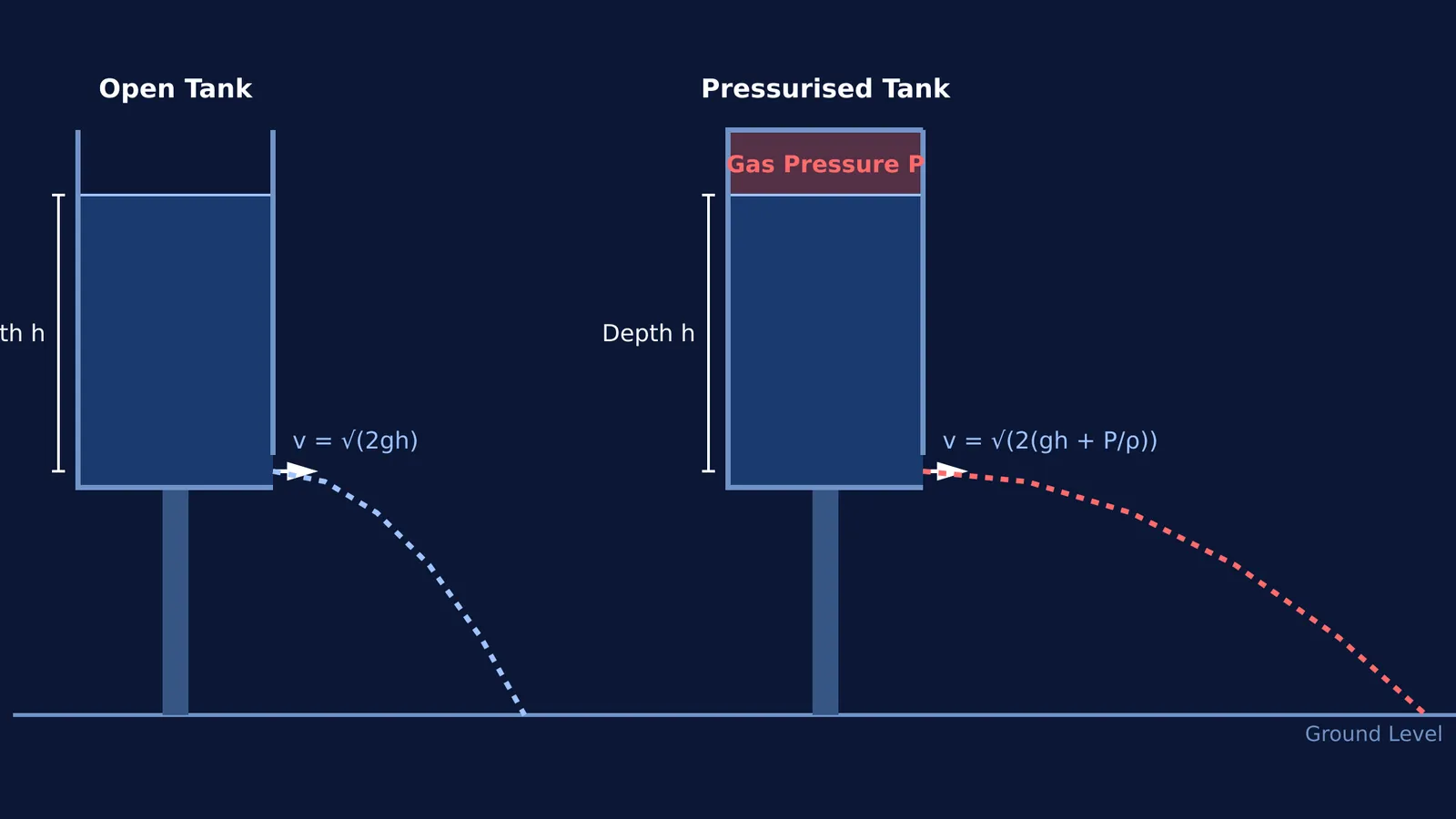
In 1643, Italian mathematician Evangelista Torricelli proved that liquid flowing under gravity from an open tank exits at a speed of v = √(2gh), where g is gravitational acceleration and h is the depth below the surface (Britannica). Torricelli's law states that the efflux speed from an open container equals the speed a body acquires in free fall from height h.
To achieve high discharge velocities in compact equipment, engineers seal the vessel and pressurize the gas above the liquid. As detailed in our guide to pressure at depth and gauge pressure, fluid transmits applied surface pressure throughout the volume. Adding gauge pressure P above the liquid creates an artificial head, raising the efflux speed to v = √(2(gh + P/ρ)).
How do you derive the efflux formula using Bernoulli's equation?
The derivation applies Bernoulli's principle along a streamline from the liquid surface (Point 1) to the orifice (Point 2) (OpenStax University Physics). Bernoulli's equation equates total mechanical energy per unit volume across these points.
By continuity, A₁v₁ = A₂v₂. Because the tank cross-section A₁ is far larger than the orifice A₂ (A₁ ≫ A₂), surface velocity is negligible (v₁ ≈ 0). At the top surface, absolute pressure is P_top = P_atm + P (where P is gauge pressure) at height y₁ = h. At the exit hole (y₂ = 0), fluid emerges at atmospheric pressure P_atm with speed v:
(P_atm + P) + ρgh = P_atm + ½ρv²
Subtracting P_atm and solving for v yields the general efflux equation:
v = √(2(gh + P/ρ))
The ratio P/(ρg) represents the equivalent pressure head. When mapping fluid streamline theorems to problem setups, the Fermi Concept Library has every concept in physics, chemistry, biology, mathematics and computing, each with its own lesson and its place in the map, demonstrating how pressure heads combine with gravitational potential energy.
Worked example: how much faster is a pressurized spray?
Consider a sprayer holding water (density ρ = 1000 kg/m³, g = 9.8 m/s²) with liquid depth h = 0.4 m (40 cm) above the nozzle.
Open tank (gravity only):
v_open = √(2 × 9.8 m/s² × 0.4 m) = √(7.84 m²/s²) = 2.80 m/s.
Pressurized tank:
The chamber is pumped to an operating gauge pressure P = 1.72 bar, or 1.72 × 10⁵ Pa (172 kPa), corresponding to 25 psi, typical for agricultural sprayers (Iraqi Journal of Agricultural Sciences). Pressure term: P/ρ = 172,000 / 1000 = 172 J/kg. Gravity term: gh = 9.8 × 0.4 = 3.92 J/kg. v_pressurized = √(2 × (3.92 + 172)) = √(351.84) ≈ 18.76 m/s.
The top gauge pressure boosts the efflux speed from 2.80 m/s to 18.76 m/s, a 6.7-fold increase that raises kinetic energy from 3.92 J/kg to 175.92 J/kg—a 45-fold leap. As covered in our review of fluid mechanics and Bernoulli mistakes, keeping density in the denominator prevents common errors. At a launch height of 0.45 m, horizontal landing range expands from 0.85 m to 5.68 m (horizontal projectile from a cliff).
Where do sprayers and fire extinguishers use this principle?
In agricultural knapsack sprayers, pneumatic pressure dominates the hydrostatic term (172 J/kg versus 3.92 J/kg). Because top pressure provides over 97% of the driving head, exit speed stays steady as liquid level falls from 40 cm to 5 cm, maintaining a uniform spray pattern instead of a fading dribble.
Stored-pressure fire extinguishers rely on this principle for fire protection standards. A portable water extinguisher is pressurized with nitrogen to a high operating service pressure. This massive P/ρ term drives water out at great speed, allowing the extinguisher to cast a jet across a room to quench flames from a safe standoff distance. Similarly, in water-rocket toys, compressed air expels water at high efflux speed to generate thrust (American Journal of Physics).
For students mastering multi-concept physics problems that unite fluid dynamics with thermodynamics and kinematics, the Fermi Problem Library provides worked problems with a step-by-step solver that explains the reasoning rather than printing an answer.


