

On this page
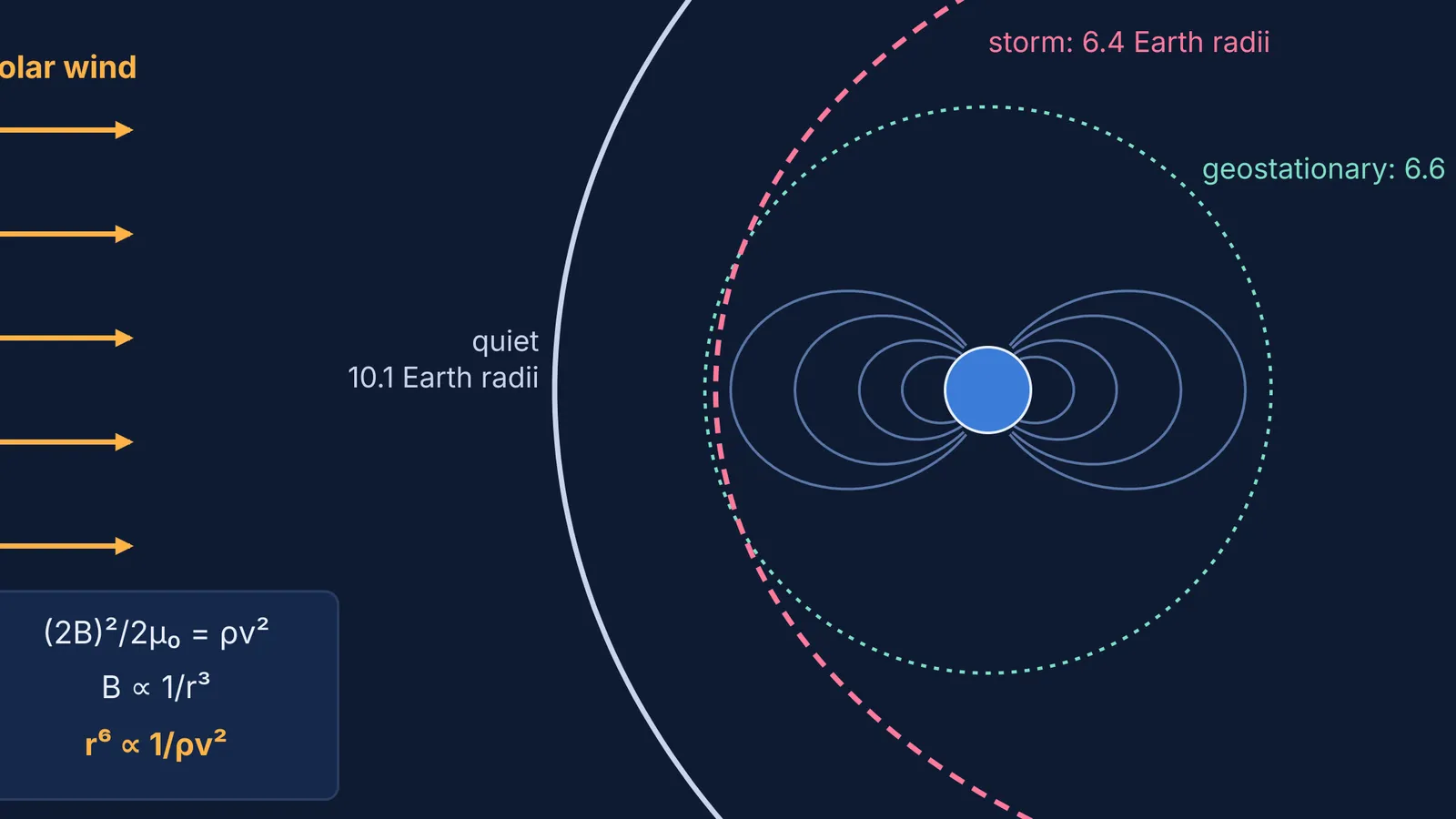
The Sun blows a thin wind of protons and electrons past the Earth at hundreds of kilometres per second. Earth's magnetic field pushes back. Where the two pressures balance, there is a boundary called the magnetopause, and on the side facing the Sun it sits about ten Earth radii away. You can estimate that distance with two formulas from Class 12 magnetism and one from Class 11 fluids. The same calculation shows why a strong solar storm can push the boundary inside the orbit of geostationary satellites, and why it is surprisingly hard to push it much further.
What is the magnetopause?
The solar wind is a plasma. It conducts electricity so well that it cannot easily cross magnetic field lines, and Earth's field cannot easily enter it. So the wind flows around the field instead of through it, and the field is confined in a cavity, the magnetosphere. The surface of that cavity is the magnetopause.
On the dayside the cavity is squashed. On the nightside it is stretched into a long tail, so the magnetopause is not a sphere. The point nearest the Sun, the nose or subsolar point, is the one with a simple estimate. NASA's ISTP educational pages by David Stern (NASA Goddard) put it at about 10.5 Earth radii (Rₑ) from Earth's centre, and note that a few times a year it is pushed past the synchronous orbit at 6.6 Rₑ.
Where the wind itself comes from, and why it is supersonic, is the story of Eugene Parker and the solar wind.
How much pressure does the solar wind exert?
When a stream of particles of density ρ moving at speed v is stopped or turned aside, it delivers momentum flux ρv². That is its dynamic pressure.
The density is usually quoted as a number of protons per cubic centimetre. Watch the units: 1 cm⁻³ = 10⁶ m⁻³. For a quiet wind with 5 protons per cm³ at 400 km/s:
ρ = 5 × 10⁶ m⁻³ × 1.673 × 10⁻²⁷ kg = 8.36 × 10⁻²¹ kg/m³
ρv² = 8.36 × 10⁻²¹ × (4 × 10⁵)² = 1.34 × 10⁻⁹ Pa = 1.34 nPa
This ignores the helium ions and electrons in the wind, so it is a slight underestimate. It is about 10⁻¹⁴ of atmospheric pressure (1.01 × 10⁵ Pa), yet it shapes the whole magnetosphere.
How strong is Earth's field out there?
Treat Earth as a magnetic dipole. At the magnetic equator on the surface its field is B₀ ≈ 3.0 × 10⁻⁵ T: the dipole terms of the International Geomagnetic Reference Field (IGRF-14, NOAA NCEI) for 2025 give 2.97 × 10⁻⁵ T.
A dipole field falls as the inverse cube of distance. In the equatorial plane, B = B₀(Rₑ/r)³.
A magnetic field exerts a pressure B²/2μ₀. The same pressure holds a lifting magnet to a steel plate, as in how many tonnes a scrap-yard lifting magnet can hold. Because B goes as 1/r³, the magnetic pressure goes as 1/r⁶. That sixth power controls everything that follows.
Why does the field count double at the boundary?
Currents flow on the magnetopause surface, called Chapman–Ferraro currents. Inside the boundary they add to Earth's field; outside they cancel it. In the simplest flat-boundary model, the field just inside the nose is twice the dipole value, 2B. A three-dimensional model by Mead raises the factor to about 2.44. Both values are given by Pudovkin, Besser and Zaitseva (Annales Geophysicae, 1998), who also note that a southward interplanetary field brings the magnetopause 0.5 to 1.5 Rₑ closer. So any simple answer is an estimate.
Worked example: where is the nose on a quiet day and in a storm?
Set the magnetic pressure just inside the boundary equal to the wind's dynamic pressure, with the factor of 2:
(2B)²/2μ₀ = ρv², with B = B₀(Rₑ/r)³
So 2B₀²(Rₑ/r)⁶/μ₀ = ρv²
r/Rₑ = [2B₀²/(μ₀ρv²)]^(1/6)
Quiet day (5 cm⁻³, 400 km/s, ρv² = 1.34 nPa):
2B₀²/μ₀ = 2 × (2.97 × 10⁻⁵)² ÷ (4π × 10⁻⁷) = 1.40 × 10⁻³ Pa.
Ratio: 1.40 × 10⁻³ ÷ 1.34 × 10⁻⁹ = 1.05 × 10⁶.
Sixth root: r = 10.1 Rₑ.
That is close to the observed figure of about 10.5 Rₑ. Without the factor of 2 the answer is 8.0 Rₑ, too small. With Mead's 2.44 it is 10.8 Rₑ.
Strong storm (illustrative values, 20 cm⁻³ at 800 km/s):
ρv² = 20 × 10⁶ × 1.673 × 10⁻²⁷ × (8 × 10⁵)² = 21.4 nPa, which is 16 times the quiet value (4 times the density, 2² times from the speed).
The distance shrinks only by 16^(1/6) = 1.59.
r = 10.1 ÷ 1.59 = 6.4 Rₑ.
Geostationary orbit is at 6.6 Rₑ. With the factor of 2, this storm puts the nose just inside it; with Mead's 2.44 it lands at 6.8 Rₑ, just outside. The honest reading is that a storm like this brings the boundary to about the geostationary distance, so satellites on the dayside part of that ring can briefly find themselves outside the magnetosphere, in the solar wind. With the factor of 2, it takes about 17 nPa to reach 6.6 Rₑ.
The sixth root also explains why the boundary is hard to push further. Even 84 nPa, more than 60 times the quiet pressure, only brings it to 5.1 Rₑ.
What does this have to do with auroras?
When the magnetopause is squeezed, the field inside is compressed and the currents around Earth change, which is part of what drives a geomagnetic storm. That is the compression mentioned in why an aurora was seen from Ladakh in May 2024. The stand-off distance gives you a number for how hard the field was pushed.
If field lines and dipole fields are still hard to picture, the Fermi Concept Library covers magnetism concept by concept.
Quick checklist
Solar wind pressure = ρv², with ρ from protons per cm³ × 10⁶ × proton mass.
Dipole field B = B₀(Rₑ/r)³, B₀ ≈ 3.0 × 10⁻⁵ T at the equator.
Magnetic pressure B²/2μ₀ falls as 1/r⁶.
Boundary currents roughly double the field at the nose: (2B)²/2μ₀ = ρv².
Quiet wind: about 10 Rₑ. A 16-fold pressure jump: about 6.4 Rₑ, near geostationary orbit at 6.6 Rₑ.
r ∝ (ρv²)^(−1/6): the estimate is approximate, and the real boundary is not a sphere.


