

On this page
On the night of 10–11 May 2024, astronomers at the Indian Astronomical Observatory in Hanle, Ladakh, recorded a rare crimson glow across the northern horizon. The display was captured starting around 11:22 PM IST by all-sky cameras at approximately 4,500 metres altitude, as documented by the Department of Science and Technology. Simultaneously, the NOAA Space Weather Prediction Center registered an extreme G5 geomagnetic storm—the strongest to strike Earth in over two decades.
What caused the May 2024 solar storm?
The storm began on the Sun in active sunspot region AR3664, a cluster spanning roughly 16 times Earth's diameter. It unleashed powerful X-class flares and multiple coronal mass ejections (CMEs). The NOAA Space Weather Prediction Center recorded a peak planetary Kp index of 9, the highest possible value, marking a G5 Extreme event on 10 May 2024.
As the plasma erupted into the solar wind, faster ejections merged with slower ones ahead. A study in Astronomy & Astrophysics (Khuntia et al., 2025) by researchers at the Indian Institute of Astrophysics documented six interacting CMEs with speeds reaching up to 1,900 km/s. When they merged into complex ejecta before reaching 1 au, their compounded magnetic fields severely compressed Earth's magnetosphere, producing an impact reminiscent of Richard Carrington's 1859 observation of a solar flare.
Why was the Ladakh aurora red instead of green?
Auroras typically occur between 65° and 75° geomagnetic latitude. Hanle sits at geographic latitude 32.8° N (about 24° N geomagnetic latitude). As documented by the Department of Science and Technology, the observatory recorded a steady crimson glow rather than the shifting green curtains seen at polar latitudes.
This difference comes down to atomic physics and altitude. Polar auroras glow green when incoming electrons strike atomic oxygen at 100–150 km. Red light comes from a slower oxygen transition. In denser air below 200 km, oxygen atoms collide with nitrogen molecules and lose excitation energy before they can emit red light. Only in the thin thermosphere above 300 km are collisions rare enough for the transition to complete, releasing deep red photons.
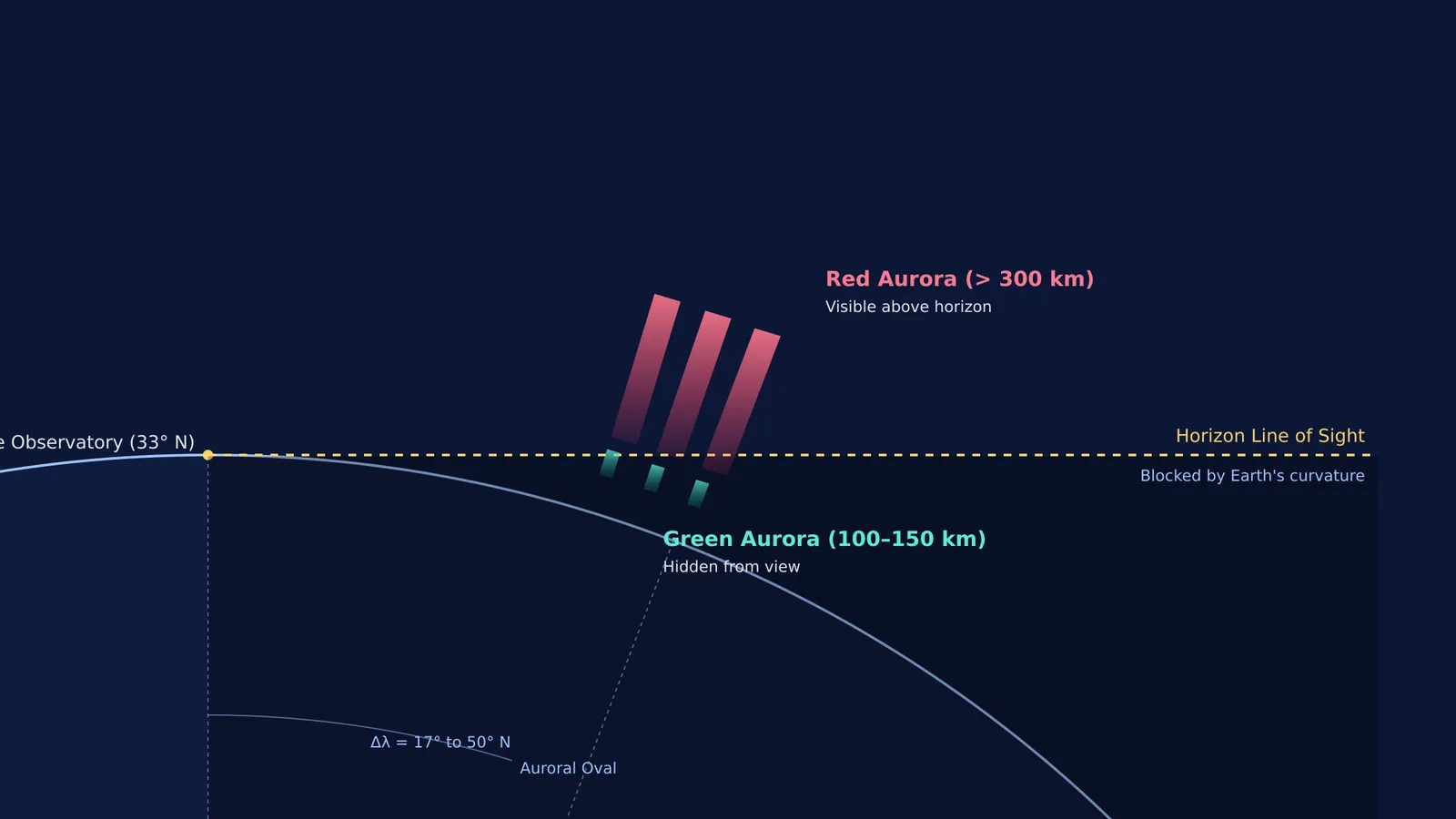
Earth's curvature determines which layer an observer sees. Looking north toward auroral activity at 50° N, Earth's limb blocks any emission below 290 km altitude. The lower green layer remained hidden below Ladakh's horizon. In contrast, the crimson emission between 300 km and 600 km cleared the horizon line of sight.
How do charged particles move in Earth's magnetic field?
For physics students, the Ladakh aurora illustrates classical electrodynamics. Charged solar particles entering Earth's magnetic field experience the Lorentz force F = q(v × B). Because this magnetic force acts perpendicular to velocity, it does no work and changes only particle direction, not kinetic energy.
The perpendicular velocity v_perp drives circular motion with cyclotron radius r = m v_perp / (q B), while parallel velocity v_parallel guides the charge along field lines into a helix. You can explore the exact mathematics in our guide to the helical path of a charge in a magnetic field, or see how Aditya-L1 studies the Sun from the L1 Lagrange point.
When visualizing three-dimensional particle trajectories in magnetic fields feels abstract, visual models make the geometry clear. The Fermi Simulation Lab provides interactive simulations for the ideas that are easier to see than to read. You can explore related principles across the Fermi Concept Library (every concept in physics, chemistry, biology, mathematics and computing, each with its own lesson and its place in the map), while the Fermi Problem Library has worked problems with a step-by-step solver that explains the reasoning rather than printing an answer.
Worked example: calculating the path of a solar proton
To see how this applies to competitive exams, consider a solar proton entering the magnetosphere with parameters reported by the NOAA Space Weather Prediction Center.
Cyclotron radius: A proton with mass m = 1.67 × 10⁻²⁷ kg and charge q = 1.60 × 10⁻¹⁹ C moves at v_perp = 1.0 × 10⁶ m/s in a field of B = 50 μT (5.0 × 10⁻⁵ T):
r = m v_perp / (q B) = (1.67 × 10⁻²⁷ × 1.0 × 10⁶) / (1.60 × 10⁻¹⁹ × 5.0 × 10⁻⁵) = 209 metres. This small radius confines the proton along geomagnetic lines toward the upper atmosphere.
Horizon clearance condition: For Earth radius R = 6,371 km, an observer at latitude λ₁ looking toward auroral activity at λ₂ has angular separation Δλ = λ₂ − λ₁. The minimum altitude h_min to clear the tangent horizon is:
h_min = R × ((1 / cos Δλ) − 1).
For Hanle at λ₁ = 33° N and the storm oval at λ₂ = 50° N, Δλ = 17°. With cos(17°) ≈ 0.9563: h_min = 6,371 × ((1 / 0.9563) − 1) ≈ 291 km. Green light at 120 km stays 171 km below the horizon line. Only red emission above 291 km reaches Ladakh. Connecting real space weather to fundamental formulas turns abstract textbook equations into visible physical reality.


