

On this page
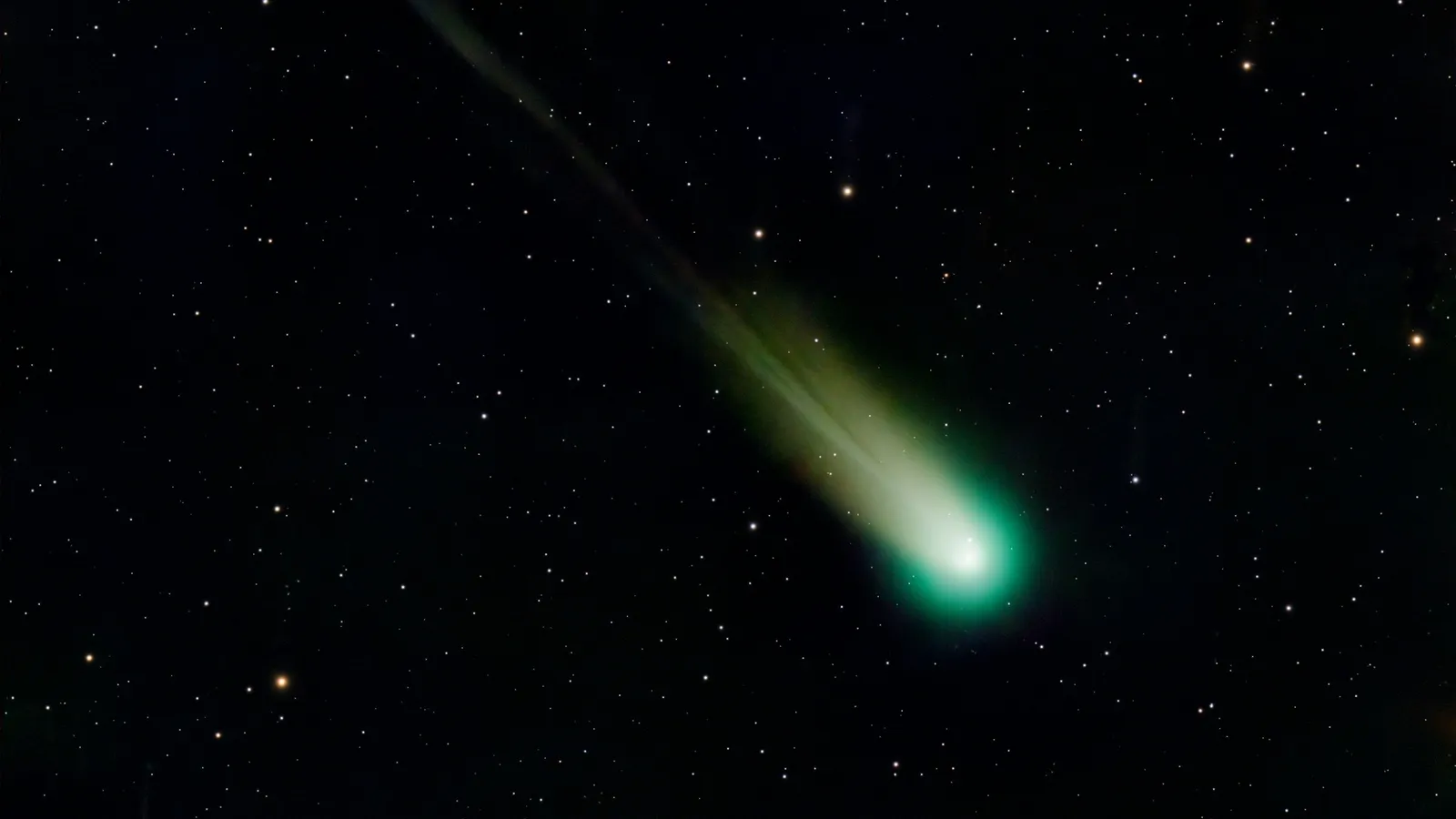
Comet tails always point away from the Sun, whichever way the comet is travelling. In the 1950s that clue, and the strange heat of the Sun's outer atmosphere, led Eugene Parker to predict a wind of particles blowing from the Sun all the time. Almost nobody believed him. This post covers what he argued, how the idea survived, a worked example using his own numbers, and what his career says about handling criticism.
Who was Eugene Parker?
According to the University of Chicago's obituary, Parker was born in 1927 in Houghton, Michigan. He studied physics at Michigan State University, earned his PhD at Caltech in 1951, taught at the University of Utah and joined the University of Chicago in 1955, where he stayed for the rest of his career. He died on 15 March 2022, aged 94.
What problem was he trying to solve?
Parker's paper, Dynamics of the Interplanetary Gas and Magnetic Fields, received by The Astrophysical Journal on 2 January 1958, starts from the astronomer Ludwig Biermann. Biermann had argued that comet tails need gas streaming outwards from the Sun in all directions. Parker asked what could drive such a flow.
He noted that known mechanisms could not do it. In his words, "Even at a coronal temperature of 3 × 10⁶ °K, the thermal velocity of a hydrogen ion is only 260 km/sec, and escape from the solar gravitational field (starting 3 × 10⁵ km above the photosphere) requires 500 km/sec."
His key step was different. He showed that a hot corona has no static solution: if it sat in equilibrium, its pressure far from the Sun would stay far higher than the thin interstellar gas could balance. The paper concludes that it is probably "not possible for the solar corona, or, indeed, perhaps the atmosphere of any star, to be in complete hydrostatic equilibrium out to large distances." The gas must keep expanding, and his equations showed it speeding up to hundreds of kilometres per second. Because the Sun rotates, he also predicted that the magnetic field carried by the gas would be wound into a spiral.
How did the idea get published?
The University of Chicago's solar wind explainer describes the reception. Reviewers were scathing. Parker later recalled the first reviewer suggesting he "go to the library and read up on the subject" because the paper was "utter nonsense", as the obituary reports. The journal's editor, his Chicago colleague Subrahmanyan Chandrasekhar, did not like the idea either but could find nothing wrong with the mathematics, so he overruled the reviewers.
Spacecraft settled it. The obituary records that NASA's Mariner 2, flying to Venus in 1962, met a constant stream of particles. A NASA feature adds that Mariner 2 saw a slow stream of about 215 miles per second and a fast stream at twice that speed.
Can you check Parker's numbers? A worked example
You need two Class 11 formulas: the escape speed v = √(2GM/r) from gravitation, and a typical molecular speed from kinetic theory. Use the NASA Sun fact sheet values GM = 1.327 × 10²⁰ m³/s² and solar radius 6.957 × 10⁸ m, and the NIST values of the Boltzmann constant (1.381 × 10⁻²³ J/K) and proton mass (1.673 × 10⁻²⁷ kg).
Escape speed from where Parker started. r = 6.957 × 10⁸ + 3 × 10⁸ ≈ 9.96 × 10⁸ m. v = √(2 × 1.327 × 10²⁰ ÷ 9.96 × 10⁸) ≈ 5.2 × 10⁵ m/s, about 520 km/s. Parker's "500 km/sec" checks out.
Thermal speed at 3 × 10⁶ K. The mean speed √(8kT/πm) = √(8 × 1.381 × 10⁻²³ × 3 × 10⁶ ÷ (π × 1.673 × 10⁻²⁷)) ≈ 2.5 × 10⁵ m/s, about 250 km/s, close to his 260 km/s.
Travel time to Earth. At the slow stream speed, 215 miles/s ≈ 346 km/s. One astronomical unit is 1.496 × 10¹¹ m, so t = 1.496 × 10¹¹ ÷ 3.46 × 10⁵ ≈ 4.3 × 10⁵ s, about 5.0 days. The fast stream takes about 2.5 days.
Step 2 shows why the problem was hard: a typical proton moves at half the escape speed. Parker's answer was that the gas behaves as a heated fluid whose pressure keeps pushing, not as separate particles that must each escape.
Common mistakes:
Using the solar radius instead of the starting radius. At the photosphere the escape speed is about 618 km/s, not 520 km/s.
Mixing up speed formulas. The rms, mean and most probable speeds differ by factors close to 1; say which one you use.
Forgetting kelvin. Kinetic theory formulas need absolute temperature.
Our guide to kinetic theory of gases covers these speeds. If you get stuck setting up problems like these, the Fermi Problem Library has worked problems with a step-by-step solver that explains the reasoning rather than printing an answer.
How was he honoured?
The obituary lists the US National Medal of Science, the Kyoto Prize and the Crafoord Prize, which he won in 2020. NASA's Parker Solar Probe, launched on 12 August 2018, was the first NASA mission named for a living researcher, and Parker watched it launch. The solar wind also sets the stage for space weather, which our post on Richard Carrington and the first solar flare explores.
What can a student take from Parker's way of working?
Asked in 2018 for advice to young scientists, Parker said: "If you do something new or innovative, expect trouble. But think critically about it because if you're wrong, you want to be the first one to know that."
Follow the argument, not the crowd. His case rested on equations that the editor could check.
Start from an odd clue. Comet tails were the observation everyone could see.
Check orders of magnitude. Comparing 260 km/s with 500 km/s showed where the real puzzle lay.
Next step: rework step 1 for a starting point 10 solar radii from the Sun's centre and see how much lower the escape speed is.


