

On this page
A crane in a scrap yard lowers a round steel disc onto a heap of old iron, someone switches on the current, and the crane lifts away a load of scrap. Switch off, and it all falls. How much can such a magnet hold? One formula answers it, F = B²A/2μ₀, and it also explains the two limits every magnet designer runs into: the iron saturates, and air gaps kill the field.
Where does a magnet's pulling force come from?
A magnetic field stores energy. The energy per unit volume is u = B²/2μ₀, the result derived in electromagnetic induction Class 12 derivations, step by step. That one line is enough to find the force.
Imagine a steel plate stuck to a magnet's pole face of area A, with field B crossing between them. Now pull the plate away by a tiny distance dx. You have created a thin new layer of gap, of volume A dx, filled with field. If B stays about the same, the energy stored rises by (B²/2μ₀) × A dx. That energy came from the work you did against the magnet, F dx. So:
F = B²A / 2μ₀
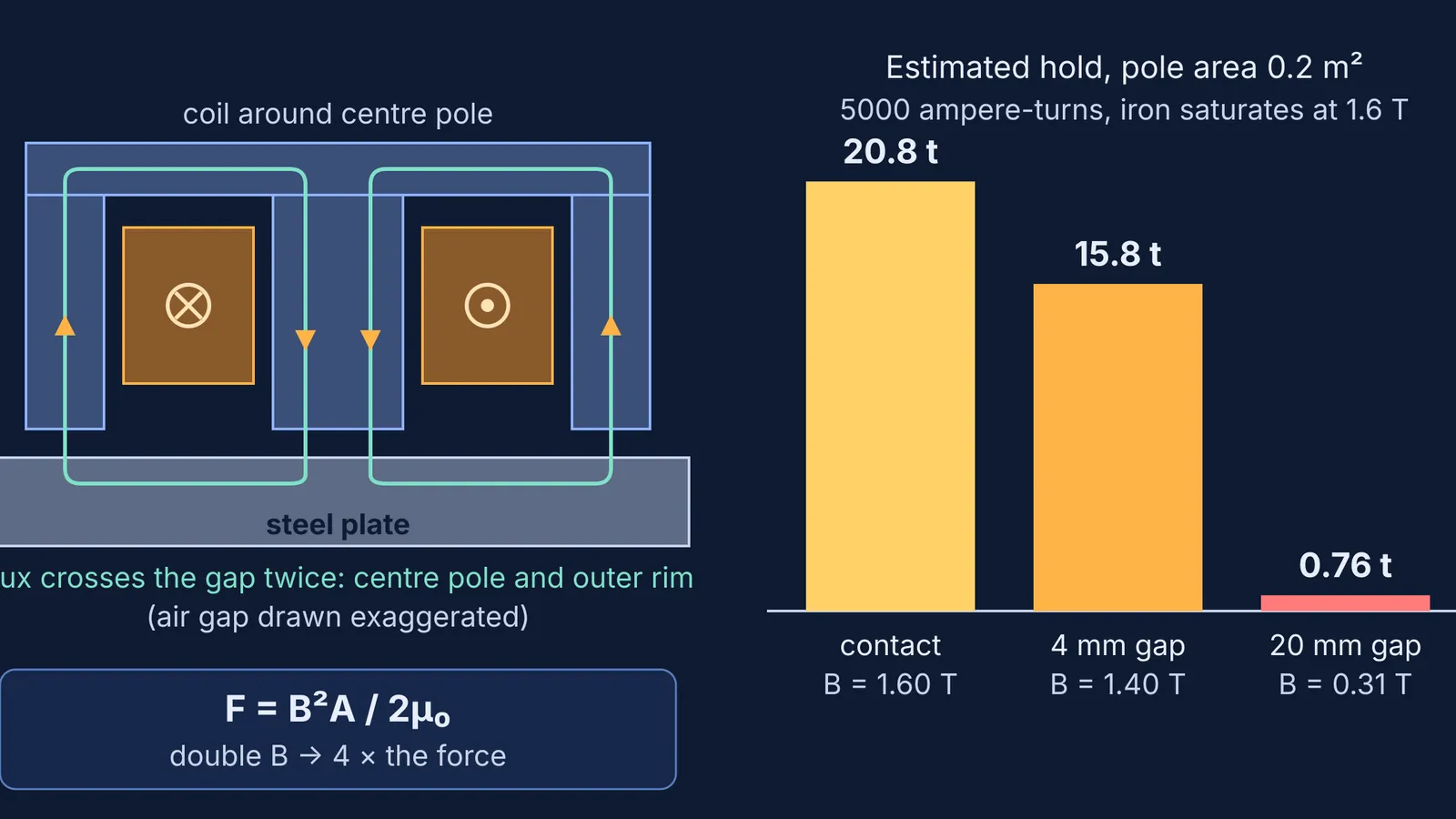
Two points matter. B here is the flux density in the gap, in tesla, not the field strength H. And A is every face where the flux crosses into the load. A circular lifting magnet sends flux down a central pole, through the load, and back up an outer rim, so it has two pole faces and you add both areas.
The force goes as B². Double B and the pull goes up four times. That is why a small change in B makes a large change in what the magnet can lift.
How many tonnes can a crane magnet hold?
Take a magnet with a total pole-face area of 0.2 m² (centre pole plus outer rim). Use μ₀ = 4π × 10⁻⁷ T m/A and g = 9.81 m/s². These are illustrative values, not a particular product.
At B = 1.0 T. F = (1.0)² × 0.2 / (2 × 4π × 10⁻⁷) = 7.96 × 10⁴ N, about 79.6 kN.
Convert to tonnes. Mass held = F/g = 79,600/9.81 ≈ 8,110 kg, about 8.1 t.
At B = 1.5 T. F scales as B², so F = 79.6 × 2.25 = 179 kN, about 18.3 t.
Check units. T² m² ÷ (T m/A) = T A m, and since 1 T = 1 N/(A m), that is N.
This is the force at the pole faces with a clean, flat steel plate in full contact. A real crane also needs a safety margin, so manufacturers rate their magnets well below this ideal pull.
Why can't you just turn up the current?
Steel does not carry unlimited flux. As B rises, the iron's domains line up until nearly all of them point the same way, and after that extra current adds very little. This is saturation. For the soft steels used in magnets it sets in at roughly 1.5 to 2 T; take 1.6 T as a round value.
At 1.6 T the magnetic pressure is B²/2μ₀ = 1.02 × 10⁶ Pa, about 1.0 MPa, or roughly 10 kgf on every square centimetre of pole face. For our 0.2 m² magnet that caps the pull at about 204 kN, or 20.8 t. No amount of extra current can push an iron-cored electromagnet much past this. The only way to hold more is a bigger pole area.
Why does a thin air gap cut the hold so much?
Treat the magnet like a circuit. The coil's ampere-turns NI drive flux around a loop of iron and air, and B ≈ μ₀NI / (L/μr + g), where L is the length of the iron path, μr its relative permeability and g the total air gap (both crossings added). Use NI = 5000 A, L = 1 m and μr = 2000, a simple model that ignores leakage and fringing, so the numbers are estimates.
Clean contact, g = 0. L/μr = 0.5 mm, so the formula gives B = 12.6 T. The iron cannot carry that: it saturates, B ≈ 1.6 T and the hold is about 20.8 t.
g = 4 mm (rust, paint or a slightly uneven surface). B = 4π × 10⁻⁷ × 5000 / 0.0045 = 1.40 T. Hold = 15.8 t.
g = 20 mm (a loose heap of scrap touching the poles at a few points). B = 0.31 T. Hold = 0.76 t, under 4% of the clean-plate figure.
Four millimetres of air matters more than a metre of iron, because air's permeability is 2000 times smaller. The same effect makes an attraction maglev's pull fall steeply with the gap, as shown in how maglev trains float.
Real ratings show the same pattern. For its 24-inch (610 mm) circular magnet, Eriez's lifting magnet catalogue lists an approximate lifting capacity of 4,536 kg for plates and slabs but 127 kg for heavy melting scrap: about 36 times less for the same magnet, because loose scrap leaves large gaps.
What happens if the power fails?
An electromagnet's grip lasts only as long as its current. If the supply fails, the field collapses and the load drops. For this reason, makers sell lifting systems with battery backup that takes over automatically during a power failure, as the same Eriez catalogue describes. Whatever the backup, nobody should stand under a suspended load.
The small version of all this is the nail-and-cell magnet in how to make an electromagnet with a nail and a cell: more turns or more current means more B, until the nail saturates. If the jump from energy density to force still feels slippery, the Concept Library has the magnetism ideas behind it set out one at a time.
Quick checklist
Holding force: F = B²A/2μ₀, from the field energy B²/2μ₀ in the gap.
A is every pole face the flux crosses; a circular magnet has two.
Force goes as B²: double B, four times the force.
Saturation near 1.6 T caps the pressure at about 1 MPa (10 kgf/cm²).
Air gaps dominate: B ≈ μ₀NI/(L/μr + g), so 4 mm costs about a quarter of the hold and 20 mm cuts it below 4%.
Rated loads for scrap are far below those for flat plate; power failure drops the load unless there is backup.


