On this page
Once a maglev train is moving, no wheel touches the rail. Magnets hold it up, keep it centred and push it along. There are two ways to do the lifting, and both rest on ideas from school physics: electromagnets pulling on iron, and electromagnetic induction.
What makes a maglev train float?
The German Transrapid relies on magnetic attraction, while Japan's design depends on repulsive forces, a larger air gap and superconducting electromagnets (IEEE Spectrum).
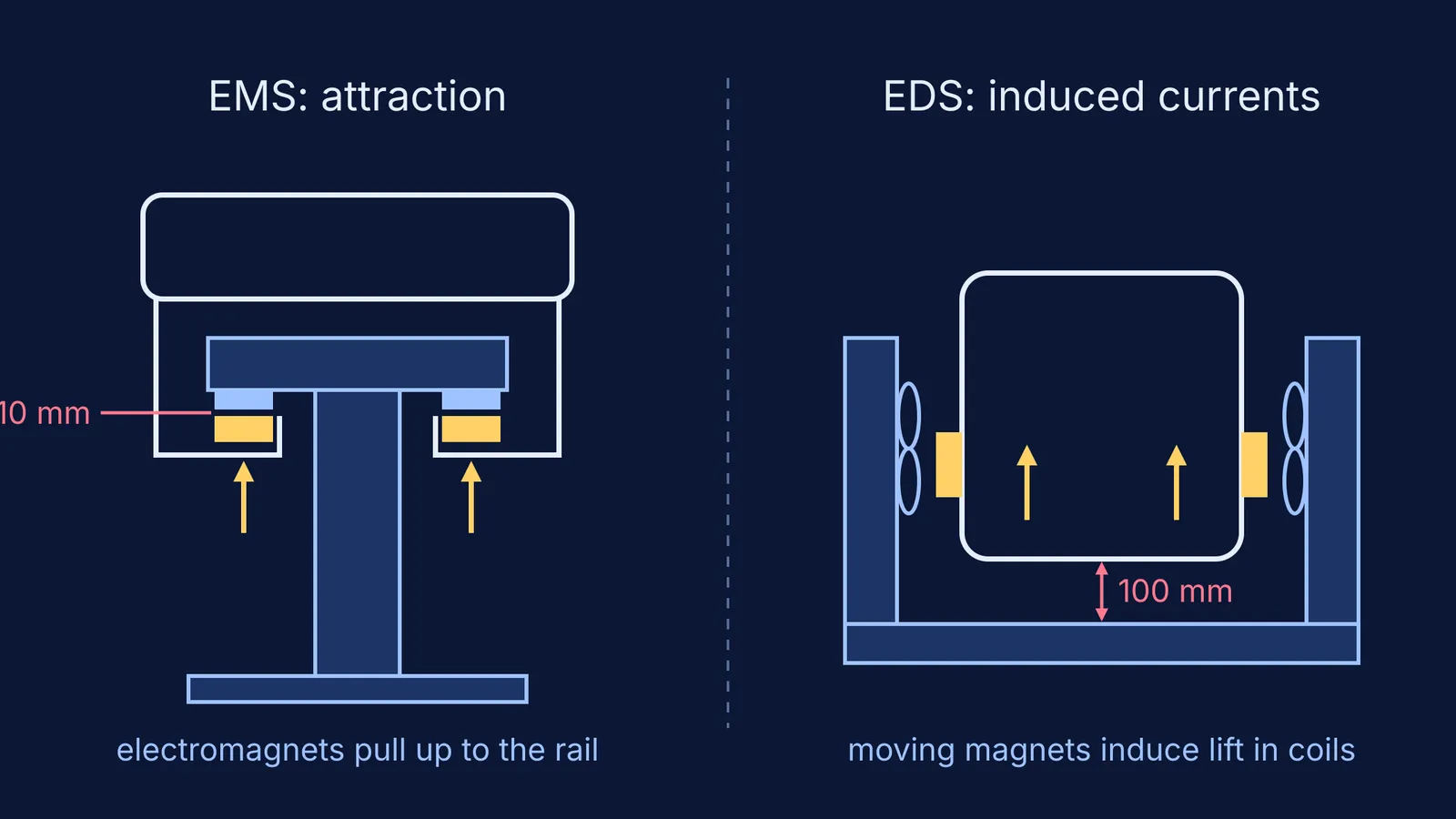
Electromagnetic suspension (EMS): ordinary electromagnets on the train are pulled up towards iron in the track.
Electrodynamic suspension (EDS): powerful magnets on a fast-moving train induce currents in track coils, and those currents push and pull the train upwards.
How does the Shanghai maglev stay in the air?
Shanghai's Transrapid line runs 30 km from an outer district of the city to Pudong International Airport and has operated since 2003 (University of Stuttgart, ITM). The underside of the vehicle wraps around the edges of the guideway, so its electromagnets sit below the rail and pull upwards towards it.
The Transrapid keeps a gap of about 10 millimetres between its magnets and the track, and its on-board electronics measure that gap 100,000 times per second (Transrapid, Wikipedia). Because magnetic attraction does not depend on motion, the magnets can hold the train up at low speeds too.
Why measure so often? Attraction on its own is unstable: the Stuttgart group describes "per se unstable system dynamics", with each levitation and guidance magnet actively controlled (University of Stuttgart, ITM).
Why does the gap need constant correction?
For an idealised electromagnet pulling on iron, the force is roughly proportional to (I/g)², where I is the current and g is the air gap. Take the Transrapid's 10 mm gap (Transrapid, Wikipedia) and set the current so the pull exactly equals the train's weight.
The train dips and the gap grows to 11 mm. The pull falls to (10/11)² = 0.83 of the weight, so the train sinks further.
A bump closes the gap to 9 mm. The pull rises to (10/9)² = 1.23 times the weight, so the magnet jumps towards the rail.
To hold the train at 11 mm, keep I/g constant: raise the current by 10%.
How does Japan's SCMaglev float 10 cm above the track?
Japan's SCMaglev levitates about 10 cm above the tracks, according to the Government of Japan. Its magnets are coils cooled with liquid helium to minus 269°C, which makes them superconducting, so a large current flows in them without resistance.
The guideway walls carry coils wound in a figure 8 (SCMaglev, Wikipedia). At low speed the train's magnets sit below the centre of each figure 8, so as they pass they induce currents in it. By Lenz's law those currents oppose the change, so the lower loop pushes the magnet up and the upper loop pulls it up. If the train drifts sideways, coils cross-connected under the track carry induced currents that push it back to the centre.
Induction needs motion, so the train runs on rubber tyres at first and begins to levitate at about 160 km/h, says the Government of Japan; the SCMaglev Wikipedia article gives 150 km/h for a lift of 100 mm. On 21 April 2015 an L0 Series test train reached 603 km/h, the record for a crewed rail vehicle.
This is not the Meissner effect (why a superconductor is a perfect diamagnet). The superconductors are just strong electromagnets; the lift comes from induction in ordinary coils, the physics behind eddy currents and magnetic braking.
What pushes a maglev train forward?
Both designs use a linear synchronous motor, which works like a rotating electric motor whose stator has been "unrolled" along the guideway (Transrapid, Wikipedia). Coils in the track are switched on in sequence, so a magnetic field travels along the track and drags the train's magnets with it. SCMaglev powers a second set of guideway coils for this (SCMaglev, Wikipedia).
Travelling fields and induced currents are easier to see moving than to read about. The Fermi Simulation Lab has interactive simulations for ideas like these, so you can watch them change before you compare them with the formula.
How do you explain maglev in an exam answer?
Name the physics, not just the hovering. Use this four-line plan:
Lift: attraction between electromagnets and an iron rail (EMS), or induced currents in track coils (EDS).
Law: the force between an electromagnet and a ferromagnetic material for EMS; Faraday's and Lenz's laws for EDS.
Stability: feedback control of current (EMS), or speed plus figure-8 coil geometry (EDS).
Drive: a linear motor with a magnetic field that travels along the track.
If step 1 feels shaky, revise how an electromagnet differs from a permanent magnet. If step 2 is the gap, the Fermi Concept Library gives every physics concept its own lesson, including electromagnetic induction.
Next time you see a maglev clip, ask one question: is it pulling up from below, or pushing off coils as it speeds past?