

On this page
This set follows set 1 of our magnetism NEET practice questions and tests the parts of the chapter that set 1 left out. New to the unit? Start with our guide on how to prepare magnetic effects of current and magnetism for NEET.
What does set 2 cover that set 1 did not?
Set 1 covered radius ratios, crossed fields, bar-magnet fields and Ampere's law. Set 2 tests the solenoid, galvanometer sensitivity and shunts, torque on a coil, fields from arcs, a proton crossing a field strip and the energy of a dipole.
All eight stay inside Unit 13 of the NMC syllabus for NEET (UG)-2026 and NCERT Class 12 Physics Chapter 4, Moving Charges and Magnetism and Chapter 5, Magnetism and Matter.
Take μ₀ = 4π × 10⁻⁷ T m A⁻¹, proton mass 1.67 × 10⁻²⁷ kg and charge 1.6 × 10⁻¹⁹ C.
How should you use this practice set?
In NEET-UG 2026, each question had four options and one correct answer, scored +4 if right and −1 if wrong, according to the NTA information bulletin.
Give yourself ten minutes for all eight, answers covered.
For every miss, name the trap: wrong formula, wrong angle, missed direction or a forgotten resistance.
Redo the misses in three days with your own numbers.
If one kind of mistake keeps returning, the Fermi Problem Library has worked problems with a step-by-step solver that explains the reasoning rather than printing an answer.
Easy: solenoid, sensitivity and circular motion
Q1 (easy). A long solenoid 40 cm long has 600 turns and carries 2.5 A. The field well inside it, away from the ends, is about:
(A) 0.75 mT (B) 1.9 mT (C) 2.4 mT (D) 4.7 mT
Answer: (D). Inside a long solenoid B = μ₀nI, with n the turns per metre: n = 600/0.40 = 1500 m⁻¹, so B = 4π × 10⁻⁷ × 1500 × 2.5 = 4.7 × 10⁻³ T. Trap: (B) puts the total 600 turns in place of turns per metre.
Q2 (easy). A moving coil galvanometer is rewound with three times as many turns, using wire of the same metal but half the cross-sectional area. Coil size, field and spring are unchanged. Then:
(A) current and voltage sensitivity both triple (B) current sensitivity triples, voltage sensitivity is unchanged (C) current sensitivity triples, voltage sensitivity halves (D) current sensitivity triples, voltage sensitivity falls to a sixth
Answer: (C). Current sensitivity φ/I = NAB/k grows with N, so it triples. The wire is three times as long and half as thick, so R = ρL/a becomes 3 × 2 = 6 times larger. Voltage sensitivity φ/V = NAB/(kR) changes by 3/6 = 1/2. Trap: (B) ignores the thinner wire.
Q3 (easy). A proton moves in a circle in a uniform magnetic field. Its speed is doubled, with the field unchanged. Its path radius and period now:
(A) radius doubles, period doubles (B) radius doubles, period unchanged (C) radius unchanged, period halves (D) radius halves, period unchanged
Answer: (B). r = mv/(qB) doubles with v, but T = 2πm/(qB) has no v in it: twice the path at twice the speed. Trap: (A) assumes a bigger circle must take longer.
Medium: shunts, coils and arcs
Q4 (medium). A galvanometer of resistance 48 Ω gives full-scale deflection at 20 mA. To make it an ammeter reading up to 0.50 A, you connect:
(A) 2.0 Ω in parallel (B) 1.92 Ω in parallel (C) 2.0 Ω in series (D) 1152 Ω in series
Answer: (A). At full scale 20 mA goes through the coil and 0.48 A through the shunt: S = (0.020 × 48)/0.48 = 2.0 Ω, in parallel. Trap: (B) divides by the full 0.50 A instead of the 0.48 A the shunt carries.
Q5 (medium). A rectangular coil of 40 turns, 6.0 cm × 5.0 cm, hangs with its plane parallel to a uniform 0.25 T field. What current gives a torque of 6.0 × 10⁻³ N m?
(A) 0.20 A (B) 8.0 A (C) 0.020 A (D) none; the torque is zero in this position
Answer: (A). With the plane along the field, the normal is at 90° to it, so τ = NIAB. Then I = 6.0 × 10⁻³/(40 × 3.0 × 10⁻³ × 0.25) = 0.20 A. Trap: (D) measures the angle from the plane instead of from the normal.
Q6 (medium). A closed loop is made of two concentric semicircles, radii 2.0 cm and 4.0 cm, on the same side of a diameter, joined by two straight pieces along that diameter. It carries 2.0 A. The field at the common centre is about:
(A) 7.9 μT (B) 15.7 μT (C) 31.4 μT (D) 47.1 μT
Answer: (B). The straight pieces point at the centre, so they add nothing. Each semicircle gives μ₀I/(4R), and in a closed loop the current goes round them in opposite senses: π × 10⁻⁷ × 2.0 × (1/0.020 − 1/0.040) = 15.7 μT, in the inner arc's direction. Trap: (D) adds the two arcs.
Hard: can you handle geometry and energy?
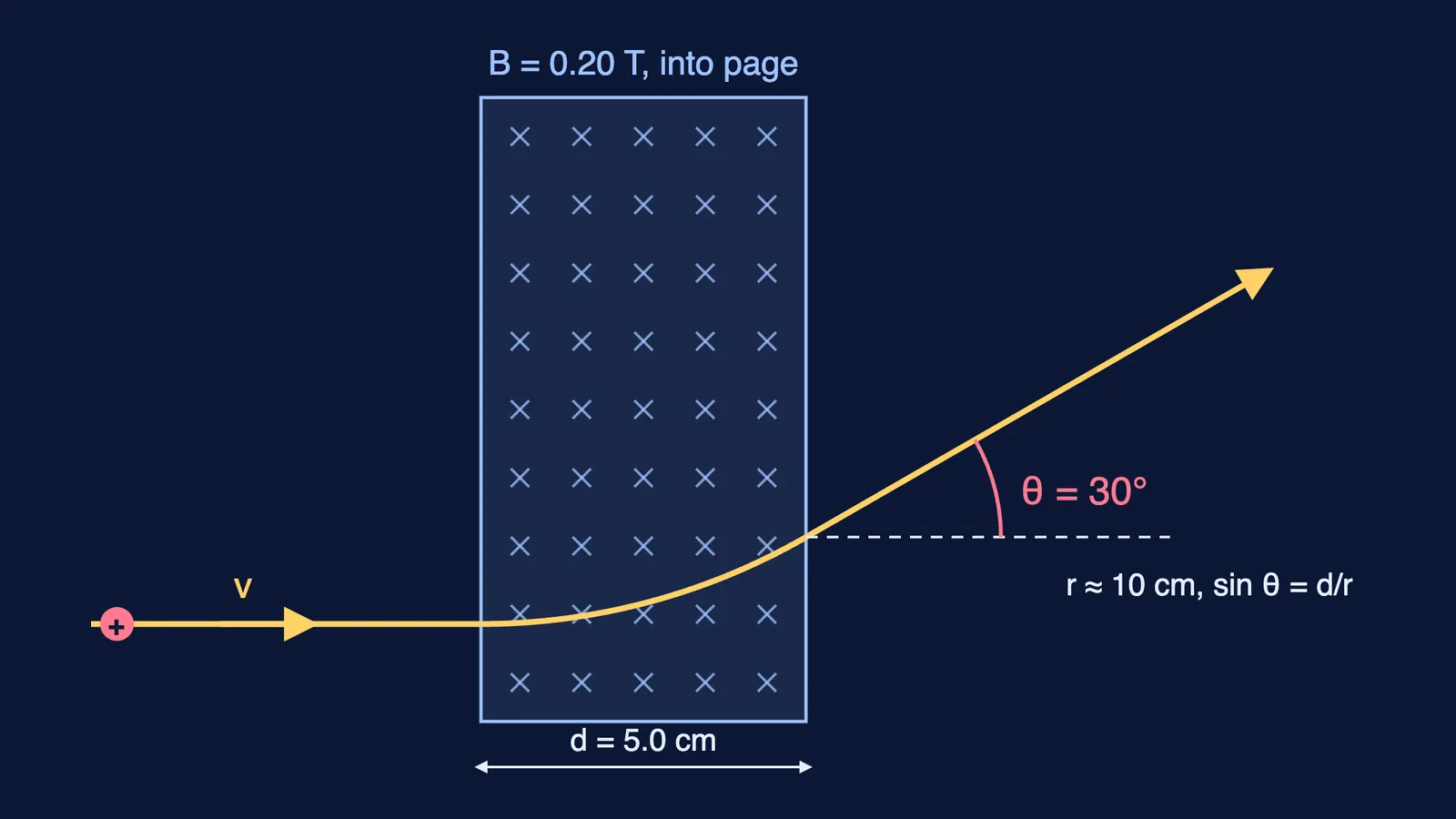
Q7 (hard). A proton moving at 1.92 × 10⁶ m/s enters, at right angles, a strip of uniform 0.20 T field 5.0 cm wide, with the field parallel to the strip's edges and perpendicular to the velocity. By what angle is it deviated when it leaves the far side?
(A) 26.6° (B) 30° (C) 60° (D) 90°; it turns back
Answer: (B). r = mv/(qB) = 1.67 × 10⁻²⁷ × 1.92 × 10⁶/(1.6 × 10⁻¹⁹ × 0.20) ≈ 10 cm. Since d < r it gets through, and the geometry of the arc gives sin θ = d/r = 0.5, so θ = 30°. Trap: (C) uses cos θ = d/r. See a charged particle leaving a magnetic field strip for the geometry.
Q8 (hard). The largest torque a short bar magnet can feel in a uniform field is 0.060 N m. How much work must you do to turn it slowly from its stable position until its axis makes 120° with the field?
(A) 30 mJ (B) 52 mJ (C) 90 mJ (D) 120 mJ
Answer: (C). The largest torque is mB, so mB = 0.060 J. With U = −mB cos θ, W = mB(cos 0° − cos 120°) = 0.060 × 1.5 = 0.090 J. Trap: (A) drops the minus sign of cos 120°.


