On this page
A charged particle shoots into a band of magnetic field of width d. Does it get through, at what angle, and how long is it inside? This JEE-style question rests on one comparison: the width d against the radius r. Our post on a charge crossing into a B-field region dealt with a field that has one edge. Here there are two, so the particle either crosses or turns back.
What happens when a charged particle enters a magnetic field of width d?
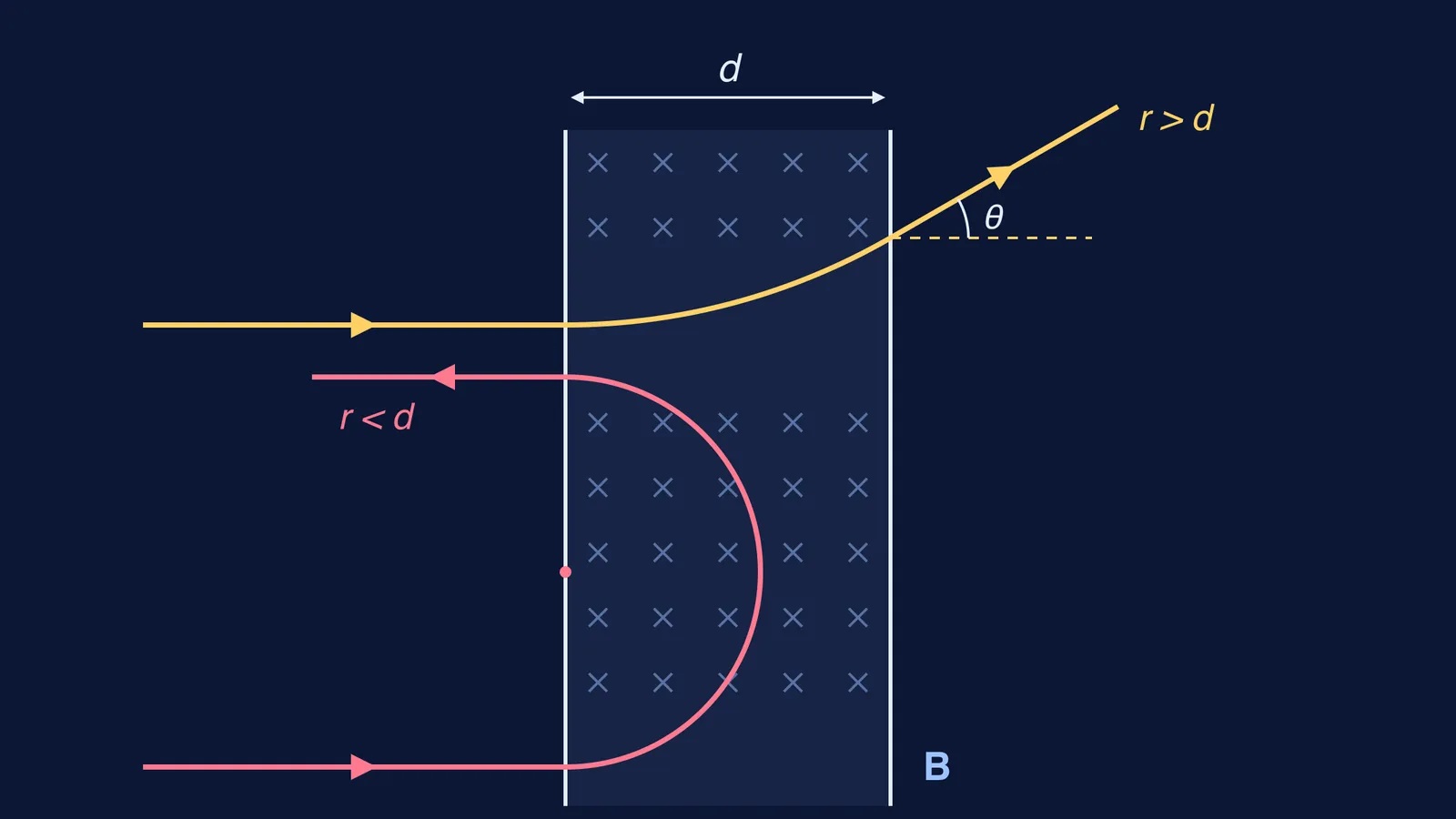
A uniform field B, into the page, fills the strip between two parallel lines a distance d apart. A particle of mass m and charge q enters at speed v, at right angles to the first edge.
The magnetic force is always perpendicular to the velocity, so it does no work, and the particle's speed stays constant (OpenStax University Physics Volume 2, section 11.3).
Inside the field the particle moves on a circle of radius r = mv/(qB), and one full turn takes T = 2πm/(qB), according to the same OpenStax section.
The key bit of geometry: the particle enters perpendicular to the edge, and the radius is perpendicular to the velocity, so the centre of the circle lies on the entry edge.
What is the angle of deviation when d < r?
With the entry point at the origin and the centre at (0, r), after the velocity turns through φ the particle is at x = r sin φ. It reaches the far edge when x = d, so the angle of deviation θ satisfies:
sin θ = d/r = qBd/(mv)
time inside: t = θ/ω = θm/(qB), with θ in radians
sideways shift at exit: y = r(1 − cos θ)
When does the particle turn back, and how long does it stay?
On this circle x never exceeds r. So if d ≥ r, the particle completes a semicircle and leaves through the entry edge, moving the opposite way:
deviation: 180°
time inside: T/2 = πm/(qB), whatever the speed
exit point: 2r along the edge from the entry point
So to get across, the particle needs r > d, which means v > qBd/m. When d = r exactly, the particle just grazes the far edge and comes back.
What if the particle enters at an angle?
If the velocity makes an angle α with the normal and the field bends it further from the normal, it crosses only if d < r(1 − sin α), leaving at angle β with sin β = sin α + d/r. If it turns back instead, it leaves the entry edge at angle α after sweeping π − 2α, so it is inside for (π − 2α)m/(qB).
Worked JEE-style numerical
A proton enters a field of B = 0.10 T at right angles to the strip's edge, with v = 1.0 × 10^6 m/s. The NIST value of the proton mass is 1.673 × 10^-27 kg, and the elementary charge is 1.602 × 10^-19 C. So m/q ≈ 1.04 × 10^-8 kg/C.
Radius: r = (m/q)(v/B) = 0.104 m = 10.4 cm.
Time scale: m/(qB) = 1.04 × 10^-7 s, so T ≈ 6.6 × 10^-7 s.
Strip of width d = 5.2 cm: d < r, so the proton crosses. sin θ = 5.2/10.4 = 0.5, so θ = 30° = π/6 rad.
Time inside: t = (π/6)m/(qB) ≈ 5.4 × 10^-8 s, about 54 ns. Sideways shift: 10.4(1 − cos 30°) ≈ 1.4 cm.
Strip of width d = 12 cm: d > r, so the proton turns back, deviated by 180°. It spends πm/(qB) ≈ 3.3 × 10^-7 s inside and exits 2r = 20.8 cm from its entry point.
Minimum speed to cross the 12 cm strip: v > qBd/m = 0.10 × 0.12 / (1.04 × 10^-8) ≈ 1.15 × 10^6 m/s.
Notice that the time in step 4 is longer than d/v = 52 ns. The curved path is longer than the straight width, and the speed along it does not change.
Which mistakes cost marks in this problem?
Using tan θ = d/r instead of sin θ = d/r.
Putting θ in degrees into t = θm/(qB). It must be in radians.
Using the full period T for the turn-back case. The particle is inside for only half of it.
Taking the time as d/v, as if the path were straight.
Forgetting the sign of the charge. An electron bends the opposite way from a proton.
If the same slip keeps coming back, try similar questions in the Fermi Problem Library. Its step-by-step solver explains the reasoning rather than just printing an answer, so you can see which step went wrong.
Next, try the helical path of a charge in a magnetic field or cyclotrons and other charged-particle motion.