On this page
In magnetic hyperthermia, tiny magnetic particles are placed in a tumour, a coil outside the body drives an alternating field through it, and the particles heat the tissue around them by a few degrees. The physics is two chapters of your syllabus side by side. Magnetism explains where the heat comes from, and electromagnetic induction explains why the field cannot simply be turned up. This post is a physics explainer, not medical advice; whether and how anyone is treated is decided by their doctors.
How does an alternating magnetic field heat iron-oxide particles?
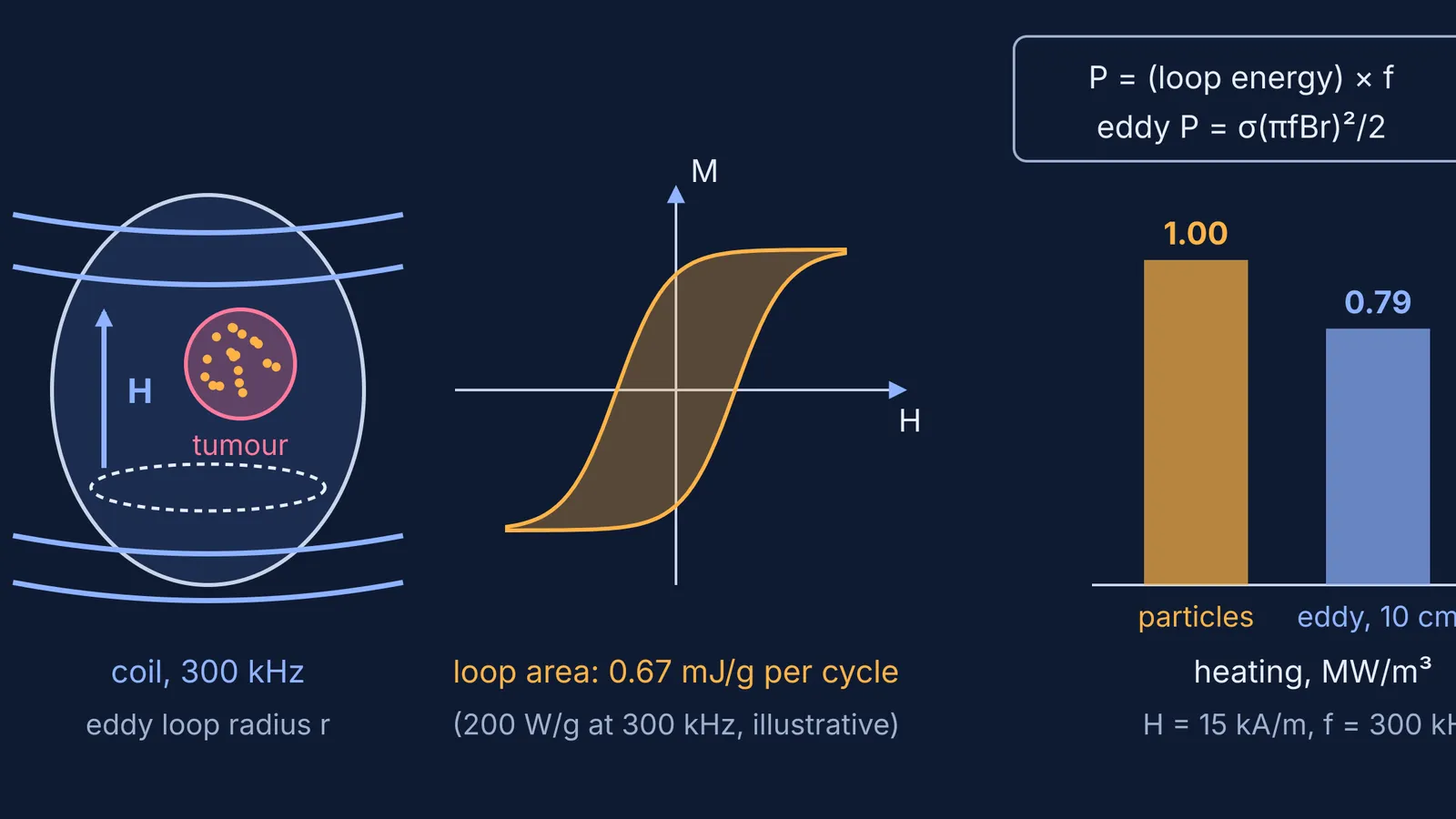
Take a ferromagnetic sample around its hysteresis loop once. The magnetisation does not retrace its path: it lags behind the field, and the loop encloses an area. That area is energy per unit volume (or per gram) turned into heat in one full cycle. You met this in magnetism and hysteresis loops.
Now repeat the cycle f times a second. The heating power is
P = (energy lost per cycle) × f
So a modest loop becomes a lot of heat at high frequency.
One honest correction. The particles used are only a few nanometres to tens of nanometres across. Particles this small often show no classical, static hysteresis loop at all. Their heating comes mostly from relaxation: the magnetic moment flips inside the particle (Néel relaxation) or the whole particle turns in the liquid around it (Brownian relaxation), and both lag behind a fast field. The lag still traces out a loop in each cycle, so "loop area × f" is the right bookkeeping, but the static loop from your textbook is a simplification of what happens.
How fast does a tumour warm up?
Heating by particles is usually quoted as power per gram of iron, called the specific loss power. Take a round illustrative value of 200 W per gram of iron at 300 kHz, and 5 mg of iron per millilitre of tissue.
Energy per cycle. 200 W/g ÷ 300,000 cycles/s = 6.7 × 10⁻⁴ J/g, about 0.67 mJ per gram of iron per cycle.
Iron per cubic metre. 5 mg/mL = 5 kg/m³ = 5,000 g/m³.
Power density. 5,000 g/m³ × 200 W/g = 1.0 × 10⁶ W/m³, one megawatt per cubic metre.
Heat capacity of tissue. Take density about 1,050 kg/m³ and specific heat about 3,600 J/kg K, so ρc ≈ 3.8 × 10⁶ J/m³ K (approximate; tissues vary).
Rate of rise. dT/dt = P/(ρc) = 1.0 × 10⁶ / 3.8 × 10⁶ ≈ 0.26 K/s.
Time for 6 K. From 37 °C to 43 °C: 6 / 0.263 ≈ 23 s.
This is only the starting rate. As the tumour warms, blood flow and conduction carry heat away, and the temperature levels off.
Why can't the field simply be made stronger?
Because the alternating field does not only reach the particles. It passes through all the tissue inside the coil, and tissue conducts electricity (it is salty water). By Faraday's law, a changing flux through any loop of tissue drives a current round that loop. These are eddy currents, the same effect used to heat metal pots in an induction cooker, covered in eddy currents and their uses. Here they heat healthy tissue too.
Work it out for a circular loop of radius r in a uniform field B = B₀ sin(2πft).
emf. ε = πr² dB/dt, with peak value πr² × 2πf B₀.
Electric field. The emf is spread round the circumference 2πr, so E = ε/(2πr) = πfB₀r at the peak.
Power density. In a conductor of conductivity σ, power per volume is σE². Averaged over a cycle this is σE₀²/2.
Now put in numbers: H = 15 kA/m, so B₀ = μ₀H = 4π × 10⁻⁷ × 15,000 = 18.8 mT. At f = 300 kHz and r = 10 cm, E = π × 300,000 × 0.0188 × 0.10 ≈ 1,780 V/m. With σ = 0.5 S/m (a round illustrative value for soft tissue), the heating is 0.5 × 1,780² / 2 ≈ 7.9 × 10⁵ W/m³.
That is 0.79 MW/m³, nearly as much as the 1.0 MW/m³ the particles deliver inside the tumour. And it grows as r², so at r = 15 cm it is 1.8 MW/m³, more than the tumour gets. The patient's healthy tissue would heat faster than the target.
What is the H × f safety limit?
Look at the eddy formula again: E = πμ₀(H × f)r. The heating in healthy tissue depends on H and f only through their product. So safety guidelines cap H × f.
The first such limit came from work by Atkinson and Brezovich in the 1980s, measured on the adult human torso: H × f ≤ 4.85 × 10⁸ A m⁻¹ s⁻¹. Hergt and Dutz later suggested a less strict value, 5 × 10⁹ A m⁻¹ s⁻¹, for smaller body regions. Both values are quoted in this 2024 review by Ferrero, Vicentini and Manzin in Nanoscale Advances.
Our example has 15,000 × 300,000 = 4.5 × 10⁹ A m⁻¹ s⁻¹. That is 0.9 times the Hergt–Dutz value and about 9 times the Atkinson–Brezovich value. At 300 kHz, the stricter limit would allow only H ≈ 1.6 kA/m. Since the loop area of the particles also shrinks at low H, you can see the trade-off: the limit keeps healthy tissue safe but also limits how much heat the particles can make.
Is magnetic hyperthermia used in hospitals?
On clinical status, it is safest to say only what the sources say. A 2018 paper in the Journal of Neuro-Oncology states that an iron-oxide nanoparticle fluid "has been approved in Europe for 'use in brain tumors' since May 2010" (Grauer and colleagues, 2018). An earlier study of patients with recurrent glioblastoma used it together with radiotherapy, with an applicator running at 100 kHz and a field adjustable from 2 to 15 kA/m (Maier-Hauff and colleagues, 2011). It is used alongside other treatments, not on its own, and decisions about it are made by doctors.
Notice the numbers in that applicator: 15 kA/m at 100 kHz is 1.5 × 10⁹ A m⁻¹ s⁻¹, between the two limits above. Lowering the frequency is one way to keep eddy heating down.
If you want a contrast, gold nanoparticles that heat cancer cells absorb laser light instead of a magnetic field. To practise hysteresis-loss and eddy-current numericals like these, the Fermi Problem Library has a step-by-step solver that explains the reasoning.
What mistakes cost marks here?
Forgetting the factor f: loop area is energy per cycle, not power.
Treating eddy heating as uniform. It grows as r², so the outer layers of a large body section heat most.
Thinking a stronger field only helps. More H × f means more heat in healthy tissue too.
Quick checklist
Heating power = loop energy per cycle × frequency.
Very small particles heat by Néel and Brownian relaxation; the loop picture is a simplification.
Rate of rise = P/(ρc); at 1 MW/m³ tissue starts warming at about 0.26 K/s.
Eddy heating in tissue = σ(πfBr)²/2, so it depends on H × f and on r².
Quoted limits: 4.85 × 10⁸ A m⁻¹ s⁻¹ (Atkinson–Brezovich) and 5 × 10⁹ A m⁻¹ s⁻¹ (Hergt–Dutz).