On this page
When treating cancer, the central challenge is destroying the tumour without killing the healthy cells around it. Traditional therapies such as radiation and chemotherapy often affect both. In the mid-2000s, physical chemist Mostafa El-Sayed, working with his son, surgeon Ivan H. El-Sayed, developed a highly selective approach using gold nanoparticles and light.
Their method, known as plasmonic photothermal therapy, turns tiny flecks of gold into microscopic heaters that attach directly to the outside of a cancer cell.
How did a chemist and a surgeon team up?
The collaboration between Mostafa El-Sayed and his son Ivan is a clear example of interdisciplinary science. Mostafa brought decades of expertise in physical chemistry and laser spectroscopy, having spent his career studying how light interacts with matter. Ivan, a head and neck cancer surgeon, understood the clinical challenges of removing tumours without damaging the delicate surrounding structures of the throat and face.
Together, they bridged the gap between fundamental physics and clinical oncology. They realised that if they could selectively heat the tumour at a microscopic level, they could offer a surgical tool that destroys the cancer while leaving the adjacent healthy cells completely untouched.
How do gold nanoparticles target cancer?
The technique relies on the fact that many malignant cells have an unusually high number of specific receptors on their surface. One common target is the Epidermal Growth Factor Receptor (EGFR).
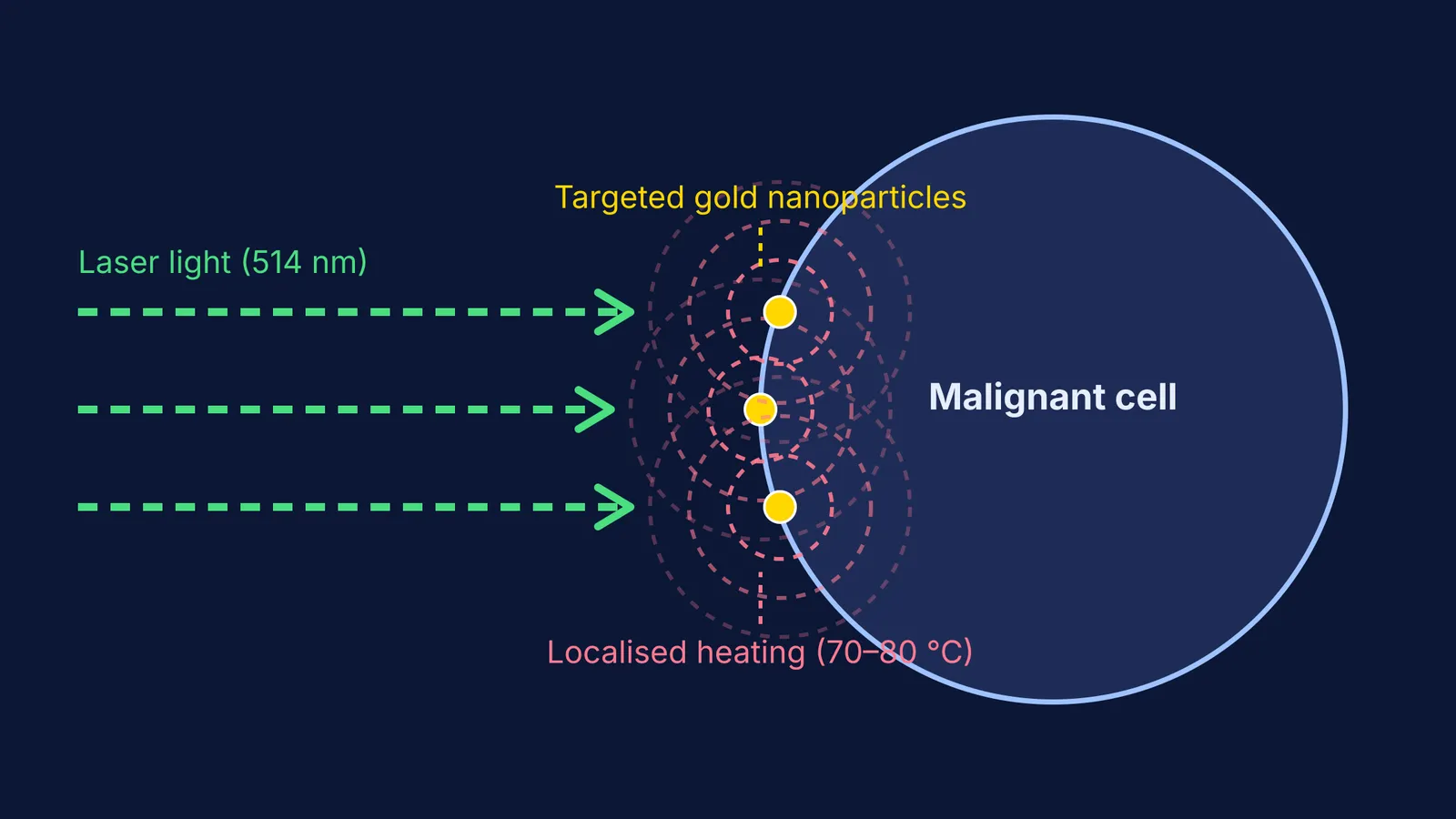
El-Sayed's team attached anti-EGFR antibodies to gold nanoparticles. When introduced to a mixture of cells, these antibodies act like guided missiles, binding strongly to the EGFR on the malignant cells. Because cancer cells overexpress this receptor, they accumulate a much higher concentration of gold nanoparticles than benign cells (DOI: 10.1016/j.canlet.2005.07.035).
Why do gold nanoparticles generate heat?
Gold nanoparticles possess a unique optical property called localised surface plasmon resonance. When struck by a specific wavelength of light, the free electrons in the gold oscillate rapidly. This collective oscillation of electrons is what physicists call a plasmon. When the frequency of the incoming light matches the natural frequency of these oscillating electrons, resonance occurs.
The particles absorb the light energy strongly and convert it into heat almost instantly. The specific wavelength required depends on the shape and size of the gold nanoparticle, which allows researchers to tune the particles to absorb different colours of light. In a 2006 study, the researchers exposed the targeted cells to a continuous visible argon ion laser (at 514 nm). The gold nanoparticles absorbed the laser light and heated the immediate surrounding area.
Numerical models and experiments showed the local temperature rose to 70–80 °C (DOI: 10.1562/2005-12-14-RA-754). This heat destroys the cell membrane and proteins, essentially cooking the malignant cell from the outside in.
If you want to understand the physics of how light waves interact with matter or see resonance in action, the Fermi Simulation Lab has interactive simulations for the ideas that are easier to see than to read.
Does the laser harm healthy cells?
The key to the method lies in the energy threshold. Because the malignant cells had bound so many more nanoparticles, they absorbed far more energy from the beam.
The researchers found that malignant cells required less than half the laser energy to be killed compared to benign cells (DOI: 10.1016/j.canlet.2005.07.035). At the low energy levels used to destroy the cancer cells, the laser alone (without the concentrated gold) did not harm either cell type.
Furthermore, the absorption coefficient of gold nanoparticles is significantly higher than that of conventional light-absorbing dyes, making the photothermal conversion much more efficient. Later variations of this technique explored using nanorods instead of solid spheres, as nanorods can be tuned to absorb near-infrared light which penetrates much deeper into the human body than visible light does.
How can you explain targeted therapy to a friend?
If you need to explain this concept in a biology or chemistry project, break it into three steps:
The Delivery: The antibody is the address label. It ensures the package goes to the cancer cell, not the healthy cell.
The Payload: The gold nanoparticle is the package. It waits on the surface of the cell.
The Trigger: The laser is the switch. It passes harmlessly through healthy tissue but heats the gold, destroying only the cell it is attached to.
Mostafa El-Sayed's work demonstrates how physical chemistry can solve biological problems. By turning light into targeted heat, his research opened a new pathway for cancer treatment that aims to leave healthy tissue entirely unharmed.
Read more about the biology of cells in our guide to visualising hard physics ideas and how polarised sunglasses cut glare.