

On this page
Every slip below is checked against the Locomotion and Movement chapter of NCERT's Class 11 Biology text (NCERT chapter kebo117, Reprint 2026-27), which falls in Unit 5, Human Physiology, of the NMC's NEET (UG) 2026 syllabus. For the whole unit, see our Human Physiology for NEET chapters and study plan.
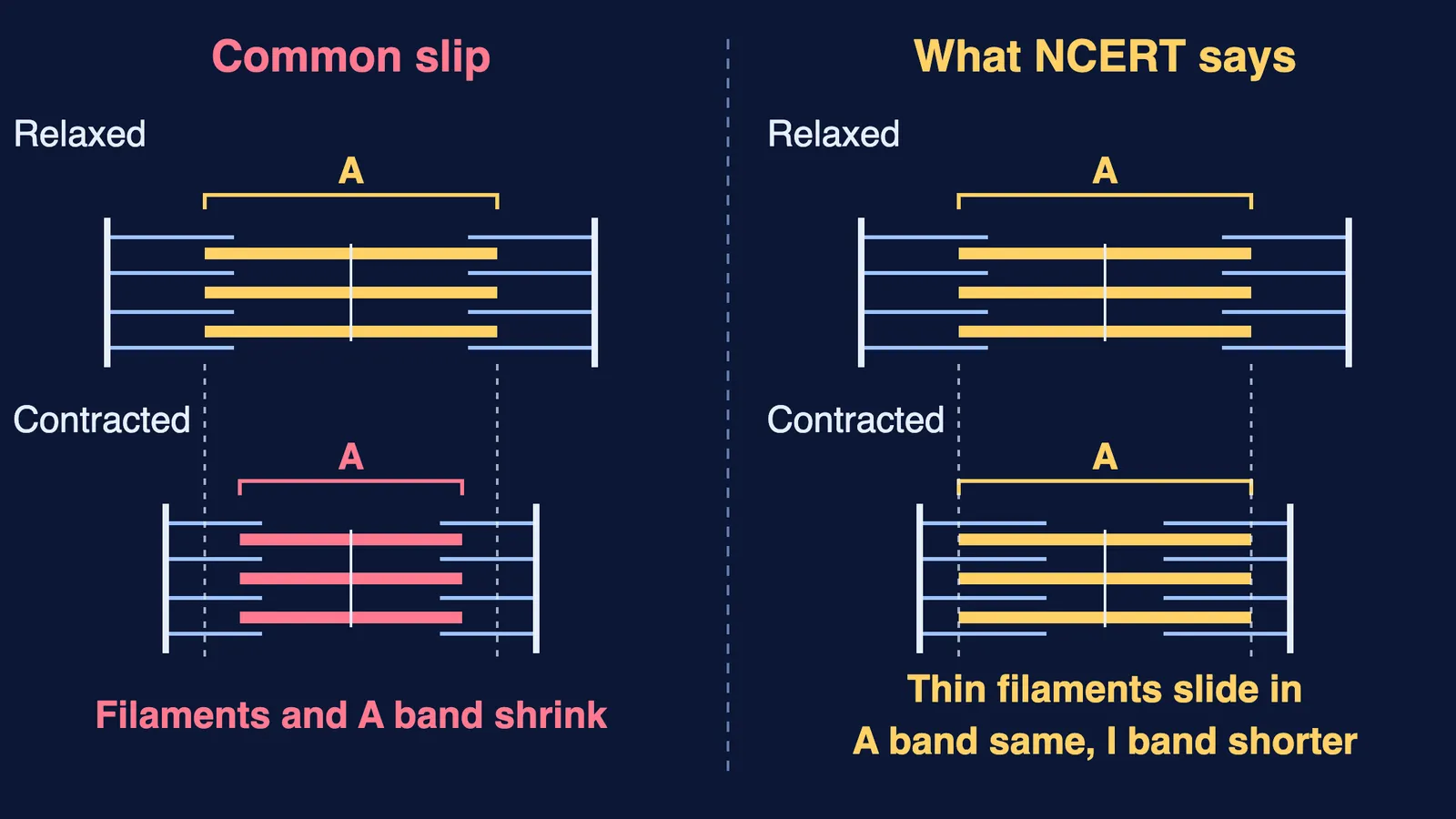
What actually shortens when a muscle contracts?
"When a muscle contracts, its actin and myosin filaments get shorter."
Why it tempts: the whole muscle shortens, so its parts seem to.
What NCERT says (17.2.2): contraction is thin filaments sliding over thick ones. Cross bridges pull actin towards the A band's centre, dragging the Z lines inwards, so the sarcomere shortens; the I bands shrink while the A bands keep their length.
Check: a friend argues, "If the A band kept its length, the muscle could not have got shorter." What does shrink, and what moves? (The I bands shrink as the Z lines are drawn inwards; the filaments slide, none shortens.)
Habit: picture two combs sliding together, not a spring squashed.
"A fresh ATP is what attaches the myosin head to actin."
Why it tempts: ATP is the "energy" molecule, so attaching seems to need a new one.
What NCERT says (17.2.2): the head attaches to exposed actin sites using energy released by hydrolysing ATP. Later, after ADP and Pi leave, the binding of another ATP is what breaks the cross bridge, and the cycle repeats.
Check: label each event "powers attachment" or "causes release": (a) the head splits ATP before it grips actin; (b) an ATP binds after ADP and Pi have left. (a powers attachment; b causes release.)
Habit: whenever a step mentions ATP, ask whether it is being split or simply arriving.
Which look-alike terms get swapped?
"Red fibres are red because they carry more haemoglobin."
Why it tempts: haemoglobin is the best-known red pigment.
What NCERT says (17.2.2): the colour comes from myoglobin, an oxygen-storing muscle pigment. Red fibres have plenty of it and many mitochondria, so NCERT also calls them aerobic muscles. White fibres have very little myoglobin.
Check: fill the blanks: red fibres look red because of ___, which stores ___ for their many ___ to make ATP. (Myoglobin; oxygen; mitochondria.)
Habit: "myo" means muscle, so the muscle pigment is myoglobin.
"Bone is hard because of chondroitin salts."
Why it tempts: NCERT names both salts in one sentence.
What NCERT says (17.3): bone has a very hard matrix because of calcium salts, while cartilage has a slightly pliable matrix because of chondroitin salts.
Check: which salt gives the patella its matrix, and which the hyaline cartilage joining a true rib to the sternum? (Calcium salts; chondroitin salts.)
Habit: link "chondr-" to cartilage, as in chondroitin, so it never drifts to bone.
"Ribs are called bicephalic because they are attached at both ends."
Why it tempts: "two heads" sounds like two ends.
What NCERT says (17.3): a rib is bicephalic because its dorsal end has two articulation surfaces. Ventrally, pairs 1 to 7 meet the sternum via hyaline cartilage, pairs 8 to 10 join rib seven through cartilage, while the floating pairs (11, 12) stay free.
Check: pair 9 ends on the seventh rib; pair 12 ends free. Which of them has two articulation surfaces at its dorsal end? (Both; every rib is bicephalic.)
Habit: read bicephalic as "two heads at the dorsal end", and judge the ventral end separately.
Which bone numbers get swapped?
NCERT's counts (17.3) are 206 bones in all, 80 of them axial.
"The hyoid and the ear ossicles are part of the skull's 22 bones."
Why it tempts: NCERT's skull figure labels the hyoid, and the ossicles sit inside the head.
What NCERT says (17.3): the skull's 22 bones are 8 cranial and 14 facial. NCERT then describes the U-shaped hyoid (sitting below the buccal cavity) and three ossicles in each middle ear as separate items. Our arithmetic: 22 + 1 + 6 + 26 vertebrae + 1 sternum + 24 ribs = 80.
Check: of the 80 axial bones, how many are neither skull, vertebrae, ribs nor sternum, and which are they? (Seven: the hyoid and six ossicles.)
Habit: keep the skull at 8 + 14; give the hyoid and ossicles their own lines.
"The wrist and ankle have the same number of bones."
Why it tempts: both limbs total 30 bones.
What NCERT says (17.3): the hand has 8 carpals; the leg has 7 tarsals. NCERT's leg list also includes the patella, the cup-shaped knee cap. Arm: 1 + 1 + 1 + 8 + 5 + 14 = 30. Leg: 1 + 1 + 1 + 1 + 7 + 5 + 14 = 30.
Check: drop the patella from the leg list. What total do you get, and which count would you have to wrongly raise to reach 30 again? (29; the tarsals, to 8.)
Habit: learn the leg as "one extra bone, one fewer ankle bone".
Is tetany caused by too much calcium?
"Tetany happens because too much Ca++ makes muscles contract wildly."
Why it tempts: Ca++ release starts contraction (17.2.2), so spasms suggest excess calcium.
What NCERT says (17.5): tetany is rapid, wild muscle spasms, and the cause it names is a low Ca++ level in the body fluid.
Check: a classmate's note reads "Tetany: high Ca++ in body fluid." Which one word must change, and to what? ("High" becomes "low".)
Habit: learn each disorder's cause as NCERT states it, not by reasoning from contraction.
This is a study summary, not medical advice.
A 60-second self-check before you mark
Contraction: did a band change length, or did filaments slide?
ATP: is it being split to power binding, or arriving to break the bridge?
Pigment: myoglobin, not haemoglobin?
Matrix: calcium salts for bone, chondroitin for cartilage?
Ribs: dorsal end (bicephalic) or ventral end?
Counts: hyoid, ossicles and patella on their own lines?
Disorders: high or low, and which substance?
Then test yourself with our Locomotion and Movement exceptions and odd-one-out questions.
Not sure which of these slips is yours? Fermi's AI tutor works out what you already know and builds a plan for the session.


