

On this page
The Large Hadron Collider (LHC) at CERN sends protons round a 26.7 km ring at 6.8 TeV each. What holds them on that circle is the same force you use in every JEE magnetism problem: F = qvB on a moving charge. The catch is that at this energy the textbook formula r = mv/qB, used with the low-speed momentum, gives an answer that is wrong by a factor of 60. This post works out the field the LHC's magnets need, why the ring's size is not the radius to use, and why a circular machine at this energy has to use protons, not electrons.
How does a magnetic field keep LHC protons on a circle?
A charge moving at right angles to a field B feels a force qvB at right angles to its velocity. That force changes the direction of motion but not the speed, so the particle moves in a circle. Setting the force equal to the momentum change needed for circular motion gives
p = qBr, or B = p/(qr).
This relation holds at any speed, including speeds close to c, as long as p is the true (relativistic) momentum. The low-speed version, r = mv/qB, is the special case p = mv. The cyclotron post shows why the orbit frequency does not depend on speed at low energy; that result fails at the LHC because p is no longer mv. You may also have seen p = qBr used to read a cosmic-ray track in Anderson's muon discovery. The LHC uses the same rule, in reverse: it picks B so that p and r match.
What are the LHC's real numbers?
From CERN's pages and a review by CERN accelerator physicists:
Beam energy: 6.8 TeV per proton in the current run, giving 13.6 TeV collisions (CERN, the Large Hadron Collider). The design energy is 7 TeV.
Main dipole magnets: 1,232, about 15 m long each, cooled to 1.9 K (same CERN page). The magnetic length of each is 14.3 m.
Circumference: 26,659 m (same CERN page).
Design field: 8.33 T at 7 TeV, with a bending radius of 2,804 m (Brüning, Burkhardt and Myers, Progress in Particle and Nuclear Physics, 2012).
The field at 6.8 TeV is not quoted on those pages, so we work it out below.
What field do the LHC dipoles need at 6.8 TeV?
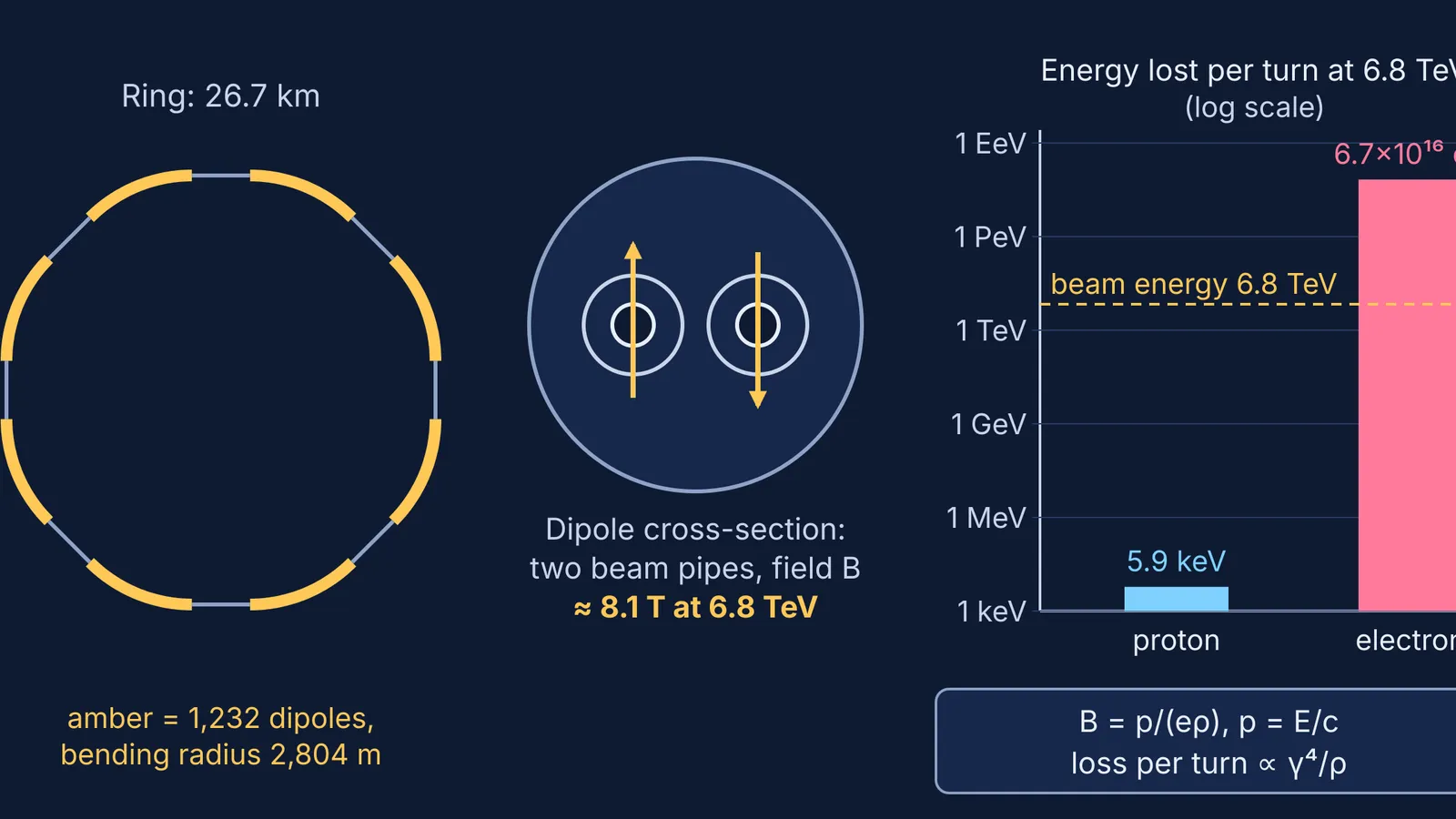
Find the bending radius. Only the dipoles bend the beam. Their total magnetic length is 1,232 × 14.3 m = 17,618 m. If that length makes one full circle, r = 17,618 m ÷ 2π = 2,804 m. This matches the 2,804 m in the review.
Find the momentum. The proton's rest energy is 938 MeV, which is 0.014% of 6.8 TeV, so you can ignore it. For E much larger than mc², E ≈ pc, so p = E/c.
Write the energy in joules. E = 6.8 × 10¹² eV × 1.602 × 10⁻¹⁹ J/eV = 1.09 × 10⁻⁶ J.
Apply B = p/(er) = E/(ecr). Because E is in eV, the charge cancels: B = 6.8 × 10¹² ÷ (3.00 × 10⁸ × 2,804) = 8.09 T.
Check against design. The same formula at 7 TeV gives 8.33 T, exactly CERN's design figure. Units: V·s/m² is the tesla, so the answer is a field.
Why does the low-speed formula give the wrong field?
Try p = √(2mE), the momentum from KE = p²/2m. For a 6.8 TeV proton this gives a momentum 60 times smaller than E/c, and a field of only 0.13 T.
The reason is that KE = ½mv² is a low-speed approximation. A 6.8 TeV proton has a Lorentz factor γ = E/mc² = 6.8 × 10¹² ÷ 9.38 × 10⁸ ≈ 7,250. Its speed is within about one part in 10⁸ of c, so adding energy changes its momentum, not its speed. That is why the field, not the speed, has to rise as the beam is accelerated: B is ramped up in step with p.
Fields of 8 T are far beyond copper-and-iron magnets, so the LHC uses superconducting niobium–titanium coils at 1.9 K. If a coil loses superconductivity, it quenches, and the stored magnetic energy has to be dumped safely. The physics of a quench is the same as in a hospital scanner, which our post on why an MRI magnet stays on and what happens in a quench explains.
Why don't circular colliders this big use electrons?
NCERT's chapter on electromagnetic waves says an accelerated charge radiates. A charge moving in a circle is always accelerating towards the centre, so it radiates all the time. This is called synchrotron radiation. The full formula is beyond JEE, but the scaling is the useful part: for the same energy and radius, the energy lost per turn grows as γ⁴/r.
For our proton, γ ≈ 7,250 and r = 2,804 m. The standard result gives a loss of about 5.9 keV per turn. That is less than one part in a billion of 6.8 TeV, matching the "10⁻⁹ per turn" in the review's parameter table. At the design beam current of 0.58 A, it adds up to about 3.4 kW per beam.
Now put an electron in at the same 6.8 TeV. Its mass is 1,836 times smaller, so its γ is 1,836 times larger. The loss scales as γ⁴:
Ratio = 1,836⁴ ≈ 1.1 × 10¹³.
Loss per turn ≈ 5.9 keV × 1.1 × 10¹³ ≈ 6.7 × 10¹⁶ eV.
Compare with the electron's energy: 6.7 × 10¹⁶ ÷ 6.8 × 10¹² ≈ 10,000.
The electron would need to lose about 10,000 times its own energy on every lap, which is impossible. In practice, electron rings stop far lower. LEP, the electron–positron collider that used the same tunnel before the LHC, ran its beams at about 100 GeV and lost about 3% of their energy every turn, according to the same review's table. Our scaling formula gives 3.2 GeV per turn for a 100 GeV electron at the LHC's radius, which agrees. That is why the tunnel was reused for protons, whose 1,836-times-larger mass makes their radiation tiny. What was found with those protons, the Higgs boson, is told in Peter Higgs and the Higgs boson.
If you want to see how a charge's path changes with B and speed, the Simulation Lab has interactive simulations of motion in fields.
Which exam ideas does the LHC test?
p = qBr is exact; r = mv/qB is only its low-speed form. When E is much larger than mc², use p = E/c.
With E in eV, the charge cancels: B = E/(cr).
A magnetic force does no work, so the magnets steer the beam but never speed it up. Electric fields in radio-frequency cavities do the accelerating.
For more problems on charges in magnetic fields, the Fermi Problem Library has a step-by-step solver that explains the reasoning.
Quick checklist
B = p/(er), with p = E/c at TeV energies.
r = 1,232 × 14.3 m ÷ 2π = 2,804 m, not the ring's 4,243 m.
6.8 TeV needs 8.09 T; the 7 TeV design needs 8.33 T.
Proton loses about 5.9 keV a turn; an electron at the same energy would lose about 10,000 times its own energy.


