

On this page
The main magnet of an MRI scanner stays on at night and on Sundays. That is not waste. Its coil is a superconductor, so once the current is set it keeps going round with no supply, and its field stores several megajoules. Losing that field suddenly, in a quench, turns the energy into heat that boils the liquid helium around the coil. This post works the numbers with ½LI², L/R and latent heat, using published figures for a real 1.5 T magnet. How the scanner makes a picture is covered in how an MRI scanner sees inside your body, so here we stay with the magnet.
How much energy does an MRI magnet store?
A magnetic field stores energy u = B²/2μ₀ per cubic metre.
At 1.5 T: u = 1.5² ÷ (2 × 4π × 10⁻⁷) = 0.90 MJ per m³.
At 3 T: u = 3.58 MJ per m³, four times as much, because u goes as B².
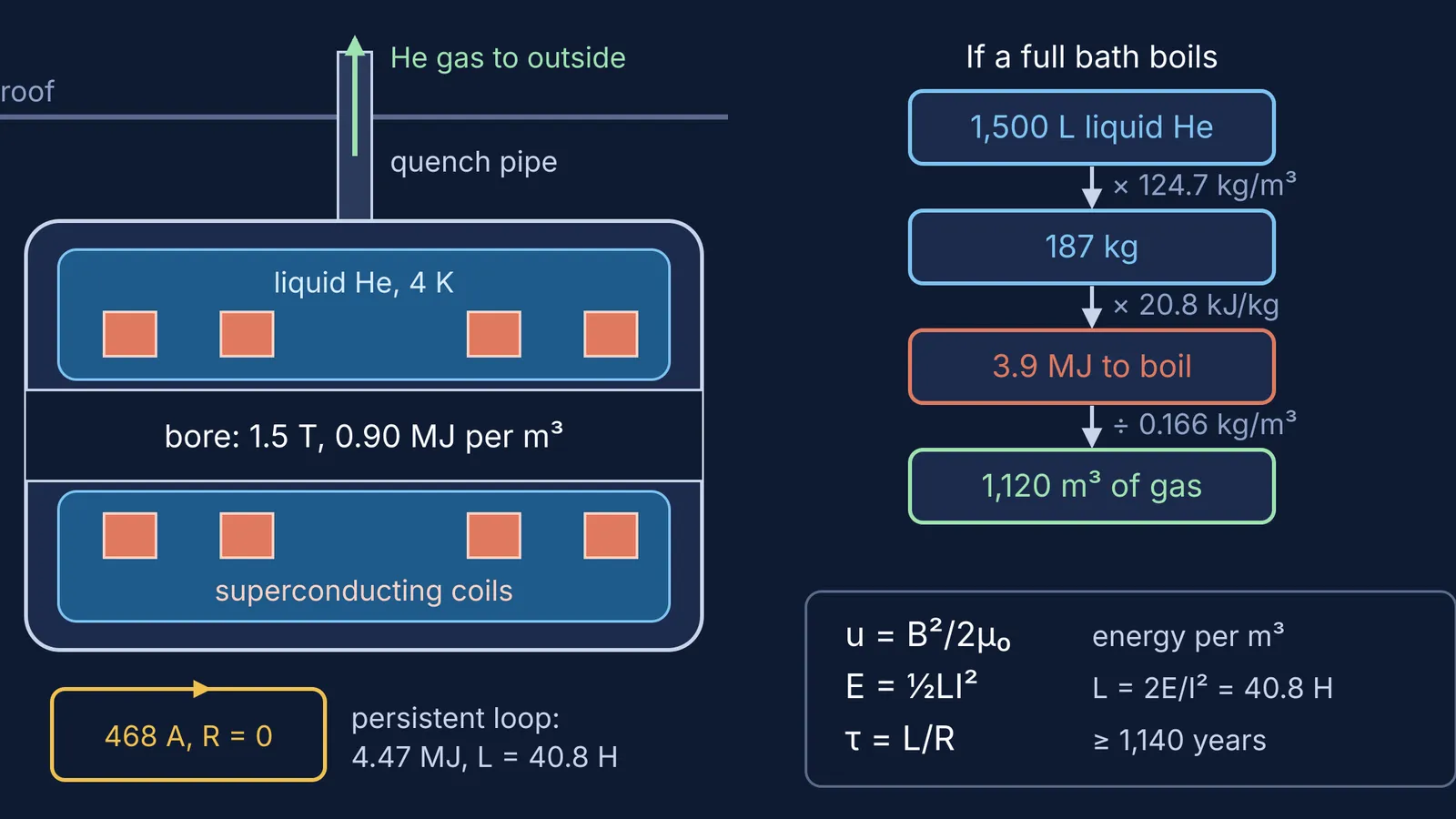
Take the 1.5 T whole-body magnet a Siemens Magnet Technology team described in 2017 (Johnstone et al., poster). Its bore is 950 mm across and the magnet is 1,528 mm long. A cylinder that size at 1.5 T holds 1.08 m³ × 0.90 MJ/m³ = 0.97 MJ. The same poster gives the total stored energy as 4.47 MJ at 468 A. So the bore holds only about a fifth. The rest sits in the field in and around the windings, outside the space where a patient lies.
The same energy in circuit language is E = ½LI². That gives the coil's self-inductance: L = 2E/I² = 2 × 4.47 × 10⁶ ÷ 468² = 40.8 H.
Why does the current keep flowing with no power supply?
The coil's wire is held near 4 K by liquid helium, so it has no resistance. Its two ends are bridged by a superconducting switch: a short piece of the same wire with a small heater. While the heater is on, the bridge is resistive, so a power supply can drive current through the coil. At the target current the heater goes off, the bridge superconducts, and coil and bridge form one closed loop with no resistance. The supply is then disconnected. This is persistent mode.
A loop with inductance L and resistance R loses current as I = I₀e^(−t/τ), with τ = L/R (the same time constant as in growth and decay of current in an LR circuit). The Siemens specification allows a field drift of less than 0.1 ppm per hour. For small t, the fraction lost per hour is about 1/τ, so:
τ ≥ 1 ÷ (10⁻⁷ per hour) = 10⁷ hours, about 1,140 years.
R ≤ L/τ = 40.8 ÷ (3.6 × 10¹⁰ s) = 1.1 × 10⁻⁹ Ω.
So the whole circuit, joints included, has less than about a nanohm. The scanner still uses power, but for the refrigerator that keeps the helium cold, not for the coil.
Why not switch the magnet off at night?
Changing the current in an inductor needs a voltage V = L dI/dt. The Siemens team ramped their magnet at about 0.2 A/s. At that rate:
Time to ramp from 468 A to zero: 468 ÷ 0.2 = 2,340 s, or 39 minutes.
Voltage needed: V = 40.8 × 0.2 = 8.2 V.
The voltage is small, but the time is long. Doing it in 10 s would need 40.8 × 46.8 = 1,910 V. The poster also measured the coils warming during ramps. A persistent coil uses no power, so there is nothing to save by switching off.
What happens when an MRI magnet quenches?
A quench is a sudden loss of superconductivity, not an explosion of the magnet. If a small region of wire warms above its critical temperature, it gains resistance, the 468 A heats it by I²R, and the warm region spreads through the coil. The current decays quickly and the stored ½LI² ends up as heat in the coil and the helium.
UK regulator guidance describes what follows (MHRA, Safety Guidelines for MRI Equipment in Clinical Use, 5th edition, section 4.4.6). A quench produces rapid boiling of the cryogens and a large rise in internal pressure. A burst disc ruptures and the helium gas is normally routed through the quench pipe to the outside. The same guidance lists the cryogen hazards as asphyxiation in oxygen-deficient air, cold burns, and over-pressurisation from the large expansion of the liquid as it evaporates.
How much helium boils off in a quench? A worked example
Data:
A traditional MRI magnet typically holds 1,000–2,000 litres of liquid helium (MHRA guidance, section 4.5.7); Philips uses 1,500 litres for a classic magnet.
Latent heat of helium at 4.2 K: 83.19 J/mol (Donnelly and Barenghi, Table 16.3). With a molar mass of 4.003 g/mol, that is 20.8 kJ/kg.
Density of liquid helium at 1 atm: 124.7 kg/m³ (NIST Chemistry WebBook).
Mass. 1,500 L is 1.5 m³, so the mass is 1.5 × 124.7 = 187 kg.
Energy to boil it. 187 kg × 20.8 kJ/kg = 3.9 MJ. That is less than the 4.47 MJ stored in the Siemens magnet. So a magnet this size carries enough energy to boil a full conventional bath, though in a real quench part of it warms the coil. (The Siemens prototype itself held only about 20 litres; this is a comparison.)
Why so little energy is needed. Water needs 2,260 kJ/kg to boil, about 109 times more than helium.
Gas volume. At 20 °C and 1 atm, helium gas has density ρ = PM/RT = 101,325 × 0.004003 ÷ (8.314 × 293) = 0.166 kg/m³. So 187 kg becomes 187 ÷ 0.166 = 1,120 m³ of gas.
Expansion. 124.7 ÷ 0.166 = 750. A scanner room 6 m × 5 m × 3 m holds 90 m³, so the gas would fill it about 12 times over. That is why the gas is piped outside.
If ½LI² and τ = L/R still feel abstract, the Simulation Lab has interactive simulations for ideas that are easier to see than read.
Why do newer MRI scanners use so little helium?
The MHRA guidance (section 4.5.7) describes low-cryogen systems holding from under 1 litre to a few tens of litres in a sealed cryostat, where a cryocooler recondenses the gas, and in many designs no quench pipe is needed, subject to the manufacturer's safety case. Philips states its sealed design holds 7 litres. The magnet still stores megajoules, so with little liquid to boil, the coil and its cold structure must absorb that heat. Helium's strange behaviour as a liquid below 2.2 K is a separate story, told in Kapitsa and superfluid helium.
Quick checklist
Field energy density: u = B²/2μ₀, 0.90 MJ/m³ at 1.5 T.
A 1.5 T whole-body magnet: 4.47 MJ at 468 A, so L = 2E/I² = 40.8 H.
Persistent mode: a superconducting switch closes the loop; τ = L/R is centuries or more.
Ramping at 0.2 A/s takes 39 minutes at 8.2 V, from V = L dI/dt.
A quench is a loss of superconductivity; the stored energy boils helium.
1,500 L of liquid helium is 187 kg, needs 3.9 MJ to boil and becomes about 1,120 m³ of gas.


