

On this page
Why do particles have mass at all? In 1964 Peter Higgs proposed part of the answer, and it took 48 years and what the Nobel press release calls probably the largest and most complex machine ever constructed to confirm it. This post tells the story of Peter Higgs and the particle named after him, and works through what the headline numbers from 2012 actually mean.
Who was Peter Higgs?
Nobel Prize records give his birth as 29 May 1929 in Newcastle upon Tyne and his death as 8 April 2024 in Edinburgh. He was at the University of Edinburgh when he received the 2013 Nobel Prize in Physics, shared with François Englert, "for the theoretical discovery of a mechanism that contributes to our understanding of the origin of mass of subatomic particles, and which recently was confirmed through the discovery of the predicted fundamental particle, by the ATLAS and CMS experiments at CERN's Large Hadron Collider".
What did the 1964 papers propose?
The Nobel press release explains that in 1964 Englert, together with his colleague Robert Brout, and Higgs proposed the theory independently. Their papers appeared that year in Physical Review Letters: Englert and Brout's Broken Symmetry and the Mass of Gauge Vector Mesons and Higgs's Broken Symmetries and the Masses of Gauge Bosons.
In the press release's words, the Higgs particle originates from an invisible field that fills up all space, and it is from contact with the field that particles acquire mass. The theory predicted that the field should show up as a particle, if a collider could make one.
How was the particle found?
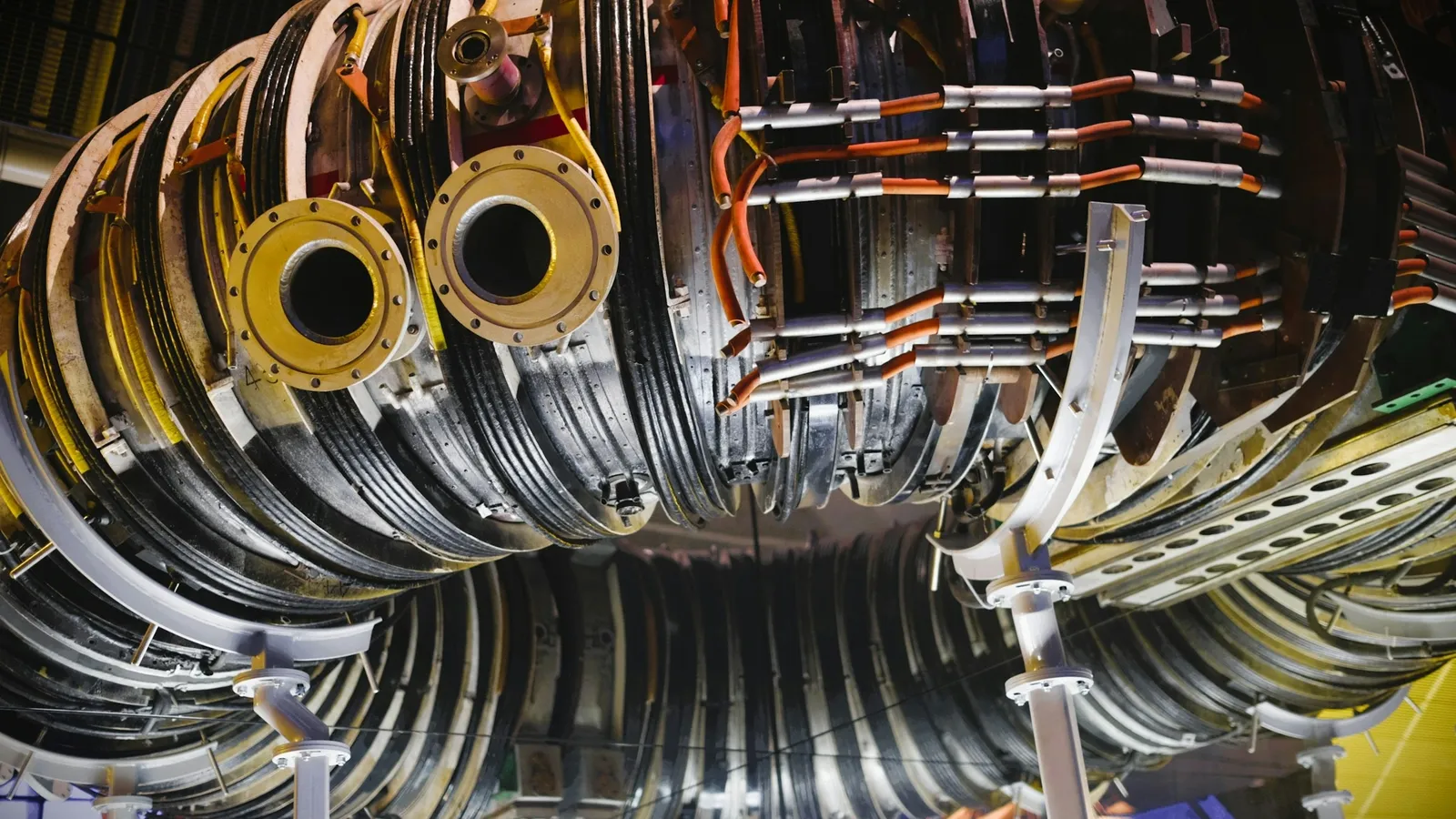
The press release says that on 4 July 2012, at CERN, the theory was confirmed by the discovery of a Higgs particle. Two research groups of some 3,000 scientists each, ATLAS and CMS, extracted it from billions of collisions in the Large Hadron Collider.
Their papers give the details:
ATLAS reported a neutral boson with a measured mass of 126.0 ± 0.4 (stat) ± 0.4 (sys) GeV, at a significance of 5.9 standard deviations, corresponding to a background fluctuation probability of 1.7 × 10⁻⁹.
CMS reported an excess at a mass near 125 GeV with a local significance of 5.0 standard deviations, and a fitted mass of 125.3 ± 0.4 (stat) ± 0.5 (syst) GeV. It noted that the decay to two photons indicates a boson with spin different from one.
Two independent detectors, built and run by different teams, found the same thing at the same mass. That agreement mattered as much as either result alone.
Worked example 1: how heavy is 125 GeV?
Particle physicists quote mass as energy, using E = mc². Use the elementary charge e = 1.602 × 10⁻¹⁹ C and proton mass 1.673 × 10⁻²⁷ kg from NIST's CODATA values.
Step 1: convert to joules. 1 eV = 1.602 × 10⁻¹⁹ J, so 125 GeV = 125 × 10⁹ × 1.602 × 10⁻¹⁹ = 2.003 × 10⁻⁸ J.
Step 2: divide by c². m = E/c² = 2.003 × 10⁻⁸ ÷ (2.998 × 10⁸)² = 2.003 × 10⁻⁸ ÷ 8.988 × 10¹⁶ = 2.23 × 10⁻²⁵ kg.
Step 3: compare with a proton. 2.23 × 10⁻²⁵ ÷ 1.673 × 10⁻²⁷ = 133. The Higgs boson is about 133 times as massive as a proton.
Worked example 2: what does five sigma mean?
ATLAS gives a background fluctuation probability of 1.7 × 10⁻⁹. That is 1 in 1 ÷ (1.7 × 10⁻⁹) ≈ 590 million.
Read this carefully. It is the chance that background processes alone, with no new particle, would produce a bump at least this large. It is not the probability that the particle is fake, and 1 minus it is not the probability that the theory is true.
What mistakes do students make with these ideas?
Mixing GeV and GeV/c². Strictly, mass is in GeV/c²; physicists drop the c² by habit. Put it back before converting to kilograms.
Forgetting the 10⁹. Giga means 10⁹; dropping it gives an answer a billion times too small.
Saying "the Higgs gives everything its mass". The Nobel motivation is careful: a mechanism that "contributes to our understanding of the origin of mass of subatomic particles".
Treating one experiment as the discovery. The confirmation rested on ATLAS and CMS agreeing.
For the related theory that unified the electromagnetic and weak forces, read our post on Abdus Salam and electroweak theory. For E = mc² itself, see Einstein's 1905 papers.
What can a student take from Higgs's way of working?
The 1964 idea was a short theoretical paper. Confirming it took 48 years, a collider, and thousands of experimenters checking each other's work. Higgs's story shows that a clear idea can wait a long time for evidence, and that the evidence has to be read with care.
When you meet a new equation in modern physics, write out the units at each step as worked example 1 did. If the jump from E = mc² to particle masses feels unfamiliar, the Fermi Concept Library has every concept in physics, chemistry, biology, mathematics and computing with its own lesson.
Convert the CMS value of 125.3 GeV into kilograms yourself and compare it with your answer from worked example 1.


