

On this page
The battery under a car bonnet or behind a home inverter is a lead storage battery, and it is one of the most asked electrochemistry examples in CBSE Class 12, JEE and NEET. You need to know four things: what the plates are made of, what happens at each electrode when it discharges, what reverses when you charge it, and why each cell gives about 2 V. Add one Faraday's-law numerical and you have the whole topic.
How is a lead storage battery built?
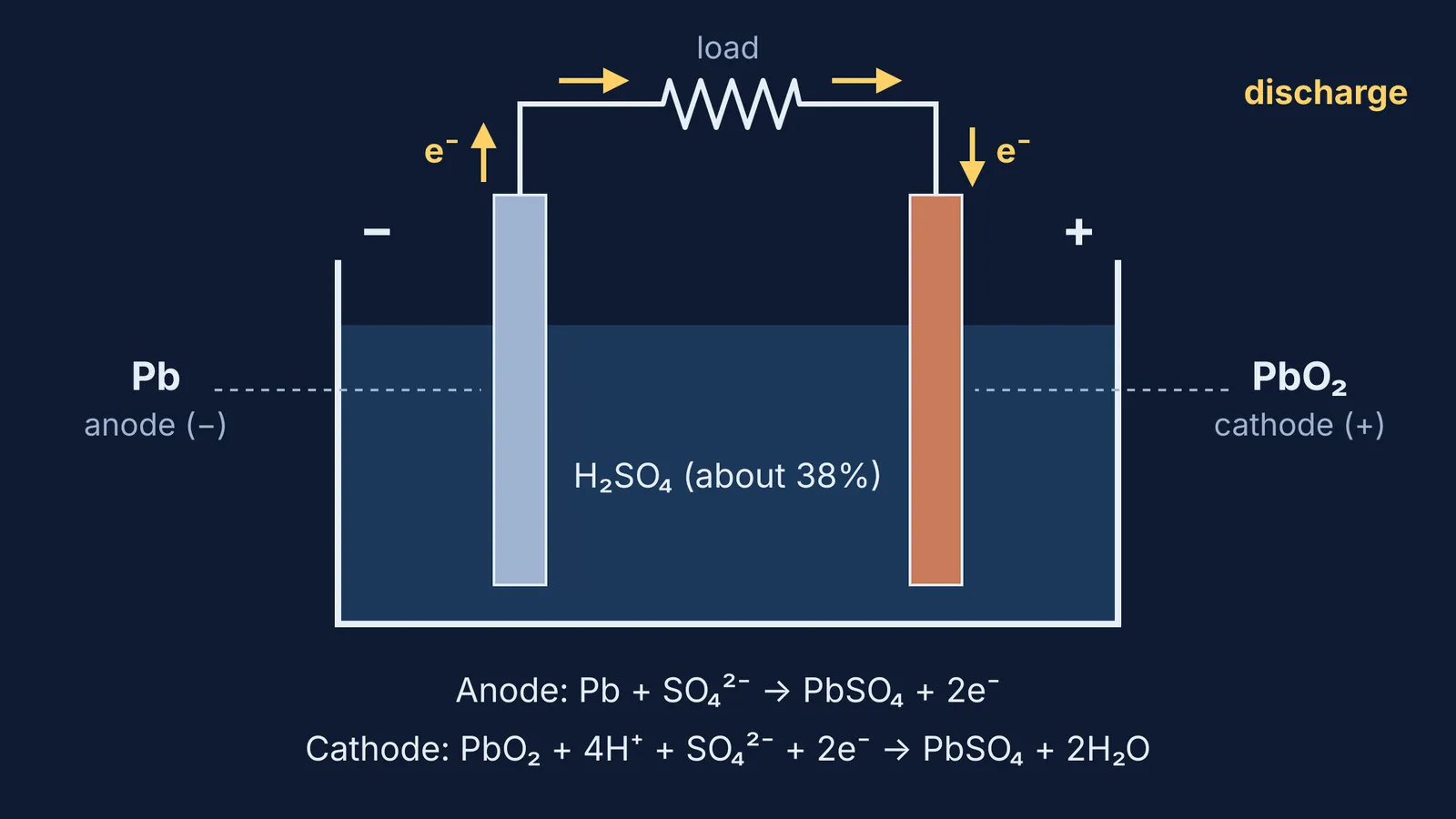
Each cell has two kinds of plates dipped in the same electrolyte.
Anode (negative plate): spongy lead, Pb.
Cathode (positive plate): a lead grid packed with lead dioxide, PbO₂.
Electrolyte: sulphuric acid, about 38% by mass.
Many plates of each kind are interleaved and separated so they cannot touch. A 12 V car or inverter battery is six such cells connected in series. If you want a wider picture of where this cell fits among dry cells, mercury cells and fuel cells, see our post on batteries and fuel cells, worked through.
What are the reactions during discharge?
When the battery runs a load, it works as a galvanic cell. Lead is oxidised at the anode and lead dioxide is reduced at the cathode. Both electrodes end up as lead sulphate, which is insoluble and sticks to the plates.
Anode (oxidation): Pb(s) + SO₄²⁻(aq) → PbSO₄(s) + 2e⁻
Cathode (reduction): PbO₂(s) + SO₄²⁻(aq) + 4H⁺(aq) + 2e⁻ → PbSO₄(s) + 2H₂O(l)
Overall: Pb(s) + PbO₂(s) + 2H₂SO₄(aq) → 2PbSO₄(s) + 2H₂O(l)
Electrons leave the Pb plate, pass through the external circuit and enter the PbO₂ plate. Check the oxidation states: lead goes from 0 to +2 at the anode and from +4 to +2 at the cathode. Two electrons are transferred per Pb atom and per PbO₂ unit.
Which electrode is the anode when you charge it?
Charging means connecting an external DC source that pushes current the other way. Now the cell works as an electrolytic cell and every reaction runs in reverse.
Overall: 2PbSO₄(s) + 2H₂O(l) → Pb(s) + PbO₂(s) + 2H₂SO₄(aq)
At the negative plate, PbSO₄ is reduced back to lead: PbSO₄(s) + 2e⁻ → Pb(s) + SO₄²⁻(aq). Reduction happens here, so this plate is now the cathode.
At the positive plate, PbSO₄ is oxidised back to lead dioxide: PbSO₄(s) + 2H₂O(l) → PbO₂(s) + SO₄²⁻(aq) + 4H⁺(aq) + 2e⁻. Oxidation happens here, so this plate is now the anode.
The terminal signs do not change. The Pb plate stays negative and the PbO₂ plate stays positive. Only the names anode and cathode swap, because those names follow the reaction (oxidation at the anode, always), not the sign.
This is why it is called a secondary cell: the discharge products stay on the plates as solid PbSO₄, so passing current backwards rebuilds Pb and PbO₂, and the cell can be used again and again. A primary cell such as a dry cell cannot be recharged this way.
Why does each cell give about 2 V, and six cells 12 V?
Use the standard reduction potentials of the two half-cells:
PbO₂/PbSO₄: E° ≈ +1.69 V
PbSO₄/Pb: E° ≈ −0.36 V
E°cell = E°cathode − E°anode = 1.69 − (−0.36) = 2.05 V
So one cell gives a little over 2 V. Six cells in series add up: 6 × 2.05 ≈ 12.3 V, which is the familiar 12 V battery. The actual voltage depends slightly on the acid concentration, as the Nernst equation predicts, so it drifts down as the battery discharges.
You can also get the free energy change. With n = 2 electrons per Pb:
ΔG° = −nFE° = −2 × 96500 × 2.05 = −395650 J ≈ −396 kJ per mole of Pb
The large negative ΔG° tells you the discharge reaction is strongly spontaneous.
Why does a hydrometer show how charged the battery is?
Look at the overall equation again. Discharge uses up 2H₂SO₄ and makes 2H₂O. The acid gets more dilute, and dilute acid is less dense than concentrated acid. A fully charged battery has a specific gravity of roughly 1.28; it falls steadily as the battery discharges. A hydrometer reads that density directly, so it tells you the state of charge without any electrical test. Charging reverses the change: H₂SO₄ is regenerated and the density rises again.
Overcharging electrolyses some water into H₂ and O₂, so the water level drops over time. That is why you top up with distilled water only, never tap water or more acid; our post on why only distilled water goes in an inverter battery explains the impurities that cause trouble.
If you find it hard to picture which way the electrons and ions move in each mode, the Simulation Lab has interactive simulations for ideas easier to see than read.
How much H₂SO₄ is used up? A worked Faraday's-law numerical
Question. A lead storage battery supplies a steady current of 2.0 A for 5.0 hours. Find the mass of H₂SO₄ consumed and the mass of Pb used up at the anode. (F = 96500 C mol⁻¹, H₂SO₄ = 98 g mol⁻¹, Pb = 207.2 g mol⁻¹)
Step 1: charge passed. Q = I × t = 2.0 A × (5.0 × 3600 s) = 36000 C
Step 2: moles of electrons. n(e⁻) = Q / F = 36000 / 96500 = 0.373 mol
Step 3: link electrons to H₂SO₄. From the overall equation, 2 mol of electrons flow for every 2 mol of H₂SO₄ consumed. So 1 mol e⁻ ≡ 1 mol H₂SO₄. n(H₂SO₄) = 0.373 mol Mass = 0.373 × 98 = 36.6 g
Step 4: lead used at the anode. Pb → PbSO₄ releases 2e⁻, so n(Pb) = 0.373 / 2 = 0.1865 mol Mass = 0.1865 × 207.2 = 38.6 g
Step 5 (bonus): water formed. 2 mol H₂O form per 2 mol e⁻, so 0.373 mol H₂O = 0.373 × 18 = 6.7 g.
The most common slip is the ratio in step 3. Students write one H₂SO₄ per two electrons because the anode half-reaction has one SO₄²⁻. But the cathode also takes one SO₄²⁻, so the full cell uses two H₂SO₄ per two electrons. If the 96500 itself puzzles you, read why the Faraday constant is 96500 C/mol. To practise more of these, the Fermi Problem Library has a step-by-step solver that explains the reasoning at each step.
Quick checklist before the exam
Anode Pb, cathode PbO₂, electrolyte about 38% H₂SO₄.
Discharge: Pb + PbO₂ + 2H₂SO₄ → 2PbSO₄ + 2H₂O.
Charging reverses it; the Pb plate becomes the cathode and the PbO₂ plate the anode, but the + and − terminals stay the same.
E°cell = 1.69 − (−0.36) ≈ 2.05 V per cell; six cells give about 12 V.
Acid is consumed on discharge, so density falls; a hydrometer reads the state of charge.
It is a secondary cell because insoluble PbSO₄ stays on the plates and can be converted back.
Faraday link: 1 mol e⁻ ≡ 1 mol H₂SO₄ ≡ ½ mol Pb.


