On this page
When the power goes out, the inverter in the corner runs your fans off a lead-acid battery, and every so often someone has to open the little caps and add distilled water. Here is why, plus a checklist for the cupboard door. For the inverter itself, see how a home inverter keeps your fans running in a power cut.
What happens inside a lead-acid cell?
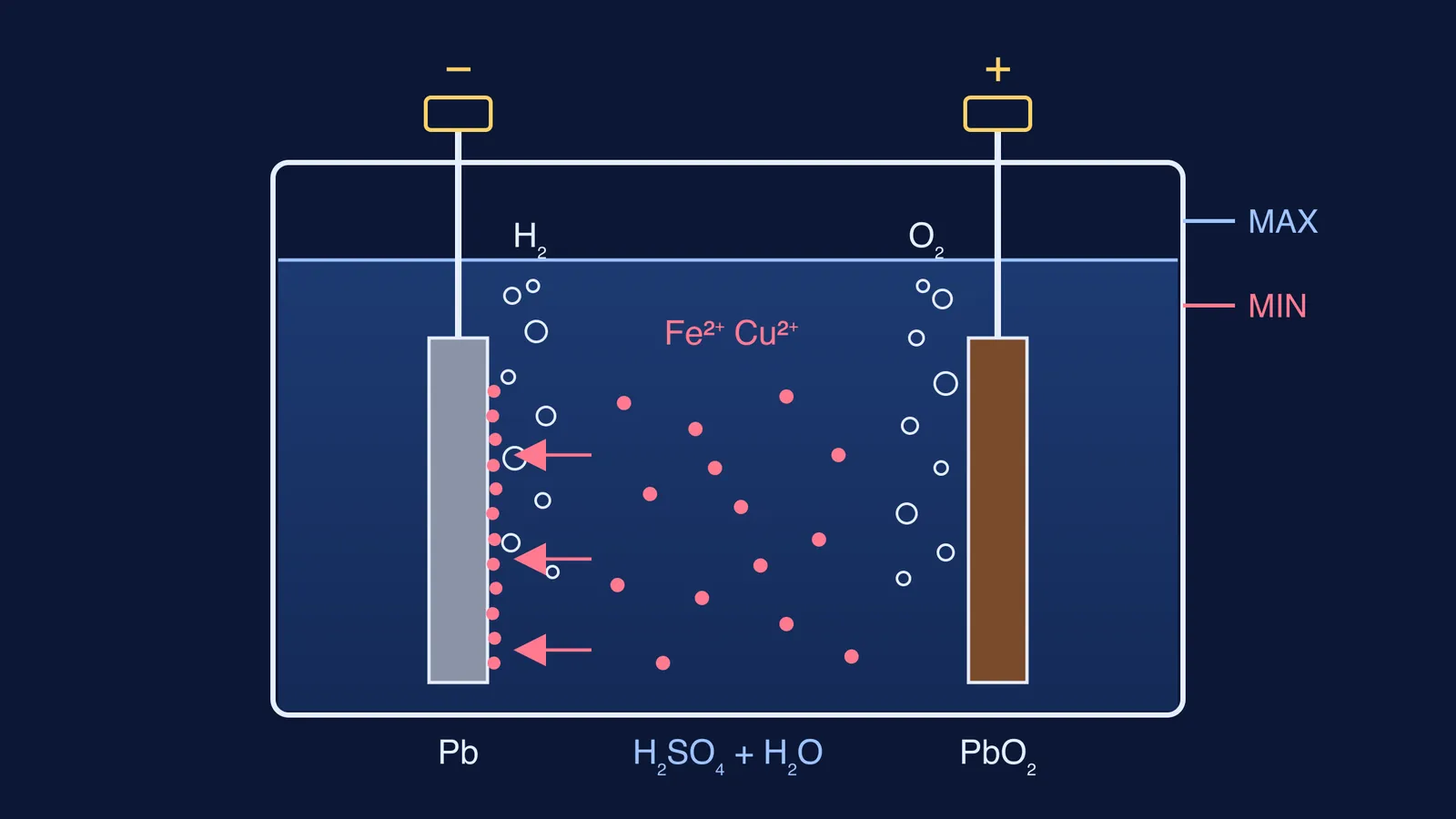
Each cell has two lead grids standing in sulphuric acid: in the negative plate the grid is packed with spongy lead (Pb), and in the positive plate with brown lead dioxide (PbO₂), as Chemistry LibreTexts describes.
When the battery powers your fans, both plates turn into lead sulphate: Pb + PbO₂ + 4H⁺ + 2SO₄²⁻ → 2PbSO₄ + 2H₂O. Charging runs the reaction backwards.
A fully charged lead-acid cell gives 2.0 volts, according to LibreTexts, so a 12-volt inverter battery is six cells joined in series. For the history, read about Gaston Planté and the lead battery that could be recharged.
Why does the water level keep dropping?
If charging continues once the cell is full, the current goes into splitting water instead: hydrogen gas forms at one plate and oxygen at the other (LibreTexts).
What leaves is water; the sulphate stays in the acid. So you replace only water: the Canadian Centre for Occupational Health and Safety says to add distilled water and not to add sulphuric acid (CCOHS).
That hydrogen is a safety issue too: it is explosive in air at concentrations from 4.1 to 72 percent, according to CCOHS.
Why only distilled water and not tap water?
India's drinking-water standard, IS 10500:2012, sets acceptable limits of 500 mg of total dissolved solids, 200 mg of hardness (as calcium carbonate) and 1.0 mg of iron per litre, with higher permissible limits for dissolved solids and hardness, as listed in IIT Kanpur's summary of IS 10500.
A worked example, using that 500 mg/L limit: each litre carries 0.5 g of dissolved solids. Pour in one litre at each of six top-ups a year and about 3 g of minerals stay inside the battery, because charging removes the water and leaves the minerals. It is the same build-up you see in a kettle, or in why tea cups get brown stains from hard water.
Inside a battery, some of those ions do harm. Metals such as iron, copper or manganese may deposit on the negative plate and form many tiny local galvanic cells that speed up hydrogen release and capacity loss, explains battery maker EverExceed. The battery slowly drains itself even when nothing is switched on. Battery maker Hoppecke says "even tap water contains trace elements and minerals which are detrimental impurities for batteries" (Hoppecke).
In a 2012 study in the Journal of Electrochemical Science and Technology, H.A. Abd El-Rahman and colleagues added 0.1 wt% of copper, arsenic or antimony to lead-calcium-tin positive grids and found that, on open circuit, self-discharge of the charged grids rose by 92 to 212% (JECST, 2012). That study tested metals in the grid, not in water, but it shows how little metal it takes.
Battery water has its own Indian standard, IS 1069:2021, Quality tolerances for water for storage batteries. Packaged drinking water is no substitute: Luminous says to use distilled water, "not tap water or packaged drinking water".
How do you top up an inverter battery safely?
Trojan Battery advises checking monthly after installation to build a routine; Luminous suggests every two to three months, more often in peak summer or heavy use.
Wait until charging has finished and the battery has cooled, as CCOHS advises, then switch the inverter off; Genus says never to top up while it is charging or on.
Check the room is well ventilated, with no flame, agarbatti or spark nearby.
Put on chemical-resistant gloves and safety goggles, as CCOHS recommends.
Read the float indicators: Genus marks the low level red and the full level green, so red means top up.
Open the vent caps and wipe away dust around them with a dry, clean cloth, as Genus suggests.
With a clean funnel, pour distilled water slowly up to the recommended mark, not to the brim; Luminous warns that overfilling can cause leakage during charging.
Never let the level fall below the top of the plates, and never add acid (Trojan Battery).
Close the caps and note the date.
If acid splashes on skin or in an eye, CCOHS advises flushing immediately with clean, lukewarm, gently flowing water for at least 30 minutes; then get medical help. Younger children should watch, not pour.
What does a battery top-up teach you about electrochemistry?
One battery holds three ideas from school chemistry: a reversible cell, electrolysis of water, and stray ions reacting where they should not. If the half-reactions still feel shaky, the Fermi Concept Library gives every concept in chemistry its own lesson and its place in the map, so you can see how cells, electrolysis and redox connect.
Next time the indicator turns red, let the teenager in the house do the top-up with an adult beside them, and explain the chemistry out loud.