

On this page
When the power goes off and the fan keeps turning, three ideas from your physics and chemistry books are working together: a chemical cell that stores energy, a switch that turns DC into AC, and a transformer that raises the voltage.
What is inside a home inverter setup?
There are two boxes. The battery stores energy. The inverter unit charges the battery while the mains is on and powers your chosen sockets from it when the mains fails.
Indian homes get alternating current at 230 V and 50 Hz, according to the table of mains electricity by country. A battery can only give direct current, which flows one way at a steady voltage. So the inverter's real task is to rebuild the mains waveform from a flat 12 V. If the AC and DC difference is still fuzzy, our post on AC versus DC and why India uses 50 Hz sets it out.
How does the battery store energy?
A common choice is lead-acid, the rechargeable design Gaston Planté invented. Each cell has a spongy lead plate and a lead dioxide plate in sulfuric acid, and each cell gives about 2 V, so a 12 V battery is six cells in series, as LibreTexts Chemistry/20%3A_Electrochemistry/20.07%3A_Batteries_and_Fuel_Cells) explains.
While it discharges, both plates turn into lead sulfate and the acid gets weaker. Charging pushes the reaction backwards: above 2.04 V per cell, lead sulfate turns back into lead and lead dioxide, according to the same LibreTexts chapter/20%3A_Electrochemistry/20.07%3A_Batteries_and_Fuel_Cells). For six cells that means the charger must supply more than 6 × 2.04 = 12.24 V. The same source warns that charging too vigorously can split water into explosive hydrogen, so keep the battery somewhere airy.
So the battery does not hold a bucket of electrons. It holds energy as chemistry, ready to become current again.
How does an inverter turn DC into AC?
An inverter makes AC from DC by switching the direction of the DC input back and forth very rapidly, and filters can then smooth the result into a sine wave, according to the US Department of Energy.
Picture four electronic switches around the battery. Close one pair and current flows one way through the transformer; close the other pair and it flows the other way. Swap so the full cycle repeats 50 times a second and you have 50 Hz AC, though at only 12 V.
The transformer then steps it up. Mains at 230 V rms has a peak of 230 × √2 ≈ 325 V (our peak voltage of mains post walks through why). In an ideal transformer the voltage ratio equals the turns ratio, so lifting 12 V pulses to a 325 V peak needs roughly 325 ÷ 12 ≈ 27 times as many turns on the output side. Real designs differ, partly because battery voltage drops as it discharges.
Pure sine or modified sine: does it matter?
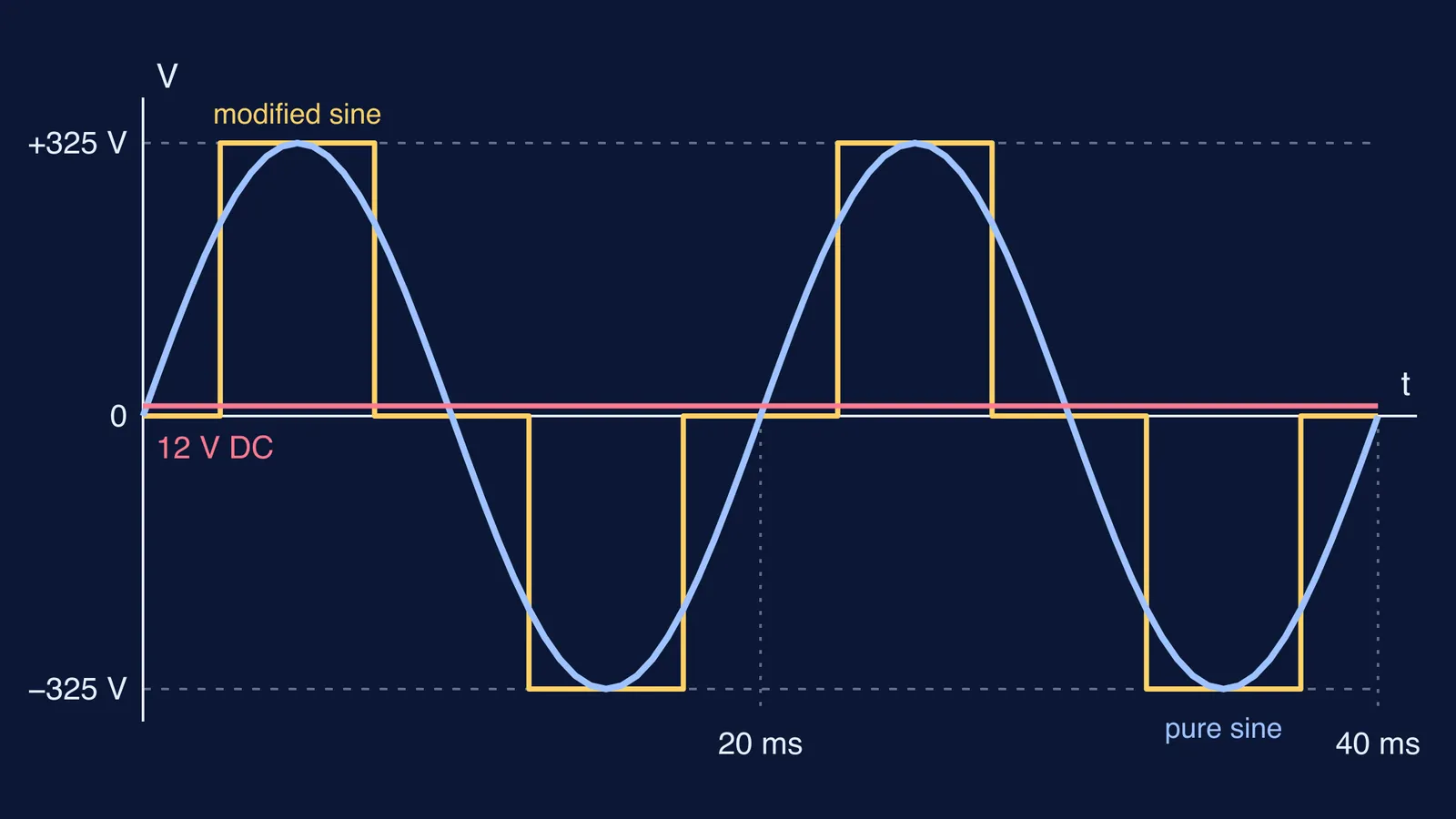
A pure sine wave rises and falls smoothly. A modified sine wave changes abruptly and sits at 0 V for a while before changing sign, as the inverter maker Samlex explains. The same page says motors and microwaves run cooler and quieter on a pure sine wave, fans make less noise on one, and devices that sense the zero crossing may not work properly on a modified wave.
Both waves in the diagram have the same 325 V peak and the same 230 V rms, but the stepped one carries extra harmonics, higher frequencies that Samlex links to extra heating in motors.
How long will an inverter run your fans and lights?
Say you have a 12 V, 150 Ah battery. Stored energy is voltage times charge: 12 V × 150 Ah = 1800 Wh.
Your load during a power cut:
2 ceiling fans at 75 W each: 150 W
4 LED bulbs at 10 W each: 40 W
1 Wi-Fi router: 10 W
Total: 200 W. In an ideal world, 1800 Wh ÷ 200 W = 9 hours.
The battery must push at least 200 W ÷ 12 V ≈ 17 A, a large current, which is why inverter cables are thick. Real run time is shorter, because the switches and transformer lose some energy as heat and a lead-acid battery should not be drained flat. Use 9 hours as the ceiling, not the promise, and check the battery's manual for the safe depth of discharge.
To plan your own:
Read the battery label for its voltage and Ah.
Multiply them to get watt-hours.
Add up the wattage printed on each appliance you will run.
Divide, then treat the answer as an upper limit.
Switching, transformers and sine waves are easier to grasp when you can watch them move. The Fermi Simulation Lab has interactive simulations for ideas that are easier to see than to read.


