

On this page
This set follows our first set of laws of motion NEET practice questions. Set 2 tests what set 1 skipped: third-law pairs, recoil, concurrent forces, lifts, a whirled string and force as rate of change of momentum.
Which parts of laws of motion does set 2 test?
Laws of Motion is Unit 3 of the physics syllabus in the NMC syllabus for NEET (UG)-2026, published by NTA. The unit lists Newton's three laws, impulse, conservation of linear momentum, equilibrium of concurrent forces, static and kinetic friction, and uniform circular motion; all eight questions stay inside it.
Not planned the chapter yet? Start with our guide on how to prepare laws of motion for NEET.
How should you use this set?
Cover the answers and time yourself: about a minute for each easy question, two for each hard one.
Draw a free-body diagram for every body before writing an equation.
Count a guess as wrong; read every trap.
Use g = 10 m/s², sin 37° = 0.6 and cos 37° = 0.8.
Easy: do you know which force is which?
Q1 (easy). A book rests on a table. The Earth pulls the book down with a force equal to its weight. Which force is the Newton's-third-law partner of this pull?
(A) The table's upward push on the book (B) The book's upward pull on the Earth (C) The book's downward push on the table (D) The table's upward push on the floor
Answer: (B). Third-law partners act on two different bodies and are the same type of force: the Earth pulls the book by gravity, so the book pulls the Earth up by gravity. Trap: (A) is equal and opposite too, but both forces act on the book, so they balance it rather than form a pair. Our post on spotting Newton's third law pairs has more examples.
Q2 (easy). A 4 kg rifle at rest fires a 10 g bullet at 400 m/s. With what speed does the rifle recoil?
(A) 10 m/s (B) 0.1 m/s (C) 1 m/s (D) 2 m/s
Answer: (C). Total momentum stays zero, so 4 × V = 0.010 × 400 = 4 kg m/s, and V = 1 m/s. Trap: (A) reads 10 g as 0.1 kg instead of 0.01 kg.
Q3 (easy). You hold a 2 kg block against a vertical wall by pushing it horizontally. The coefficient of static friction between block and wall is 0.4. What is the least push that stops the block from sliding down?
(A) 8 N (B) 20 N (C) 50 N (D) 5 N
Answer: (C). Your push is the normal force, and friction must carry the weight: 0.4 × F ≥ 20 N, so F ≥ 50 N. Trap: (A) multiplies μ by the weight, as if the weight pressed the block into the wall.
Medium: can you balance forces and handle a lift?
Q4 (medium). A 2 kg bob hangs on a string. A horizontal force pulls it aside and holds it at rest with the string at 37° to the vertical. What is the tension in the string?
(A) 20 N (B) 16 N (C) 15 N (D) 25 N
Answer: (D). Three concurrent forces balance. Vertically, T cos 37° = 20 N, so T = 20 / 0.8 = 25 N. Trap: (B) takes T = mg cos 37°, a habit carried over from inclines.
Q5 (medium). A string that breaks at 39 N hangs a 3 kg mass from the ceiling of a lift. What is the largest upward acceleration of the lift before the string breaks?
(A) 13 m/s² (B) 3 m/s² (C) 23 m/s² (D) 1.3 m/s²
Answer: (B). For the mass, T − mg = ma, so 39 − 30 = 3a and a = 3 m/s². Trap: (A) divides 39 N by 3 kg and forgets that part of the tension only holds up the weight.
Q6 (medium). A 0.5 kg puck on a smooth horizontal table is tied by a 0.4 m string to a fixed peg and circles it. The string breaks at 20 N. What is the shortest period the puck can have?
(A) 0.63 s (B) 0.10 s (C) 1.57 s (D) 0.31 s
Answer: (A). Tension alone supplies the centripetal force: T = mω²r, so ω = √(20 / (0.5 × 0.4)) = 10 rad/s and the period is 2π/ω = 0.63 s. Trap: (C) divides 2π by the speed, 4 m/s, not the angular speed.
Hard: can you think in rates and directions?
Q7 (hard). Sand drops vertically at 4 kg/s onto a conveyor belt that moves horizontally at a steady 3 m/s. What extra horizontal force must the motor apply to keep the belt at that speed?
(A) 0 N (B) 6 N (C) 12 N (D) 40 N
Answer: (C). Each second, 4 kg of sand gains 3 m/s of horizontal speed, so the force is v × (dm/dt) = 3 × 4 = 12 N. Trap: (A) reasons that constant speed needs no force, but the moving mass keeps growing.
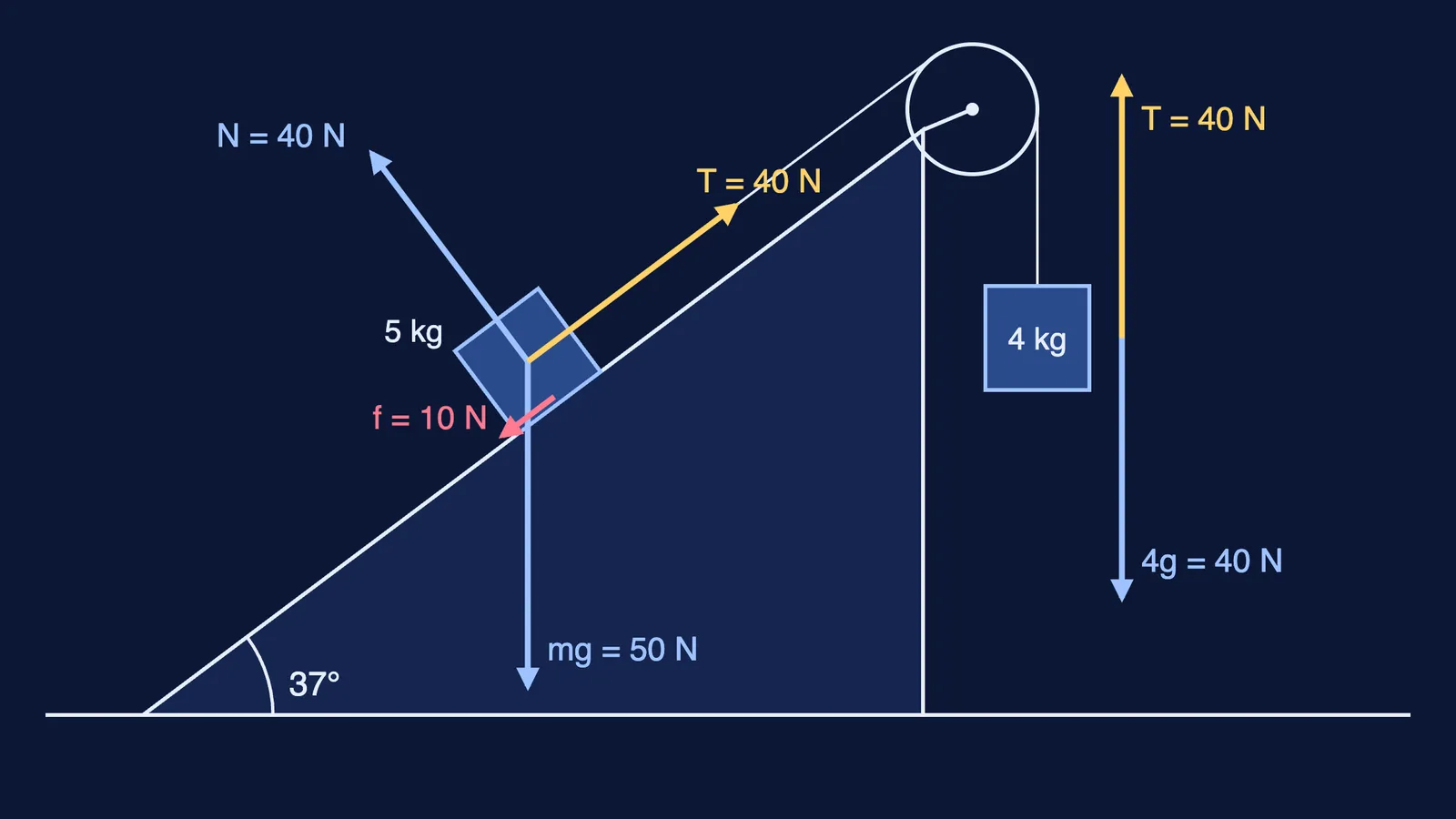
Q8 (hard). A 5 kg block rests on a 37° incline (μs = 0.5). A string from it runs up the slope, over a smooth pulley at the top, to a hanging 4 kg mass. What is the friction force on the block?
(A) 20 N down the slope (B) 10 N down the slope (C) 10 N up the slope (D) 20 N up the slope
Answer: (B). The hanging mass pulls with 40 N, while gravity pulls the block down the slope with 50 × 0.6 = 30 N. Limiting friction is 0.5 × 50 × 0.8 = 20 N, and the 10 N imbalance is less, so nothing moves and friction supplies exactly 10 N down the slope. Trap: (A) assumes friction always takes its limiting value μN.
The diagram at the top shows Q8's forces drawn to scale.
What should you do after set 2?
Log each miss in one line: question, trap, correct first step. Missed Q1 or Q3? Redraw with one diagram per body. Missed Q7 or Q8? Ask what is changing, or which way the body would slip without friction, before you write anything.
When a wrong method keeps coming back, the Fermi Problem Library has worked problems with a step-by-step solver that explains the reasoning rather than printing an answer.


