

On this page
This set follows our first set of Kinematics NEET practice questions and covers the parts of the chapter that set 1 skipped: scalar and vector products, braking distance, a release from a climbing drone, reading a projectile from its range and height, and comparing circular motions.
Kinematics is Physics Unit 2 in the NMC syllabus for NEET (UG)-2026. That unit names the frame of reference, relations for uniformly accelerated motion, scalar and vector products, unit vectors, resolution of a vector, projectile motion and uniform circular motion, and every question here stays inside it.
How should you use kinematics set 2?
Hide the answers and allow about a minute per question.
Write down your equation before touching the numbers.
Mark each question right, wrong or guessed, and count a guess as wrong.
For every miss, read the trap line and ask whether that was your slip.
Take g = 10 m/s² and ignore air resistance. If vectors or projectiles feel shaky, read our guide on how to prepare kinematics for NEET first.
Easy: can you handle vector products and braking distance?
Q1 (easy). For A = 2î + pĵ + k̂ and B = 3î − 2ĵ + 4k̂ to be perpendicular, what must p be?
(A) −5 (B) 5 (C) 1 (D) 3
Answer: (B). Perpendicular vectors have a zero scalar product: 2 × 3 + p × (−2) + 1 × 4 = 10 − 2p = 0, so p = 5.
Trap: (A) comes from a sign slip on the −2ĵ term, and (D) drops the k̂ term altogether.
Q2 (easy). A motorbike moving at 40 km/h stops in 16 m when braked. With the same deceleration, how far does it take to stop from 60 km/h?
(A) 24 m (B) 32 m (C) 36 m (D) 54 m
Answer: (C). From v² = u² − 2as with v = 0, stopping distance is u²/2a, so it grows with the square of the speed. The speed rises 1.5 times, so the distance is 16 × 1.5² = 36 m.
Trap: (A) scales the distance with speed instead of speed squared.
Q3 (easy). Two sides of a parallelogram are A = 3î + 4ĵ and B = 2î − ĵ, in metres. What is its area?
(A) 2 m² (B) 5.5 m² (C) 11 m² (D) 5 m²
Answer: (C). Area = |A × B|. Here A × B = (3 × (−1) − 4 × 2) k̂ = −11k̂, so the area is 11 m².
Trap: (A) is the scalar product A · B, and (B) is the area of the triangle on those two sides.
Medium: can you switch frames and read a projectile backwards?
Q4 (medium). A drone climbs straight up at a steady 5 m/s. When it is 30 m above the ground, it lets go of a packet. How long does the packet take to reach the ground?
(A) 2.45 s (B) 3 s (C) 2 s (D) 3.5 s
Answer: (B). At release the packet moves up at 5 m/s, the drone's velocity. With up as positive, −30 = 5t − 5t², so t² − t − 6 = 0 and t = 3 s.
Trap: (A) treats the packet as dropped from rest, and (C) gives it a downward start.
Q5 (medium). A football kicked from level ground lands 60 m away and reaches a maximum height of 20 m. What was its launch speed?
(A) 15 m/s (B) 20 m/s (C) 24.5 m/s (D) 25 m/s
Answer: (D). For a level-ground projectile, H/R = tan θ / 4, so tan θ = 4 × 20/60 = 4/3 and θ ≈ 53°. Then sin 2θ = 2 × 0.8 × 0.6 = 0.96, and u² = gR/sin 2θ = 600/0.96 = 625, so u = 25 m/s.
Trap: (C) assumes a 45° launch, and (B) is only the vertical component, u sin θ.
Q6 (medium). A toy train laps a circular track of radius 0.8 m every 2 s. On a smaller track of radius 0.2 m it laps every 0.5 s. What is its acceleration on the smaller track?
(A) 7.9 m/s² (B) 31.6 m/s² (C) 126 m/s² (D) 2.0 m/s²
Answer: (B). Centripetal acceleration is 4π²r/T². On the big track that is 0.8π² ≈ 7.9 m/s². On the small one, r falls 4 times and T² falls 16 times, so a rises 4 times: about 31.6 m/s².
Trap: (A) notices the speed 2πr/T is the same on both tracks and assumes the acceleration is too. But a = v²/r, and r is smaller.
Hard: can you combine vectors and projectile components?
Q7 (hard). Two vectors have equal magnitudes. The magnitude of their sum is twice the magnitude of their difference. What is the angle between them?
(A) 37° (B) 53° (C) 60° (D) 70.5°
Answer: (B). With magnitude P and angle θ, |A + B|² = 2P²(1 + cos θ) and |A − B|² = 2P²(1 − cos θ). Squaring the condition gives 1 + cos θ = 4(1 − cos θ), so cos θ = 3/5 and θ ≈ 53°.
Trap: (D) forgets to square the factor of 2, giving cos θ = 1/3.
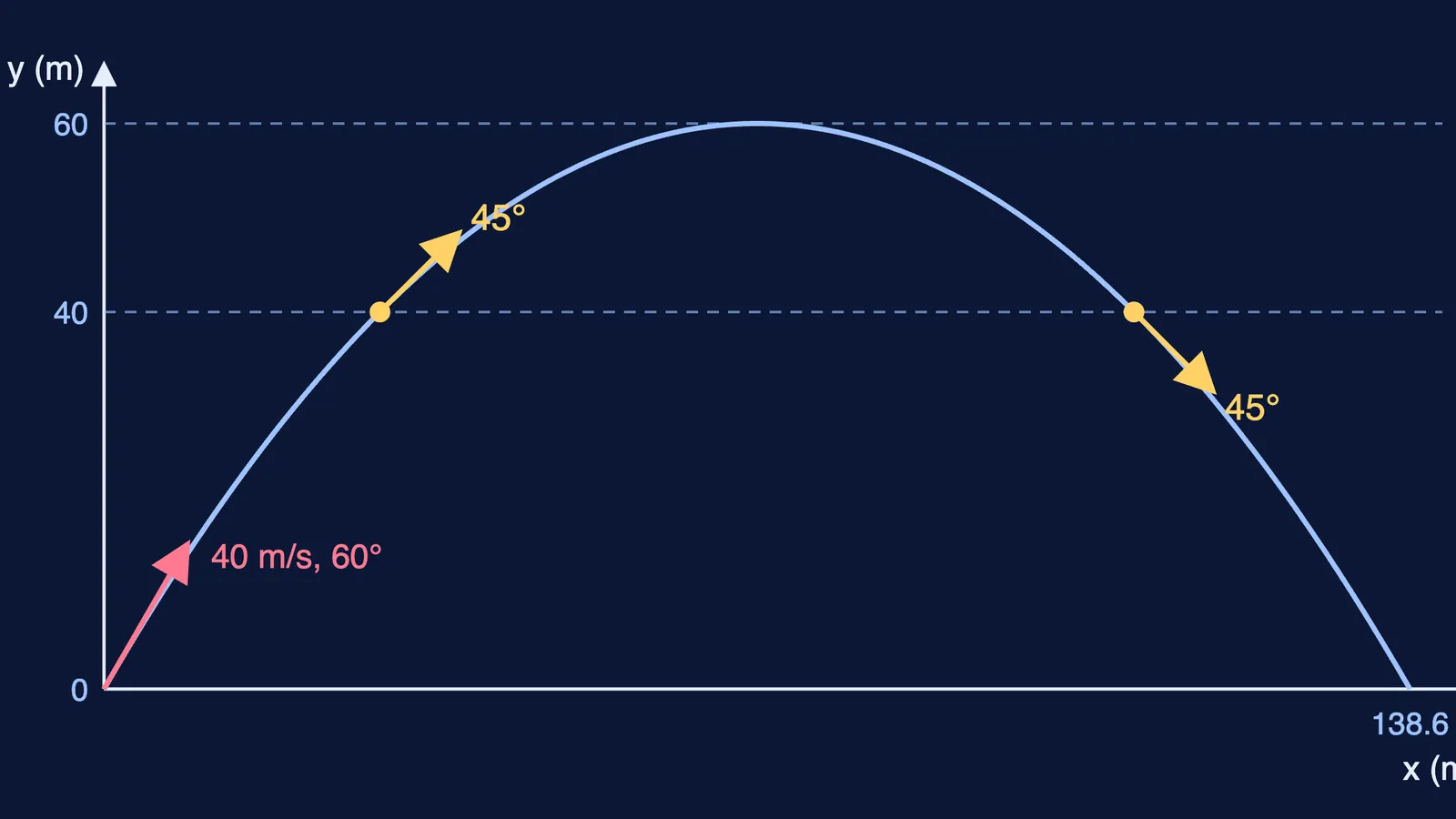
Q8 (hard). A ball is thrown from level ground at 40 m/s, 60° above the horizontal. At what height does its velocity make 45° with the horizontal?
(A) 20 m (B) 40 m (C) 60 m (D) 29.3 m
Answer: (B). The horizontal component stays 20 m/s, so at 45° the vertical component is also 20 m/s (upward on the way up, downward on the way down). The launch vertical component is 20√3 m/s, so from v² = u² − 2gh: 400 = 1200 − 20h, giving h = 40 m both times.
Trap: (A) uses only the horizontal component, u cos θ, (C) is the maximum height, and (D) is the horizontal distance covered when the velocity first reaches 45°.
What should you do after checking your answers?
Sort your misses: misread question, wrong idea, or arithmetic slip. If Q1, Q3 or Q7 went wrong, our explainer on Motion in a Plane for Class 11 starts from vectors.
For more practice, the Fermi Problem Library has worked problems with a step-by-step solver that explains the reasoning rather than printing an answer.
Redo both sets in a week, timed and without notes.


