

On this page
This set follows our first set of Kinematics JEE Main practice questions and tests the parts of the chapter that set 1 left out: graphs, circular motion, the trajectory equation, two-angle projectiles, vertical throws, river crossings and motion with a sideways acceleration.
In NTA's Syllabus for JEE (Main) - 2027, Kinematics is Physics Unit 2. That unit lists position-time and velocity-time graphs, non-uniform motion, relative velocity, motion in a plane, projectile motion and uniform circular motion, and every question here stays inside it.
How should you use this kinematics set 2?
Cover the answers and give yourself about two minutes per question.
Draw the situation and choose a positive direction before writing any equation.
Mark each question right, wrong or guessed, and count a guess as wrong.
Take g = 10 m/s² and ignore air resistance. If the basics feel shaky, start with our guide on how to prepare Kinematics for JEE Main.
Easy: can you read graphs and circular motion correctly?
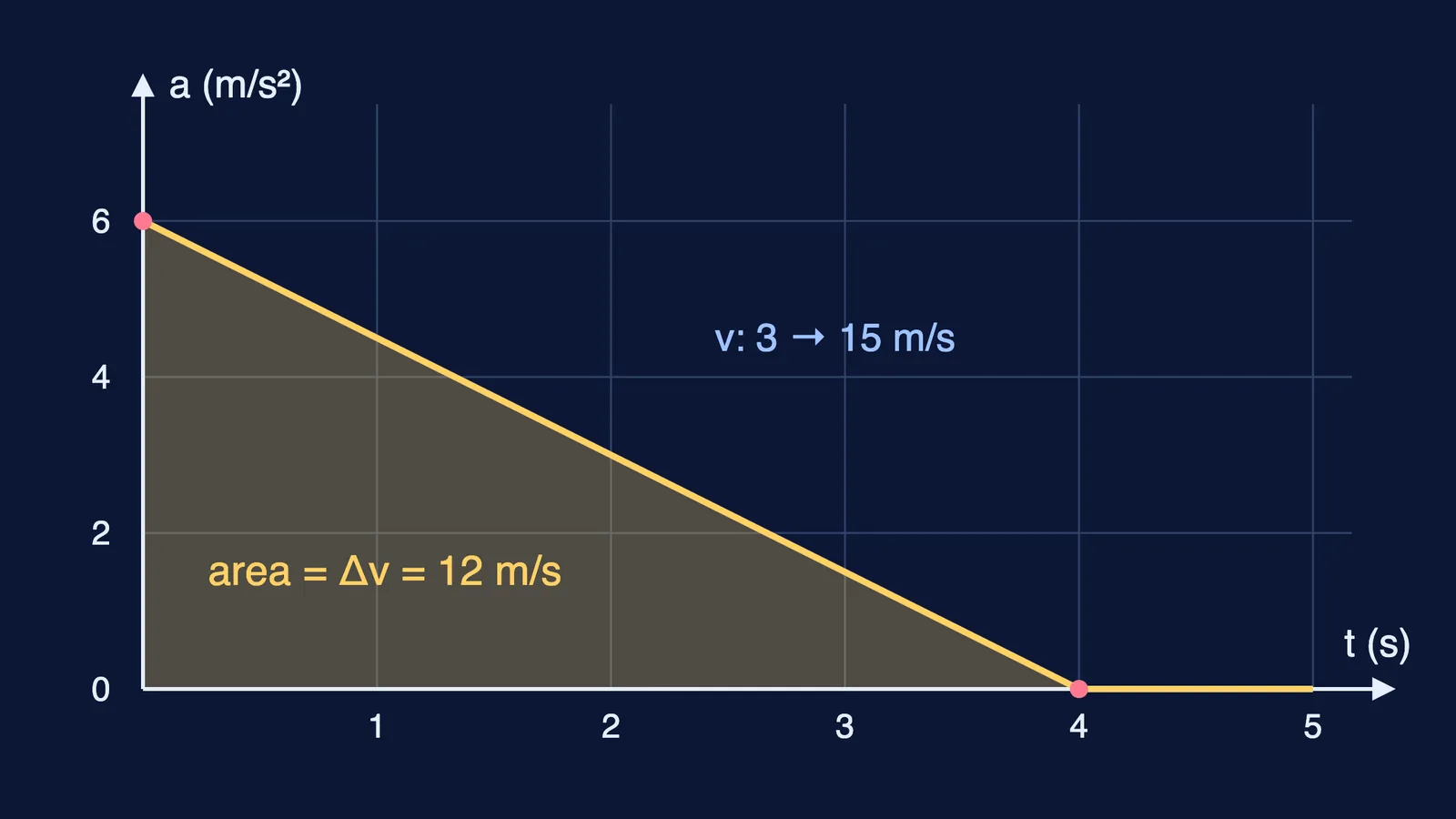
Q1 (easy). A particle moving in a straight line has a velocity of 3 m/s at t = 0. Its acceleration falls steadily from 6 m/s² at t = 0 to zero at t = 4 s. What is its velocity at t = 4 s?
(A) 3 m/s (B) 12 m/s (C) 15 m/s (D) 27 m/s
Answer: (C). The change in velocity is the area under the acceleration-time graph: ½ × 4 × 6 = 12 m/s. So v = 3 + 12 = 15 m/s.
Trap: (A) assumes the velocity drops back when the acceleration reaches zero. Zero acceleration only means v stops changing.
Q2 (easy). The tip of a ceiling fan blade is 0.6 m from the axis, and the fan turns at a steady 300 revolutions per minute. What is the acceleration of the tip?
(A) 0 (B) 15 m/s² (C) 18.8 m/s² (D) 592 m/s²
Answer: (D). ω = 300 × 2π / 60 = 10π rad/s. Centripetal acceleration = ω²r = 100π² × 0.6 ≈ 592 m/s², pointing towards the axis.
Trap: (B) uses ω = 5 rad/s, forgetting the 2π in each revolution.
Q3 (easy). A ball thrown straight up reaches a maximum height H. At what height is its speed half the launch speed?
(A) H/4 (B) H/2 (C) 3H/4 (D) H/√2
Answer: (C). From v² = u² − 2gh with v = u/2: h = 3u²/8g. Since H = u²/2g, h = 3H/4.
Trap: (B) assumes speed falls in step with height.
Medium: can you read a trajectory and combine two motions?
Q4 (medium). A projectile launched from the origin follows y = x − x²/40, with x and y in metres. What are its launch speed and maximum height?
(A) 20 m/s, 10 m (B) 20 m/s, 20 m (C) 14.1 m/s, 10 m (D) 20 m/s, 40 m
Answer: (A). Compare with y = x tan θ − gx²/(2u² cos² θ). tan θ = 1, so θ = 45°. Then u² cos² θ = 10 × 40 / 2 = 200, so u² = 400 and u = 20 m/s. H = (u sin θ)²/2g = 200/20 = 10 m.
Trap: (C) takes u cos θ = 14.1 m/s as the launch speed.
Q5 (medium, numerical). A ball launched from level ground at 20 m/s can land 30 m away at two different angles. If t₁ and t₂ are the two times of flight, what is t₁t₂ in s²?
Answer: 6. The two angles add to 90°, so t₁t₂ = (2u sin θ/g)(2u cos θ/g) = 2(u² sin 2θ/g)/g = 2R/g = 2 × 30/10 = 6.
Trap: 3 drops the factor 2 when turning 2 sin θ cos θ into sin 2θ.
Q6 (medium). Ball A is dropped from the top of a 45 m tower. At the same instant, ball B is thrown straight up from the foot of the tower at 30 m/s. How high above the ground do they meet?
(A) 11.25 m (B) 22.5 m (C) 33.75 m (D) 45 m
Answer: (C). Both fall with the same g, so the gap closes at a steady 30 m/s and they meet at t = 45/30 = 1.5 s. A has fallen 5 × 1.5² = 11.25 m, so the height is 45 − 11.25 = 33.75 m. B is still rising at 15 m/s.
Trap: (A) is how far A has fallen, measured from the top, not the ground. Our explainer on the sign of g in kinematics helps with this kind of slip.
Hard: can you handle crossings and motion in a plane?
Q7 (hard). A river 60 m wide flows at 4 m/s. A boat can move at 2 m/s relative to the water. What is the least distance it can drift downstream while crossing?
(A) 0 m (B) 103.9 m (C) 120 m (D) 34.6 m
Answer: (B). The boat is slower than the river, so it cannot go straight across. The drift is least when its heading is perpendicular to its resultant velocity, which means pointing 30° upstream of the straight-across line (sin 30° = 2/4). Drift = d√(v_r² − v_b²)/v_b = 60 × √12 / 2 ≈ 103.9 m.
Trap: (C) is the drift when the boat heads straight across. That gives the shortest time, not the shortest drift.
Q8 (hard, numerical). A particle at the origin has velocity 10 î m/s and a constant acceleration (−3 î + 4 ĵ) m/s². What is its minimum speed, in m/s?
Answer: 8. Speed is least when the velocity is perpendicular to the acceleration: (10 − 3t)(−3) + (4t)(4) = 0, so t = 1.2 s. The velocity is then (6.4, 4.8) m/s and the speed is 8 m/s.
Trap: setting the x-velocity to zero at t = 10/3 s gives 13.3 m/s, which is not the minimum.
What should you do after checking your answers?
Sort each miss into one of three kinds: misread question, wrong idea or arithmetic slip. If you got Q4, Q5 or Q8 wrong, it often helps to watch the path change as you change the numbers. The Fermi Simulation Lab has interactive simulations for ideas that are easier to see than to read.
Redo both sets in a week, timed and without notes.


