

On this page
In kho-kho, the active chaser may not simply turn round in the middle of the court. To change direction, the chaser has to run to a pole at the end of the central lane and go round it. Watch a good chaser do this and you will see a hand shoot out, grab the pole, and swing the body round it in a tight arc. That grab is not just style. It is a second source of centripetal force, and it lets the chaser turn on a much smaller circle than feet alone allow.
What does the kho-kho court have to do with circular motion?
A senior kho-kho court is 27 m long and 16 m wide. A central lane 23.5 m long and 30 cm wide runs down the middle, with a pole at each end. The poles stand 1.20 to 1.25 m above the ground and are 9 to 10 cm thick, smooth and without sharp edges. The active chaser who wants to change direction has to go round a pole; crossing the central lane to turn back is not allowed. These figures and the direction rule are from the kho-kho rules document on the Government of Bihar portal (in Hindi).
So every change of direction is a turn of about 180° round a fixed post. How fast you can make that turn is a circular-motion question.
How much force does a runner need to turn?
Any body moving at speed v on a circle of radius r needs a net force towards the centre:
F = mv²/r.
Something outside the runner must provide it. On open ground the only horizontal force on a runner is friction from the ground on the feet. Friction has a limit, F ≤ μmg, where μ is the coefficient of friction between shoe or foot and ground. Setting mv²/r = μmg gives the tightest circle you can run at speed v:
r(min) = v²/(μg).
This is the same limit that decides when a coin slides off a spinning turntable, and why a cyclist must lean into a turn. The mass cancels, so a heavier chaser has no advantage on foot. The only ways to turn tighter are to slow down, find more friction, or add another force.
Why does gripping the pole help?
The pole is fixed in the ground. When the chaser holds it with one hand and leans away, the arm is pulled taut, and the pole pulls the chaser towards itself through the arm. That pull points at the pole, which is the centre of the turn. It is exactly the direction a centripetal force needs.
Now two forces share the job:
mv²/r = F(pole) + F(friction), so F(pole) = mv²/r − F(friction).
With friction at its limit, F(pole) = mv²/r − μmg. The pole supplies whatever friction cannot. It is the same idea as a hammer thrower pulling the hammer round through a wire, with the roles swapped: here the fixed post pulls the person.
Worked example: a 3.5 m/s turn round the pole
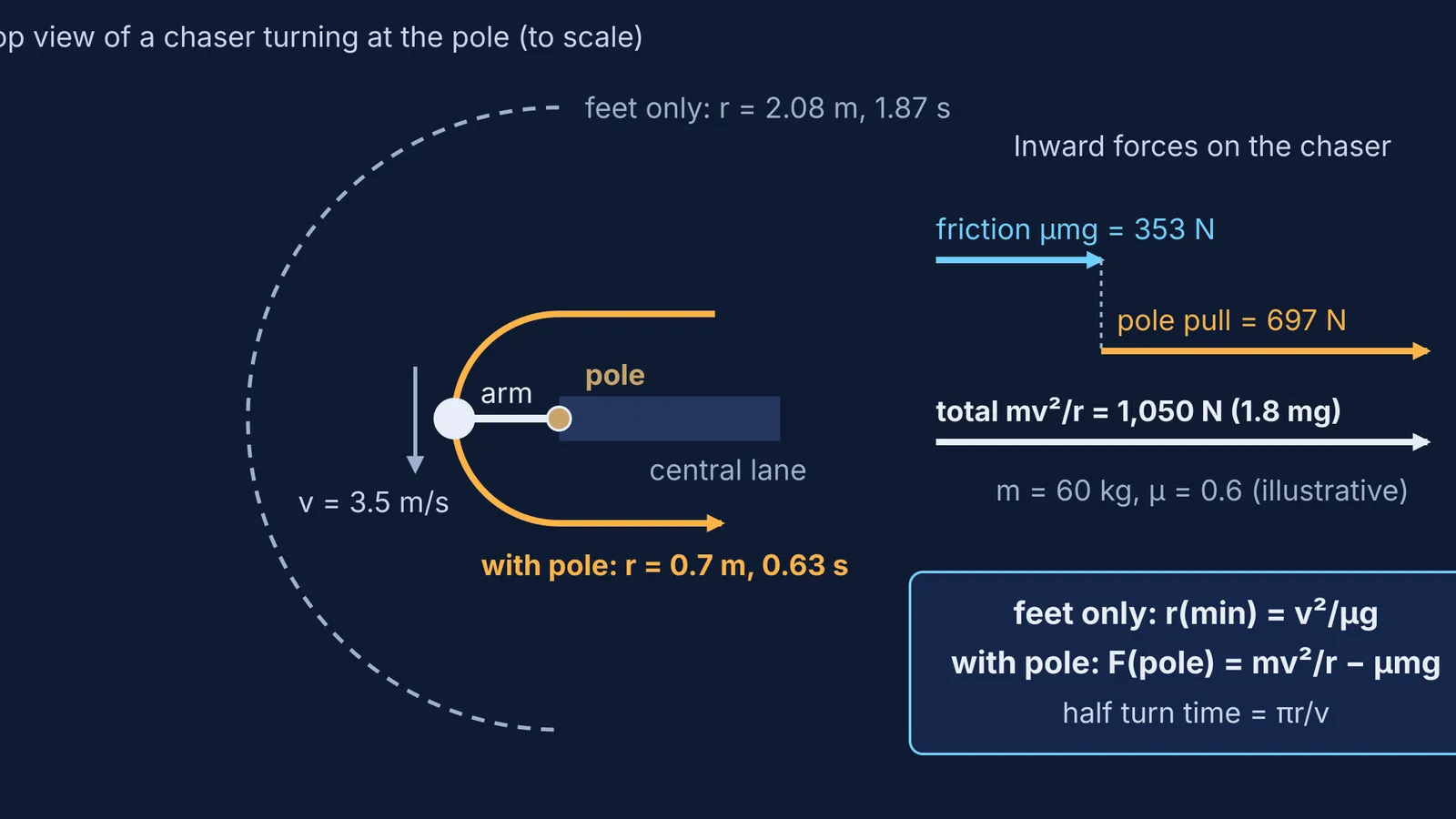
The numbers below are round illustrative values, not measurements: a 60 kg chaser reaches the pole at 3.5 m/s and turns on a circle of radius 0.7 m (about arm's length plus the pole's radius). Take μ = 0.6 between foot and a mud court, and g = 9.81 m/s². Real friction on mud or mats varies with moisture, footwear and surface, so treat μ as a guess.
Centripetal force needed. F = mv²/r = 60 × 3.5² ÷ 0.7 = 60 × 12.25 ÷ 0.7 = 1,050 N.
Compare with weight. mg = 60 × 9.81 = 589 N, so the turn needs 1,050 ÷ 589 = 1.8 times body weight, sideways. The centripetal acceleration is v²/r = 17.5 m/s², or 1.8g.
What friction can give. μmg = 0.6 × 589 = 353 N at most.
What the pole must give. F(pole) = 1,050 − 353 = 697 N, about 1.2 times body weight, pulled through one arm.
Feet only. Without the pole, the tightest circle at 3.5 m/s is r = v²/(μg) = 3.5² ÷ (0.6 × 9.81) = 2.08 m.
Time to turn back. A half circle is πr long. Round the pole: π × 0.7 ÷ 3.5 = 0.63 s. On feet only: π × 2.08 ÷ 3.5 = 1.87 s, about three times as long, and the wide arc carries the chaser 4.2 m across the court.
Or slow down. To turn on the 0.7 m circle with feet only, the chaser would have to drop to v = √(μgr) = √(0.6 × 9.81 × 0.7) = 2.0 m/s.
Units check: kg × (m/s)² ÷ m = kg·m/s² = N.
Who decides how the force is shared?
The split between friction and the pole is not fixed by the equations. Only the total, mv²/r, is fixed. A chaser who plants the feet well and leans can take more of the load on friction; one who slips will hang more weight on the arm. The 697 N above is the smallest pole force that works, because it assumes friction is already at its limit. If friction gives less, the arm must give more.
Two further points are worth seeing:
Leaning. On feet only, the chaser has to lean inward so that the ground's push passes through the centre of mass, just like the cyclist. At the 2.08 m radius, tan θ = v²/(rg) = μ, so the lean is about 31° from vertical. Holding the pole, the arm takes much of the sideways load and the chaser can lean far out from the pole.
The pole feels it too. By Newton's third law the chaser pulls on the pole with the same 697 N, which is why the poles are set firmly in the ground.
If you want to practise splitting a centripetal force between two sources, the Fermi Problem Library has a step-by-step solver that explains the reasoning at each stage.
How would you measure a real pole turn?
The 3.5 m/s and 0.7 m above are guesses. To get real numbers, film a turn from above or side-on at a known frame rate, mark the chaser's hip in each frame, and measure the radius of the path and the time to go round. Speed is the arc length divided by the time. Then F = mv²/r with the chaser's mass. Compare with μmg for the court surface, measured by pulling a shoe with a spring balance. The difference is the pole's share.
Quick checklist
Turning needs a centripetal force mv²/r towards the centre.
On foot, only friction can supply it, so r(min) = v²/(μg).
Gripping the pole adds an inward pull through the arm: F(pole) = mv²/r − μmg.
Example: 1,050 N needed, 353 N from friction, 697 N from the pole.
The pole shrinks the turn from 2.08 m to 0.7 m and cuts the time from 1.87 s to 0.63 s.
The pole changes the radius, not the speed.


