

On this page
Watching an elite hammer thrower is one of athletics' most dramatic demonstrations of rotational physics. Instead of heaving the metal sphere from a standstill like a shot putter, the athlete spins three to four times within a 2.135-metre circle before release. This rotation extends the path over which muscles apply force, accelerating the implement to highway speeds while the thrower counters thousands of Newtons of wire tension.
Why do hammer throwers spin instead of throwing from a standstill?
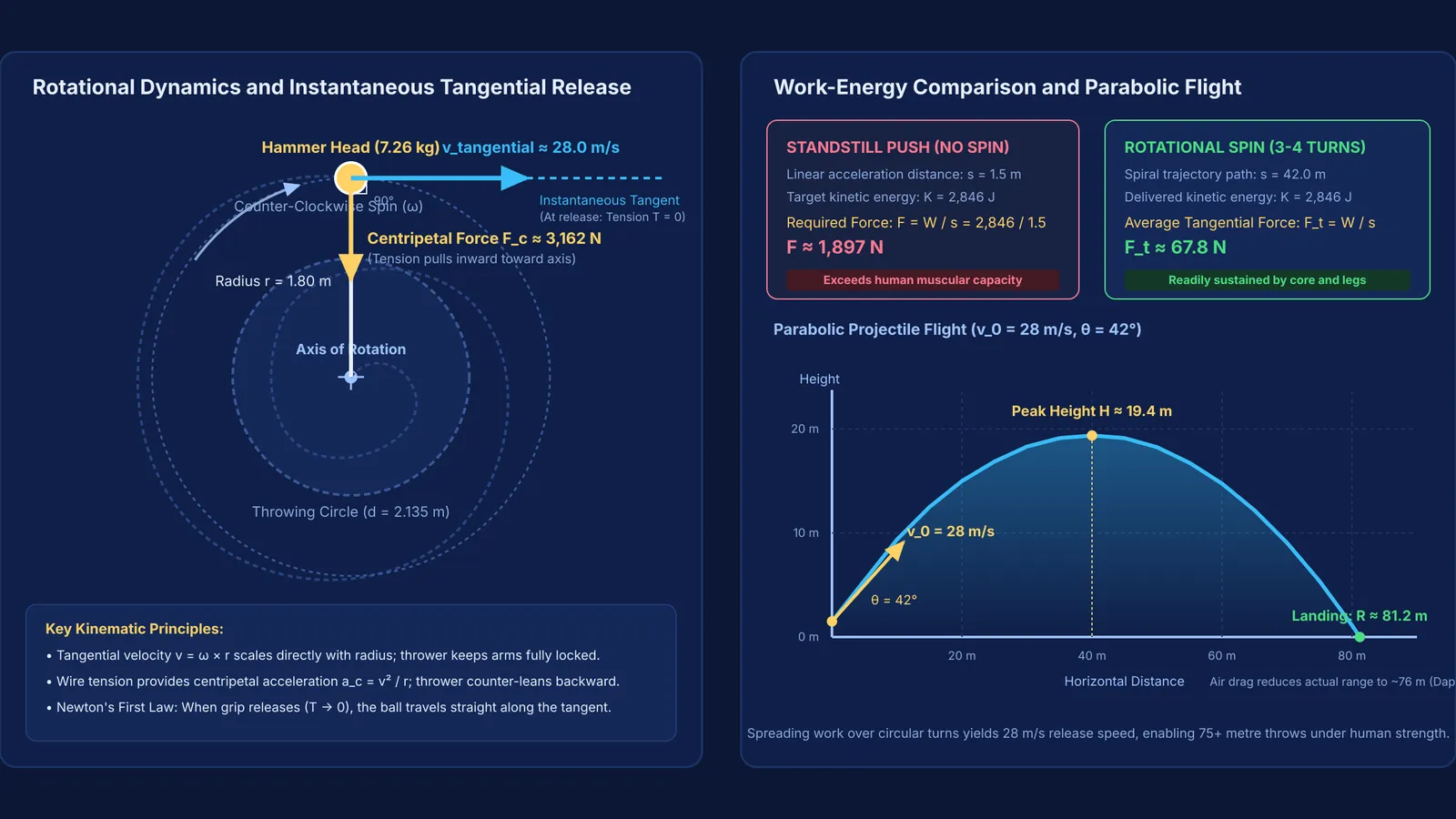
Under the World Athletics Technical Rules, a senior men's hammer has a minimum mass of 7.260 kg, while a women's hammer weighs 4.000 kg. Launching the implement 75 to 80 metres requires a release speed of 27 m/s to 29 m/s. Accelerating a 7.260 kg hammer to 28 m/s requires roughly 2,846 Joules of kinetic energy (K = 0.5 × m × v²). Delivering that energy across a straight 1.5-metre arm stroke from a standstill would demand nearly 1,900 Newtons of force—far beyond human arm strength.
Spinning solves this constraint by extending the acceleration distance (W = F × s). Across three to four turns, the hammer travels 35 to 45 metres along an expanding spiral, as documented in Frontiers in Physiology. Extending the path reduces the required forward accelerating force to roughly 68 Newtons. Biomechanical research in Sports Biomechanics shows that elite throwers shift their centre of mass out of phase with the hammer, acting like a driven pendulum to pump kinetic energy into each turn.
How does circular motion build tangential velocity?
Linear speed along a circular path—tangential velocity (v)—equals angular velocity (ω) multiplied by radius (r): v = ω × r. For a hammer thrower, the radius extends from the rotation axis through the extended arms and 1.215-metre cable to roughly 1.80 to 2.00 metres. A kinematic study in Medicine and Science in Sports and Exercise showed that the thrower and hammer act as a coupled system whose angular momentum vectors stay half a cycle out of phase, preserving balance as rotation accelerates.
Because tangential velocity scales with radius, athletes keep their arms straight. Bending the elbows shrinks r and reduces launch speed. Similar constraints govern centripetal acceleration and normal forces on curved paths. Visualising how cable tension stays perpendicular to velocity can be challenging; the Fermi Simulation Lab provides interactive simulations for ideas that are easier to see than to read, allowing students to observe vector components in real time.
What happens to centripetal force and wire tension at release?
Curving any path requires an inward centripetal force: F_c = m × v² / r. For a 7.260 kg hammer moving at 28 m/s with a 1.80-metre radius, wire tension reaches roughly 3,162 Newtons, matching measurements in Sports Biomechanics. This pull exceeds 320 kg of gravitational force—nearly 3.8 times the body weight of an 85 kg athlete. The thrower counters this immense tension by leaning their hips and torso backward.
At release, wire tension drops to zero. With no inward force left to curve its path, the hammer obeys Newton's first law of motion and travels along the instantaneous tangent to its circular orbit. Once airborne, the implement transitions into projectile motion. Just as with string tension in circular motion, rotational forces cease and flight is governed by gravity and the projectile radius of curvature.
Why do throwers stop at three or four turns?
If spinning builds speed, why not turn five or six times? Under the World Athletics Technical Rules, the circle diameter is only 2.135 metres. Each heel-and-toe turn translates the thrower forward toward the rim, leaving no space for extra rotations without fouling.
Biomechanical analysis in Frontiers in Physiology demonstrates that maintaining double-support coordination and balance degrades as speed rises. Squeezed by the rim, throwers attempting extra turns bend their elbows, shrinking the radius and halting speed gains. Aerodynamic research in the Journal of Sports Sciences also confirms that drag on the ball and wire causes substantial distance loss. Hitting an optimal launch angle between 40° and 44° with clean posture delivers far better range than risking an uncontrolled turn.
How do you calculate hammer wire tension and release kinetic energy?
Using competition values from the World Athletics Technical Rules, consider a men's hammer (m = 7.260 kg) accelerated along a radius r = 1.80 m to a release speed v = 28.0 m/s across an accumulated path s = 42.0 m:
Centripetal force (wire tension): F_c = m × v² / r = 7.260 kg × (28.0 m/s)² / 1.80 m ≈ 3,162 N.
Delivered kinetic energy: K = 0.5 × m × v² = 0.5 × 7.260 kg × (28.0 m/s)² ≈ 2,846 J.
Average tangential force along path: F_t = K / s = 2,845.9 J / 42.0 m ≈ 67.8 N.
This comparison highlights the mechanical benefit of spinning: although the thrower must withstand over 3,100 N of centripetal tension, the forward force needed along the spiral path is under 70 N. When preparing for mechanics questions in school exams or competitive tests, the Fermi Problem Library provides worked problems with a step-by-step solver that explains the reasoning rather than printing an answer.


