

On this page
Take a bend fast and your body leans in without being told to. NCERT's Class 11 chapter on Laws of Motion covers the force side: on a level road, only friction can turn you. This post adds the torque side, which is where the lean comes from, then shows how friction sets the safe speed.
Why does a cyclist lean inward while taking a turn?
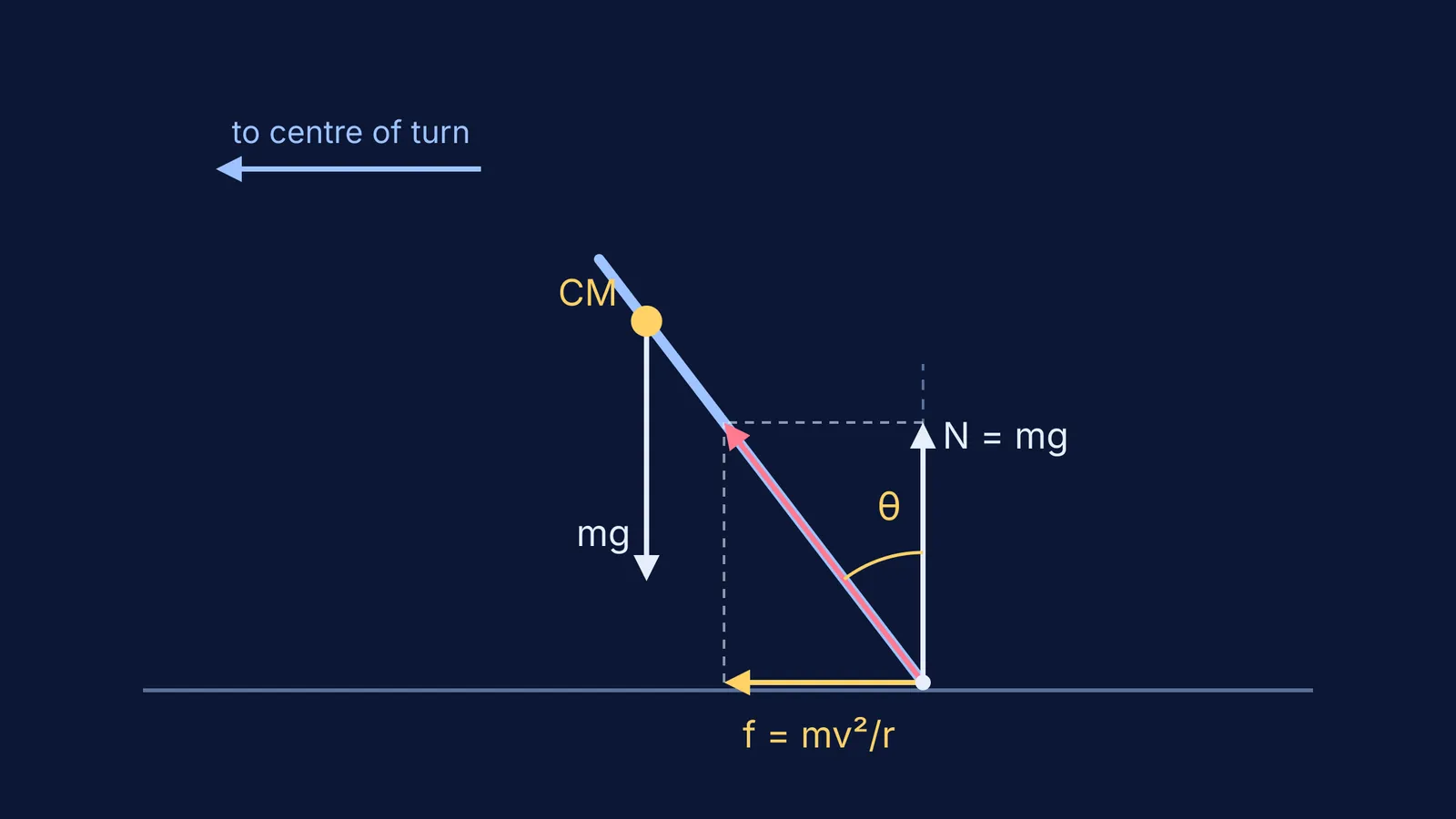
Three forces act on cycle and rider: weight mg at the centre of mass, the normal force N straight up at the tyre, and static friction f at the tyre, towards the centre of the turn. The NCERT chapter states that on an unbanked road, friction alone provides the centripetal force needed to keep the cyclist on the circle (Example 4.10).
The catch is where friction acts: at the ground, not at the centre of mass. If you stayed upright, that low sideways push would have a torque about your centre of mass and roll you outward, like a rug pulled from under your feet. Leaning in puts your centre of mass inside the contact point, so the normal force gives an opposite torque. At the right angle, the two cancel.
How do you derive tan θ = v²/rg?
Model the cycle and rider as one rigid body leaning at angle θ from the vertical, with the centre of mass a distance h from the contact point along the lean.
Vertical: there is no vertical acceleration, so N = mg.
Horizontal: friction is the centripetal force, so f = mv²/r.
Torque about the centre of mass: the contact point sits h sin θ to the outside and h cos θ below it. N gives a torque N h sin θ one way; f gives f h cos θ the other way.
For the lean angle to stay steady, these cancel: mg h sin θ = (mv²/r) h cos θ.
Divide through: tan θ = v²/rg.
Mass and height both cancel, so a light child and a heavy adult at the same speed on the same bend lean by the same angle.
This is a simplified model. B. Shayak's paper on the physics of motorcycles and fast bicycles calls θ = arctan(V²/gR) the oft-quoted lean formula, obtained by treating the bike as a stick pivoted to the ground, and builds fuller equations that model the wheels as spinning disks. School and JEE problems usually use the stick model.
How does friction limit the safe speed on a turn?
Static friction has a ceiling: f ≤ μs N. Put f = mv²/r and N = mg and you get v² ≤ μs r g, so the NCERT chapter's maximum speed on a level road is v_max = √(μs r g) (equation 4.18). In lean language, tan θ = f/N cannot exceed μs, so the steepest possible lean is the angle whose tangent is μs. That is the same tan θ = μ result you meet in the angle of repose.
Worked example, from NCERT's Example 4.10: a cyclist at 18 km/h (5 m/s) takes a level turn of radius 3 m with μs = 0.1. NCERT finds μs r g = 2.94 m²/s² but v² = 25 m²/s², so the cyclist slips. In lean terms, the cyclist needs tan θ = 25/29.4 ≈ 0.85, about 40°, but friction only supports about 5.7°. The safe speed is √2.94 ≈ 1.7 m/s, roughly 6 km/h.
Speed enters squared, so doubling it makes tan θ, and the friction you need, four times larger.
Does the same formula work for a motorbike?
Yes. The derivation never asks what the vehicle is, and the same friction limit applies. A motorbike at 54 km/h (15 m/s) on a 30 m bend needs tan θ = 225/294 ≈ 0.77: a lean of about 37° and μs of at least 0.77. Suppose, for the exercise, that rain drops μs to 0.5. Then v_max = √(0.5 × 30 × 9.8) ≈ 12.1 m/s, about 44 km/h, with a steepest lean near 27°. Enter at the dry-road speed and the tyres slide out.
Shayak's motorcycle model adds what the stick leaves out, including the spinning wheels and a rider who leans off the bike. On a tilted road the normal force helps too; see banked roads and circular motion problems.
A checklist for lean-angle questions
Draw N and f at the tyre and mg at the centre of mass, not all at one dot.
Convert km/h to m/s (divide by 3.6) before squaring.
Write N = mg and f = mv²/r, then tan θ = f/N.
Check the limit: compare tan θ with μs, or v with √(μs r g).
For tipping questions, take torques about the centre of mass, as in toppling versus sliding.
To practise, the Fermi Problem Library has worked problems with a step-by-step solver that explains the reasoning rather than printing an answer.


