

On this page
You put a coin on a record player, switch it on, and the coin rides along. Turn the speed up, or move the coin outwards, and at some point it shoots off sideways. That moment comes down to one inequality.
What force keeps the coin moving in a circle?
Nothing pushes the coin towards the centre except the turntable surface. OpenStax University Physics defines centripetal force as any net force causing uniform circular motion, directed toward the centre of curvature, with magnitude F = mv²/r = mrω². For a coin on a flat, horizontal turntable, gravity and the normal force cancel vertically, so the only horizontal force left is static friction. Friction is the centripetal force here.
Static friction is not a fixed number. It grows to whatever is needed, up to a ceiling. The same textbook states that static friction obeys fs ≤ μs N, with a maximum of μs N. On a flat turntable, N = mg.
When does a coin slip off a rotating turntable?
The coin stays put as long as the friction it needs is no more than the friction available:
mω²r ≤ μs mg
The mass cancels on both sides. Rearranging gives the slipping condition:
At a given radius, the coin slips when ω > √(μs g / r).
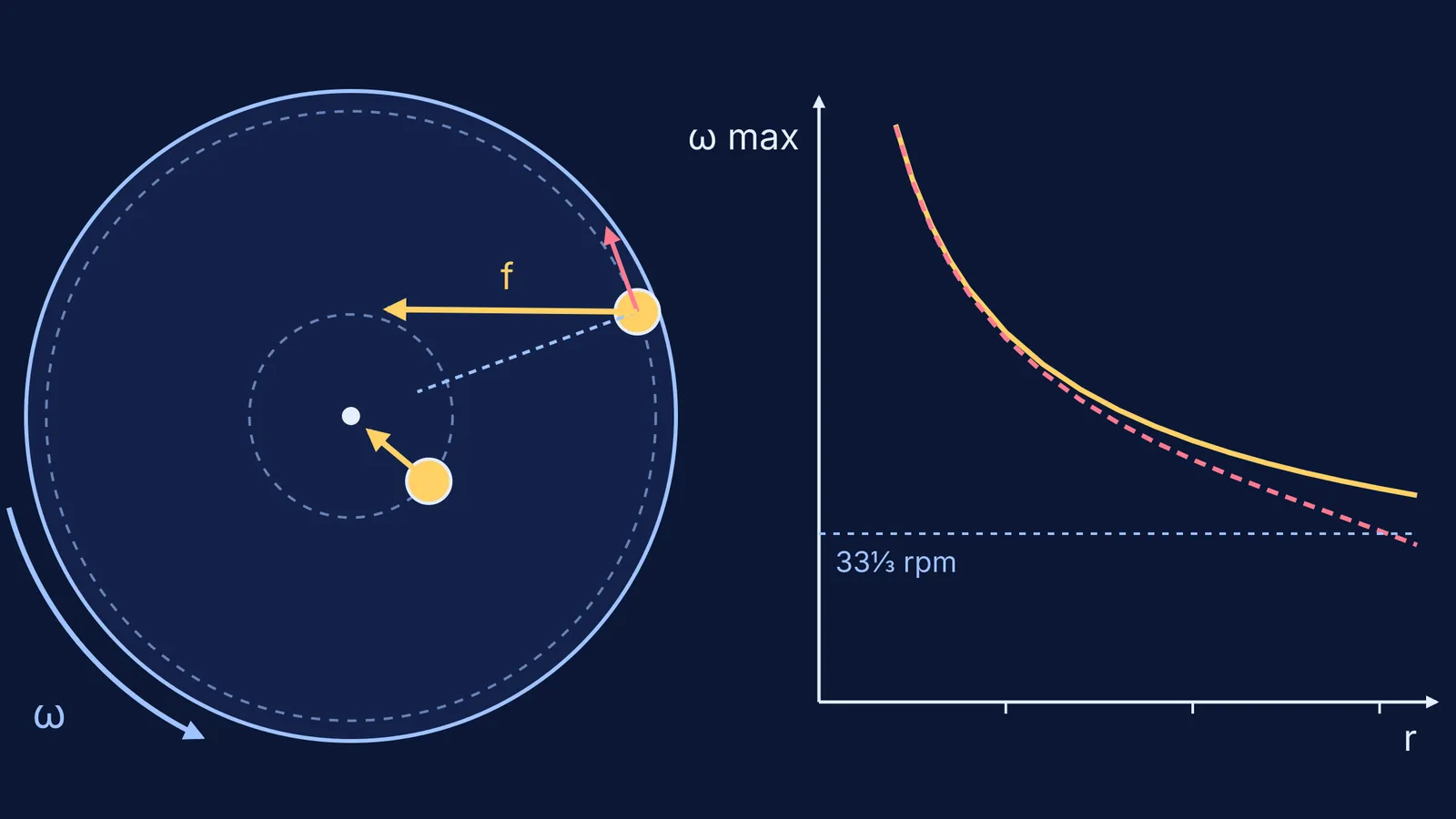
At a given ω, the coin slips at any radius r > μs g / ω².
This is the same physics as a car on a flat curve, where OpenStax shows μs = v²/(rg) and notes that the mass cancels. Put v = ωr and you get the turntable version.
Worked example: two coins on one turntable
Take μs = 0.3 and g = 9.8 m/s². The 0.3 is an assumed value: real values depend on the surfaces, and the OpenStax friction table lists static coefficients such as 0.05 for oiled steel on steel and 1.0 for rubber on dry concrete.
Coin A at r = 5 cm: ω_max = √(0.3 × 9.8 / 0.05) = √58.8 ≈ 7.67 rad/s, about 73 rpm.
Coin B at r = 15 cm: ω_max = √(0.3 × 9.8 / 0.15) = √19.6 ≈ 4.43 rad/s, about 42 rpm.
Tripling the radius cuts the safe angular speed by a factor of √3. If you slowly raise the speed, coin B flies off first while coin A stays put. The friction needed, mω²r, grows with r; the friction available, μs mg, does not.
Now a real turntable. A long-playing record spins at 33⅓ revolutions per minute, and the 12-inch LP became the standard format, according to the Library of Congress. That is ω ≈ 3.49 rad/s. At the rim of a 12-inch record (r ≈ 15.2 cm), a coin needs μs ≥ ω²r/g ≈ 0.19 to stay on. On a slipperier surface, it slides off even at normal playing speed.
What changes when the turntable is speeding up?
Now give the turntable an angular acceleration α. The coin must speed up along its path too, so it needs a tangential acceleration αr as well as the centripetal ω²r. OpenStax gives the total acceleration in non-uniform circular motion as the vector sum of these two perpendicular parts, with magnitude √(a_c² + a_T²).
Friction has to supply that whole vector, so it no longer points at the centre. It tilts forward, in the direction of rotation. The condition becomes:
m√((ω²r)² + (αr)²) ≤ μs mg
So the coin slips when ω⁴ + α² reaches (μs g / r)².
For coin B with α = 5 rad/s²: (μs g / r)² = 19.6² = 384.16, so ω⁴ = 359.16 and ω ≈ 4.35 rad/s, a little below the 4.43 rad/s of the steady case. Two more results fall out:
If αr > μs g, the coin slips the instant the turntable starts, even at ω = 0. For coin B, that means α > 19.6 rad/s².
At start-up, friction points almost entirely along the tangent. As ω grows, it swings round towards the centre.
How do you avoid the usual mistakes?
Before you write the final answer:
Draw a side view and a top view. Side view: mg down, N up. Top view: friction only.
Write "friction needed ≤ μs N". It equals μs N only at the point of slipping.
Check whether ω is constant. If the problem says "speeding up" or gives α, add the tangential term.
Convert rpm to rad/s by multiplying by 2π/60.
Sanity check: the mass should cancel, and a larger r should give a smaller ω_max.
The same reasoning about which way friction points shows up in static vs kinetic friction problems with blocks, in circular motion problems on banking and vertical circles, and in tangential and radial acceleration in non-uniform circular motion.
For practice, the Fermi Problem Library has worked problems with a step-by-step solver that explains the reasoning rather than printing an answer. If you need to revisit friction or centripetal force first, the Fermi Concept Library gives each concept its own lesson and its place in the map.


