

On this page
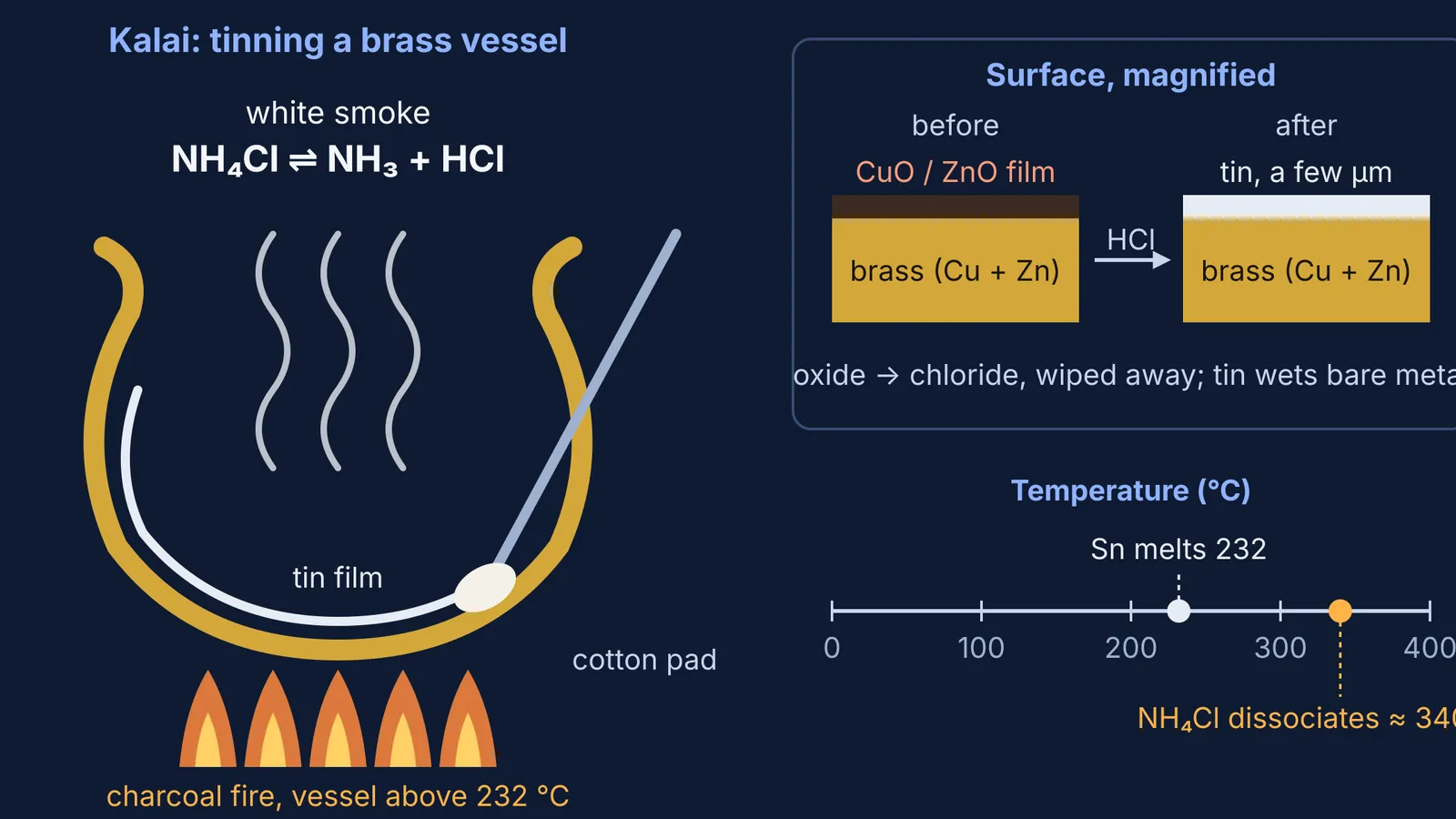
In many Indian towns, a kalaiwala sets up a small charcoal fire and re-coats brass and copper vessels with tin. He heats the pot, throws in a pinch of white powder, and wipes a lump of tin around the inside with a cotton pad. A puff of white smoke rises, and the dull inside of the vessel turns silvery in seconds. The white powder is ammonium chloride, sold as nausadar or navsagar. Each step is Class 11 and 12 chemistry.
What does a kalaiwala actually do to a brass vessel?
The job has four steps.
Scour. The inside is rubbed clean with sand or ash.
Heat. The vessel is held over the fire until it is hotter than the melting point of tin, 232 °C.
Flux. A little NH₄Cl powder is sprinkled in. It fizzes and gives off white smoke.
Tin. A stick of tin is touched to the hot surface. It melts, and the tinsmith spreads it with a pad of cotton so that a thin, even, silvery film covers the inside.
Brass is an alloy of copper and zinc, and its surface always carries a thin film of oxide (CuO, Cu₂O and ZnO). Molten tin will not stick to oxide. The NH₄Cl is there to remove that film at the exact moment the tin goes on. That job is called a flux.
Why does ammonium chloride give white smoke when heated?
NH₄Cl does not melt in the ordinary sense. On heating, it dissociates into two gases:
NH₄Cl(s) ⇌ NH₃(g) + HCl(g)
At about 338–340 °C the pressure of these gases reaches 1 atm, so the solid disappears quickly. Below that temperature dissociation still happens, only more slowly, so a vessel just above 232 °C still releases plenty of HCl. In cooler air the reaction runs backwards, so the white smoke is fine solid NH₄Cl, not steam and not tin.
This is the same behaviour that lets you separate NH₄Cl from salt in the lab, described in separating ammonium chloride and salt by sublimation. The heating reactions of other ammonium salts are compared in what ammonium salts give on heating.
How does NH₄Cl clean the oxide film off brass?
The HCl is an acid gas. It turns the basic metal oxides into chlorides and water:
CuO + 2HCl → CuCl₂ + H₂O
Cu₂O + 2HCl → 2CuCl + H₂O
ZnO + 2HCl → ZnCl₂ + H₂O
As one overall equation, with ammonia escaping:
CuO + 2NH₄Cl → CuCl₂ + 2NH₃ + H₂O
Check: one Cu, one O, two N, eight H and two Cl on each side.
The chlorides form a loose crust that the spreading tin and the cotton pad push aside. Zinc chloride is itself a well-known soldering flux, so the zinc in brass helps the process along. With the oxide gone, the tin touches bare metal. A very thin copper–tin alloy layer forms at the boundary, and that is why a good kalai coat does not peel.
Why is tin used for kalai and not another metal?
Look at the standard reduction potentials (approximate values):
Zn²⁺/Zn: −0.76 V
Sn²⁺/Sn: −0.14 V
H⁺/H₂: 0.00 V
Cu²⁺/Cu: +0.34 V
Tin sits only just below hydrogen. In principle it can displace hydrogen from acids (Sn + 2H⁺ → Sn²⁺ + H₂), but the reaction with weak food acids such as the lactic acid in curd or the tartaric acid in tamarind is very slow. That is the key point: tin is not inert, it is slow. Zinc, much further down, reacts readily, which is the problem explained in why curd should not be kept in brass or copper vessels.
Three more reasons make tin the practical choice:
Low melting point. At 232 °C, tin can be melted and spread on a charcoal fire.
It wets clean copper and brass well, so a thin, even coat forms without special equipment.
Less metal reaches the food. The small amount of tin that dissolves is much less of a concern than copper or zinc salts from bare brass.
There is a nice twist compared with tin cans. On iron, tin is the less reactive metal, so a scratch makes the iron rust faster, as explained in galvanisation vs tinning. On copper, tin is the more reactive metal. At a small scratch, tin corrodes first and copper is spared. Still, kalai is mainly a barrier; once brass shows through, it needs redoing.
Worked example: how much nausadar and how much tin?
The numbers below are illustrative, to show the method.
Part 1. A vessel's inside carries 0.20 g of CuO. How much NH₄Cl is needed, at minimum, to remove it?
Molar mass of CuO = 63.55 + 16.00 = 79.55 g mol⁻¹.
Moles of CuO = 0.20 / 79.55 = 2.5 × 10⁻³ mol (2.5 mmol).
From CuO + 2HCl → CuCl₂ + H₂O, you need 2 × 2.5 = 5.0 mmol of HCl.
Each NH₄Cl gives one HCl, so you need 5.0 mmol of NH₄Cl.
Molar mass of NH₄Cl = 53.49 g mol⁻¹, so the mass = 5.0 × 10⁻³ × 53.49 = 0.27 g.
Tinsmiths use more than this pinch, because much of the HCl escapes as smoke.
Part 2. The coat is 5 µm thick over an inner surface of 1 500 cm². What mass of tin is that? (Density of white tin ≈ 7.3 g cm⁻³.)
Thickness: 5 µm = 5 × 10⁻⁴ cm.
Volume = 1 500 × 5 × 10⁻⁴ = 0.75 cm³.
Mass = 0.75 × 7.3 = 5.5 g.
Real kalai thickness varies with the tinsmith and the vessel, so treat 5 µm as an example, not a standard. For more mole and density chains like this, the Fermi Problem Library has a step-by-step solver that explains the reasoning.
Is kalai safe, and is it something to try at home?
Two cautions matter.
The tin must be pure. Tin sold for kalai is not always pure, and tin mixed with lead would put lead into food. The World Health Organization states that no level of lead exposure is known to be without harmful effects. Ask for food-grade tin, and get advice from a doctor rather than guessing if you are worried about a vessel.
This is a job for a trained tinsmith, not a home experiment. The white fumes contain HCl and NH₃, which irritate the eyes, nose and lungs. The vessel is well above 232 °C, and molten tin causes deep burns. If you watch a kalaiwala at work, stand back, upwind and in the open air.
Quick checklist
Kalai is a thin coat of tin wiped onto hot brass or copper.
NH₄Cl ⇌ NH₃ + HCl on heating (about 338–340 °C); the white smoke is NH₄Cl re-forming.
HCl dissolves the oxide film: CuO + 2HCl → CuCl₂ + H₂O, ZnO + 2HCl → ZnCl₂ + H₂O.
Sn²⁺/Sn is about −0.14 V: tin reacts with food acids slowly, not never.
On copper, tin is the more reactive metal; on iron, it is the less reactive one.
Lead-free tin, a trained tinsmith, and open air.


