

On this page
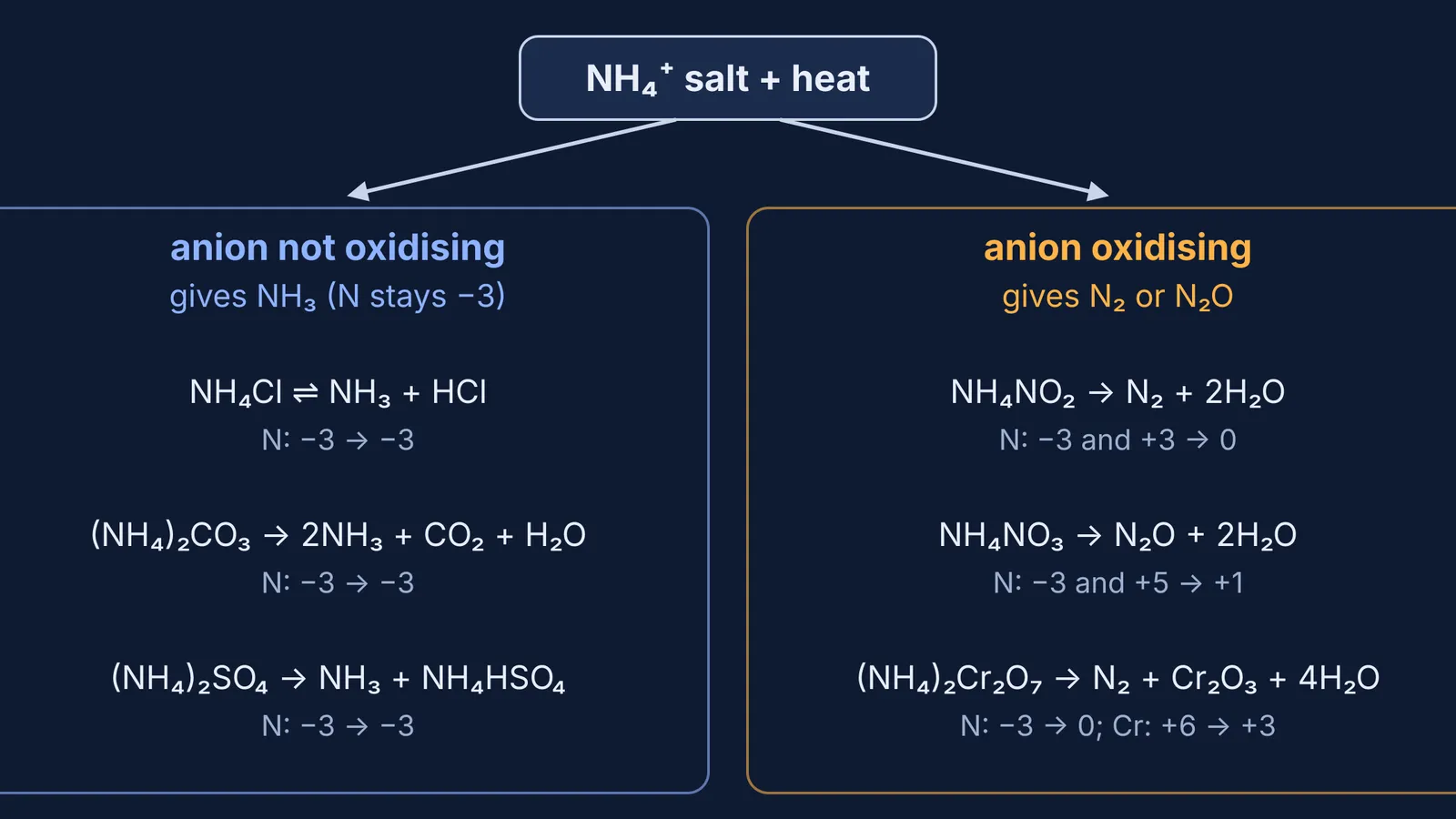
Heat any ammonium salt and it breaks down, but the gas that comes off is not always ammonia. Ammonium chloride gives NH₃ and HCl. Ammonium nitrite gives nitrogen. Ammonium nitrate gives nitrous oxide. One rule sorts all of them: ask whether the anion can oxidise the nitrogen in NH₄⁺. This post gives you that rule, the equations to learn, and the oxidation-state bookkeeping that proves each one.
Why do ammonium salts decompose on heating at all?
NH₄⁺ is the conjugate acid of ammonia. In the solid it holds its fourth proton only because the lattice keeps the ions together. On heating, that proton can move back to the anion:
NH₄⁺ + X⁻ → NH₃ + HX
A solid turns into gases, so entropy rises sharply, and at high enough temperature the TΔS term wins. This is the "acid–base" route, and nitrogen stays at −3 throughout.
Nitrogen at −3 is also a reducing agent. If the anion is an oxidiser, a second route opens: the anion takes electrons from the nitrogen of NH₄⁺. This redox route is strongly exothermic and cannot be reversed, so when it is available it takes over.
That gives the rule:
Anion not oxidising (Cl⁻, CO₃²⁻, SO₄²⁻, PO₄³⁻): you get NH₃ plus the acid, or the acid's breakdown products.
Anion oxidising (NO₂⁻, NO₃⁻, Cr₂O₇²⁻): NH₄⁺ is oxidised, and you get N₂ or N₂O and water.
Which ammonium salts give ammonia on heating?
These four are the ones to know. Nitrogen does not change oxidation state in any of them.
NH₄Cl ⇌ NH₃ + HCl
(NH₄)₂CO₃ → 2NH₃ + CO₂ + H₂O
(NH₄)₂SO₄ → NH₃ + NH₄HSO₄
(NH₄)₃PO₄ → 3NH₃ + H₃PO₄
Notice the difference between them. HCl, CO₂ and water are volatile, so everything leaves the tube. Sulphuric and phosphoric acids are not volatile, so the acid part stays behind as NH₄HSO₄ or H₃PO₄. Ammonium sulphate breaks down further only on much stronger heating. Ammonium carbonate is so unstable that it smells of ammonia even at room temperature, which is why it was used in smelling salts.
Why does ammonium chloride seem to sublime?
Heat NH₄Cl in a test tube and a white solid appears on the cooler, upper part of the tube. It looks like sublimation, but it is not. At around 340 °C the solid dissociates into two gases, NH₃ and HCl. When they reach the cool glass, they recombine into NH₄Cl. A true sublimate is the same molecule in the gas and the solid; here the gas is a mixture of two different molecules.
Two pieces of evidence show this.
Vapour density. NH₄Cl has a molar mass of 53.5 g/mol, so an undissociated vapour would have a vapour density of about 26.7. The measured value at high temperature is close to half that, about 13.4, because each formula unit becomes two gas molecules.
Diffusion. NH₃ (17 g/mol) is lighter than HCl (36.5 g/mol), so by Graham's law it diffuses about 1.46 times as fast. If you heat NH₄Cl in a tube with a loose plug of glass wool and hold moist litmus paper beyond the plug, the litmus turns blue first, as NH₃ arrives, and red later, as HCl catches up.
This is also why the salt can be separated from common salt by heating, as described in separating ammonium chloride and salt by sublimation.
Which ammonium salts give N₂ or N₂O on heating?
Here the anion oxidises NH₄⁺. Mark the oxidation state of every nitrogen and the products make sense.
Ammonium nitrite: NH₄NO₂ → N₂ + 2H₂O. Nitrogen goes from −3 and +3 to 0. In the lab the nitrite is made in the flask by warming NH₄Cl with NaNO₂: NH₄Cl + NaNO₂ → N₂ + 2H₂O + NaCl. The method is set out in laboratory preparation of nitrogen gas from ammonium nitrite.
Ammonium dichromate: (NH₄)₂Cr₂O₇ → N₂ + Cr₂O₃ + 4H₂O. Nitrogen goes from −3 to 0, and chromium from +6 to +3. Two N atoms lose 6 electrons, and two Cr atoms gain 6. The orange salt swells into a pile of green Cr₂O₃, the classic "volcano".
Ammonium nitrate: NH₄NO₃ → N₂O + 2H₂O on gentle heating, at around 200–250 °C. Nitrogen goes from −3 and +5 to +1. On rapid or strong heating the decomposition can become explosive: 2NH₄NO₃ → 2N₂ + O₂ + 4H₂O.
Worked example: oxidation-state bookkeeping for NH₄NO₃ → N₂O
Question. Show that heating ammonium nitrate is a redox reaction, balance it, and find the mass of N₂O and its volume at STP from 8.00 g of NH₄NO₃.
Assign oxidation states in the salt. In NH₄⁺: N + 4(+1) = +1, so N = −3. In NO₃⁻: N + 3(−2) = −1, so N = +5.
Assign the product. In N₂O: 2N + (−2) = 0, so N = +1.
Count electrons. The NH₄⁺ nitrogen goes from −3 to +1 and loses 4 electrons. The NO₃⁻ nitrogen goes from +5 to +1 and gains 4 electrons. One of each balances exactly, and the salt contains one of each. Two atoms of the same element in different states meeting at one in-between state is called comproportionation.
Balance atoms. NH₄NO₃ is N₂H₄O₃. One N₂O takes both N and one O. The remaining 4 H and 2 O make 2H₂O. So NH₄NO₃ → N₂O + 2H₂O.
Moles. M(NH₄NO₃) = 80.0 g/mol, so 8.00 g is 0.100 mol. This gives 0.100 mol N₂O.
Mass and volume. M(N₂O) = 44.0 g/mol, so 0.100 mol is 4.40 g. At STP (273 K, 1 atm, 22.4 L/mol) that is 2.24 L. If your book uses 1 bar (22.7 L/mol), it is 2.27 L.
Check. The 0.200 mol of water weighs 3.60 g, and 4.40 g + 3.60 g = 8.00 g. Mass is conserved.
Compare ammonium nitrite: there the two nitrogens are −3 and +3, each moves 3 electrons, and they meet at 0 as N₂. Same idea, different anion, different gas. If oxidation states still feel shaky, the Concept Library covers them with worked examples, and the Fermi Problem Library has a step-by-step solver that explains the reasoning for questions like this one.
What mistakes cost marks on these questions?
Writing NH₄NO₃ → NH₃ + HNO₃ as the answer for heating. A little of this does happen at lower temperatures, but the expected product is N₂O.
Writing N₂ for ammonium nitrate. N₂ comes from ammonium nitrite and dichromate.
Calling the NH₄Cl change true sublimation. It is dissociation followed by recombination.
Treating ammonium nitrate like a metal nitrate. Metal nitrates give NO₂ and O₂, or a nitrite and O₂, as covered in what happens when nitrates and carbonates are heated. Ammonium nitrate is different because the cation itself gets oxidised.
Leaving out water. Every oxidising-anion equation above makes H₂O from the hydrogens of NH₄⁺.
Quick checklist
First ask: can the anion oxidise nitrogen at −3?
Not oxidising (Cl⁻, CO₃²⁻, SO₄²⁻, PO₄³⁻): NH₃ plus the acid, with N staying at −3.
Oxidising: NH₄NO₂ → N₂, NH₄NO₃ → N₂O, (NH₄)₂Cr₂O₇ → N₂ + Cr₂O₃.
Product oxidation state for nitrite and nitrate: the average of −3 and the anion's N.
NH₄Cl "sublimes" only by splitting into NH₃ and HCl, which recombine on cooling.
Balance with H₂O and check that mass is conserved.


