On this page
Most lab methods for surface tension need a clean glass bore and a liquid that wets it. Jaeger's method needs neither. You blow air slowly through a fine tube dipped in the liquid and watch a manometer. The pressure climbs as each bubble forms, peaks, and drops as the bubble breaks away. That peak gives you the surface tension, and you can read it again and again while the liquid heats up.
What is Jaeger's method for surface tension?
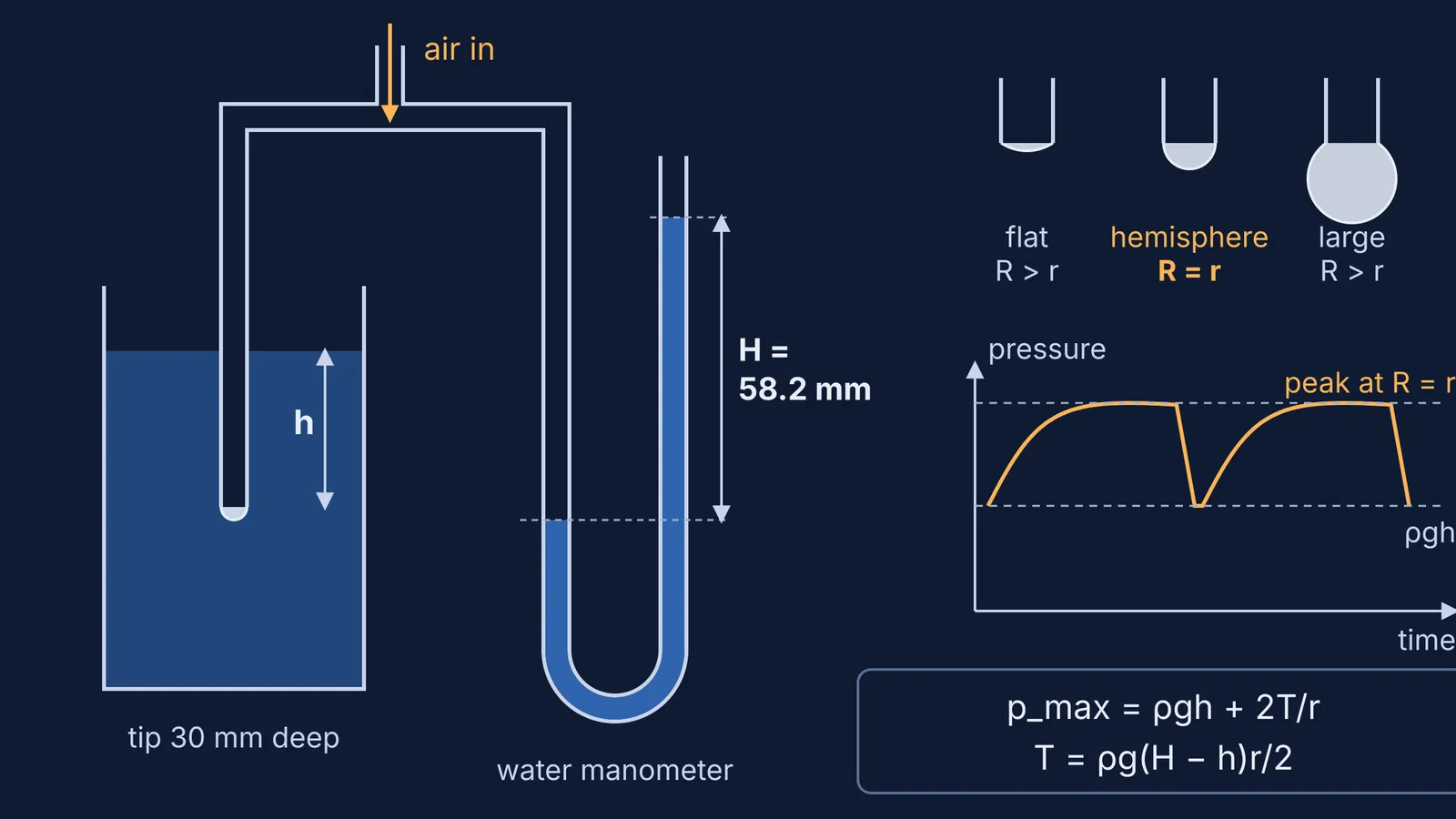
A fine glass tube of inner radius r is dipped vertically into the liquid, with its tip a depth h below the surface. Its top is joined to an air supply and to a manometer. Air is pushed in slowly, so a bubble grows at the tip, detaches and rises, and a new one starts. The manometer shows the air pressure above atmospheric. You note the highest reading H just before each bubble breaks away.
The pressure inside a bubble held under a liquid is the sum of two parts: the depth head ρgh and the excess pressure 2T/R across a curved surface of radius R. How those two add for a bubble that already exists is worked in pressure inside an air bubble under water. Jaeger's method runs that idea backwards: it measures the pressure and solves for T.
Why is the pressure highest when the bubble is a hemisphere?
Follow one bubble as it grows at the tip of a tube of radius r.
Just starting. The surface is almost flat across the mouth of the tube. A flat surface has a very large radius R, so 2T/R is small.
Growing. The surface bulges more. R gets smaller and 2T/R rises.
Hemisphere. The bubble is exactly a half-sphere. Its radius now equals the tube's radius, R = r. This is the smallest radius the bubble can have while attached to that tube, so 2T/R is at its largest, 2T/r.
Beyond. If the bubble grows any further, R gets bigger again and the pressure needed falls. The air already in the line pushes it out faster than before, the bubble swells and breaks away, and the cycle starts again.
So the highest pressure the manometer ever records is
p_max = ρgh + 2T/r
and it happens at the hemisphere stage. Here is the size of the effect for water at 25 °C, where IAPWS gives T = 71.97 mN/m in its release on the surface tension of water. With r = 0.50 mm, the surface-tension part at the hemisphere is 2 × 0.07197 ÷ 0.0005 ≈ 288 Pa, about 29.3 mm of water. A free bubble of radius 2 mm needs only 2 × 0.07197 ÷ 0.002 ≈ 72 Pa.
How do you get T from the manometer reading?
If the manometer holds the same liquid as the beaker (water in both, for example), its reading H measures p_max directly: p_max = ρgH. Then
ρgH = ρgh + 2T/r
T = ρg(H − h)r/2
If the two liquids differ, keep their densities apart: ρ_m g H = ρ_l g h + 2T/r, with ρ_m for the manometer liquid and ρ_l for the test liquid.
Worked example: surface tension of water
These are illustrative readings. Take g = 9.81 m/s² and ρ = 1,000 kg/m³ for both the beaker and the manometer.
Data. Tube inner radius r = 0.50 mm = 5.0 × 10⁻⁴ m. Depth of tip h = 30 mm = 0.030 m. Peak manometer reading H = 58.2 mm = 0.0582 m.
Subtract the depth head. H − h = 0.0582 − 0.030 = 0.0282 m.
Pressure due to surface tension. 2T/r = ρg(H − h) = 1,000 × 9.81 × 0.0282 ≈ 277 Pa.
Solve. T = 277 × 5.0 × 10⁻⁴ ÷ 2 ≈ 0.0692 N/m.
Check the units. Pa × m = (N/m²) × m = N/m.
Compare. IAPWS gives 0.0720 N/m at 25 °C. The result is about 4% low, a typical lab result; a trace of grease or soap in the beaker lowers T.
Now change the liquid. A soap solution in the same set-up peaks at 44.6 mm. Then T = 1,000 × 9.81 × (0.0446 − 0.030) × 5.0 × 10⁻⁴ ÷ 2 ≈ 0.0358 N/m, about half the value for clean water (illustrative reading; take its density as that of water).
Why use bubble pressure instead of capillary rise?
The standard school method is capillary rise, covered in how to find surface tension by capillary rise in the lab. That method needs the contact angle, which is taken as zero for clean water and glass, and a long, clean, uniform bore. Jaeger's method avoids both.
No contact angle. The bubble forms at the tip, and the hemisphere stage depends only on the tip's radius. Liquids that do not wet glass can be measured.
A fresh surface each time. Every bubble makes a new air-liquid surface, so a dirty old surface does not linger.
Easy to repeat while conditions change. You can heat the beaker and keep reading.
That last point lets you follow how T changes with temperature. IAPWS gives 66.24 mN/m for water at 60 °C. Compared with 25 °C, the surface-tension part of the peak falls by 2 × (0.07197 − 0.06624) ÷ 0.0005 ≈ 23 Pa, about 2.3 mm on a water manometer. Hot water is also slightly less dense, so recompute the depth head with the hot density. Why T falls as the liquid warms is explained in why surface tension decreases with temperature.
What makes the reading accurate?
Blow slowly. A rapid stream of bubbles reads high, because the gas and liquid have no time to settle and the line adds its own pressure drop.
Know r well. T is proportional to r, so a 5% error in the radius is a 5% error in T. Measure the bore with a travelling microscope.
Keep the tube vertical and the tip clean and sharp-edged, so the bubble grows evenly round the rim.
Measure h to the tip, not to the bottom of the beaker.
If a pressure-balance step like this one trips you up, the Fermi Problem Library has a step-by-step solver that explains the reasoning.
Quick checklist
The bubble's radius shrinks to the tube's radius r at the hemisphere, then grows again.
Maximum pressure: p_max = ρgh + 2T/r.
Same liquid in beaker and manometer: T = ρg(H − h)r/2.
Use the inner radius, not the diameter, and subtract the depth head.
Different liquids: ρ_m gH = ρ_l gh + 2T/r.
No contact angle is needed, and you can follow T as temperature changes.