

On this page
Have you ever wondered why washing oily pans in cold water leaves a stubborn, greasy film, but hot water strips it away easily? The answer lies at the very surface of the water, where molecules pull on each other to create an invisible barrier.
Surface tension is the phenomenon that gives a liquid a "skin", allowing insects to walk on ponds and water to form perfect spherical droplets. When you heat water, you are adding thermal energy to the system. This fundamentally changes how the molecules interact, altering the physical properties of the liquid in ways that are crucial for both daily chores and industrial processes.
Why does surface tension decrease with temperature?
Inside a drop of water, every molecule is pulled equally in all directions by its surrounding neighbours. However, at the surface, there are no water molecules above. The surface molecules are pulled inwards and sideways, creating a tight, cohesive layer that resists being stretched or broken. In water, this strong pull is primarily due to hydrogen bonds.
When you raise the temperature, you give these molecules more kinetic energy. They vibrate, jiggle and move past each other at much higher speeds. This violent molecular motion constantly disrupts and weakens the hydrogen bonds. Because the molecules can no longer hold onto each other as tightly, the cohesive forces at the surface drop. The result is a direct, inverse relationship: as temperature goes up, surface tension goes down.
If you struggle to picture how molecular kinetic energy disrupts macroscopic forces like surface tension, you can explore every concept in physics mapped out with its own lesson in the Fermi Concept Library to build a stronger, more intuitive grasp of thermodynamics.
Why does hot water clean better?
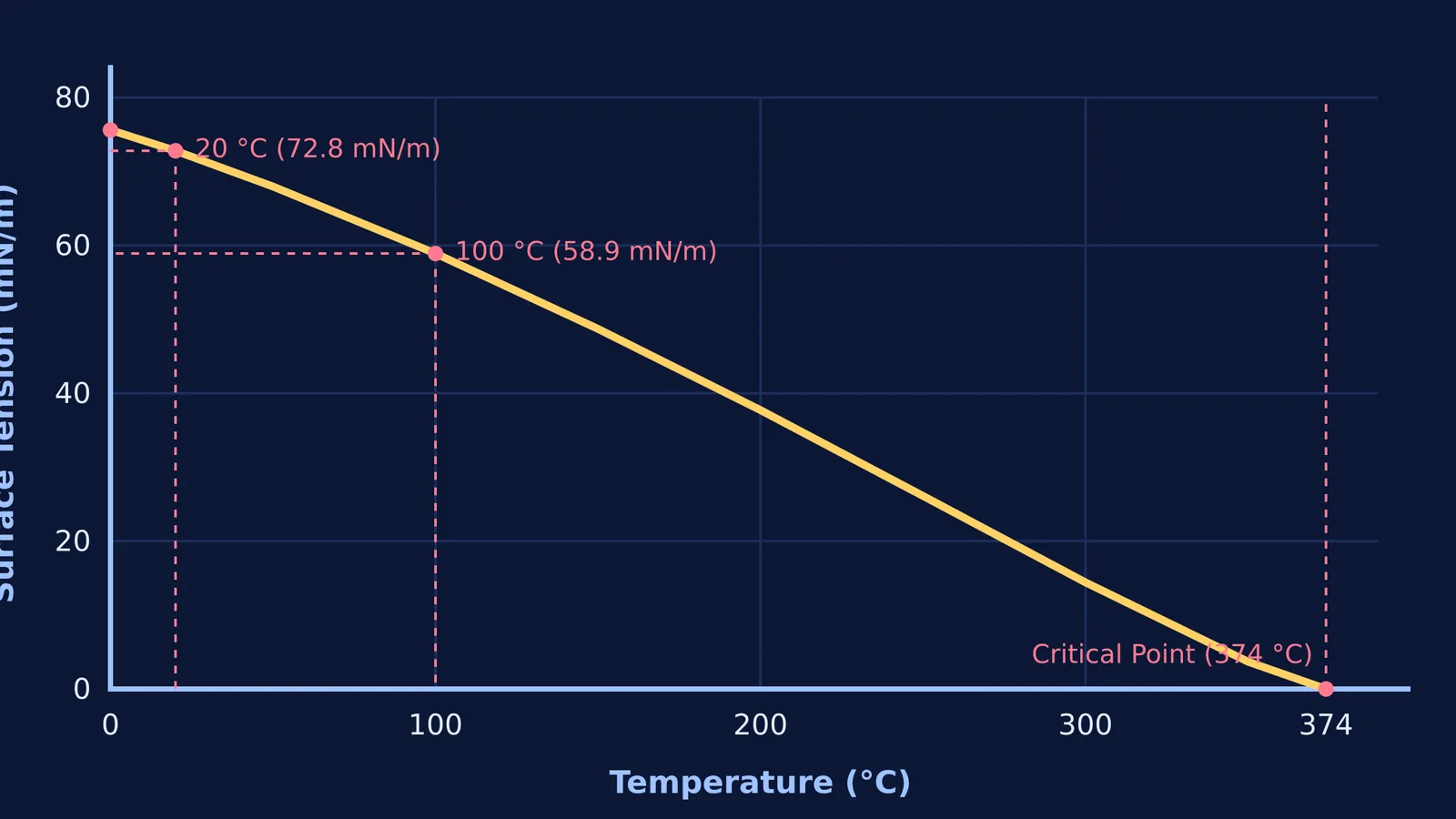
The drop in surface tension is the main reason hot water is such a powerful cleaning agent. At room temperature (20 °C), water has a relatively high surface tension of 72.8 mN/m according to the International Association for the Properties of Water and Steam. This high tension means cold water tends to bead up on surfaces and struggles to penetrate the microscopic pores in fabrics.
When you heat water to near boiling (100 °C), its surface tension drops significantly to 58.9 mN/m. This reduction changes how water behaves:
Better wetting: The "weaker" skin allows the water to spread out flat over a surface rather than pulling itself into stubborn droplets.
Deeper penetration: With lower cohesion, hot water can easily seep into the tiny crevices of dirty clothes to reach trapped grime (which is highly effective when you also learn how soaps clean: micelles and hard water).
Lifting grease: Cold water simply slides over oils. Hot, low-tension water can get underneath greasy layers, encapsulate them, and lift them away from the surface.
What happens at the critical temperature?
If heating water continuously lowers its surface tension, what happens if we keep heating it indefinitely under high pressure? The Eötvös rule states that a liquid's surface tension decreases steadily with temperature until it reaches exactly zero.
This total loss of surface tension happens at a substance's critical temperature (Tc). For water, the critical temperature is 374 °C (or 647 K), as detailed in its standard physical properties.
At 374 °C, water reaches its critical point. The kinetic energy of the molecules is so extreme that the liquid expands, and the dense vapour above it compresses, until both phases share the exact same density. At this precise moment, the physical boundary between the liquid and the gas completely vanishes, creating a "supercritical fluid". Because surface tension is simply the energy required to maintain an interface between two distinct phases, it ceases to exist when that interface disappears—a phenomenon closely related to the early discoveries of Thomas Andrews and the critical temperature.
Exam focus: Assertion and Reason framework
In the JEE and NEET exams, the relationship between temperature and surface tension is a classic target for Assertion-Reason questions. Here is a reliable framework to tackle them:
The Assertion: "Surface tension of a liquid decreases with an increase in temperature."
*This statement is True.*
The Reason: "At higher temperatures, the cohesive forces between the liquid molecules become weaker due to increased kinetic energy."
*This statement is True, and it is the correct explanation for the assertion.*
When you see conceptual questions about matter in our surroundings, evaporation and latent heat, keep in mind that temperature always works against cohesion. Whether the heat is melting a solid block of ice, boiling a pot of liquid water, or merely lowering its surface tension, thermal energy is always actively breaking the bonds that hold matter together.


