

On this page
Give a farmer 40 metres of fencing and ask for the biggest kitchen garden. A square gives 100 m². A circle gives about 127 m². No shape at all beats the circle, and the reason is one of the oldest results in geometry.
Why does a circle enclose the most area for a given perimeter?
The isoperimetric inequality says that a closed curve of length L enclosing area A always satisfies 4πA ≤ L², and equality holds if and only if the curve is a circle (Isoperimetric inequality, Wikipedia).
Rearranged: A ≤ L²/(4π). A circle of radius r = L/(2π) has area πr² = L²/(4π), exactly the ceiling.
The classical argument, in three moves:
No dents. Flip any inward dent outward. Length stays the same, area grows, so the best shape is convex.
Equal halves. Cut the best shape with a line that halves the perimeter. If one side had more area, replace the smaller side with a mirror copy of the bigger one. So you only need the best arc of length L/2 with both ends on a line.
Right angles. Join any point P on that arc to the two ends X and Y and hinge the curved pieces at P. Only the middle triangle changes, and its area, ½ × PX × PY × sin P, is largest when the angle at P is 90°. An arc whose every point sees the ends at a right angle is a semicircle (Thales' theorem). Mirror it: a circle.
The Swiss geometer Jakob Steiner showed exactly that much: if a solution exists, it must be the circle; a fully rigorous proof came later in the 19th century, and in 1902 Adolf Hurwitz published a short proof using Fourier series (Wikipedia).
How do polygons compare with the circle?
The ancient Greek mathematician Zenodorus proved that a circle has more area than any polygon with the same perimeter (MathWorld, Isoperimetric Problem). You can see why for regular polygons with a short calculation.
A regular n-sided polygon with perimeter L has side L/n and apothem (centre-to-side distance) L/(2n tan(π/n)). Its area is half the perimeter times the apothem:
A = L² / (4n tan(π/n))
Since tan x > x for 0 < x < π/2, n tan(π/n) > π, so every regular polygon sits below the circle. As n grows, n tan(π/n) shrinks towards π.
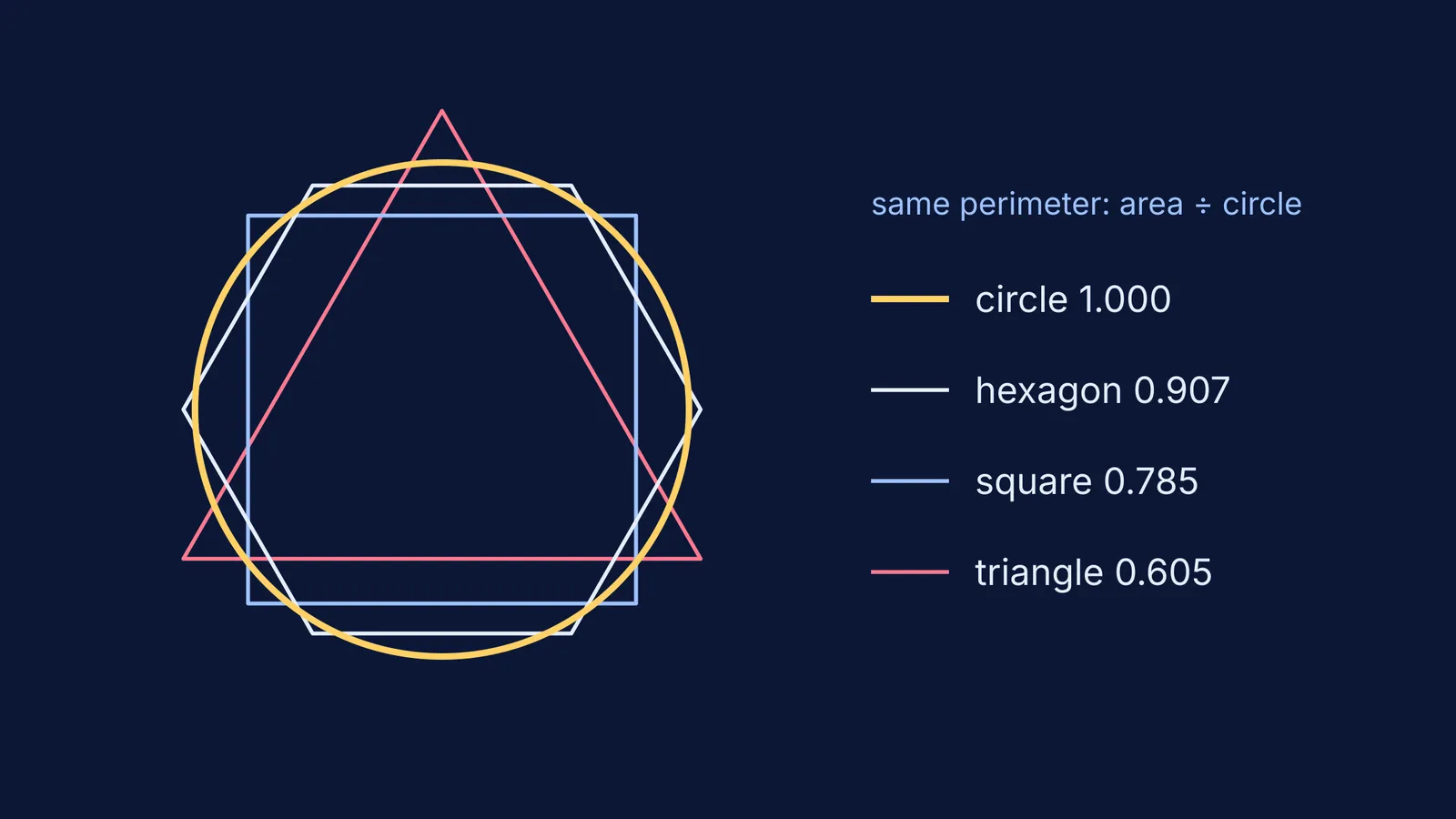
A handy score is the isoperimetric quotient Q = 4πA/L², the shape's area divided by the area of a circle with the same perimeter; Q ≤ 1 for every shape (Wikipedia).
Worked example, 40 m of fencing (L² = 1600):
Rectangle 15 m × 5 m: 75 m², Q ≈ 0.59
Equilateral triangle, side 13.33 m: about 77.0 m², Q ≈ 0.605
Square, side 10 m: 100 m², Q ≈ 0.785
Regular hexagon, side 6.67 m: about 115.5 m², Q ≈ 0.907
Circle, radius 6.37 m: about 127.3 m², Q = 1
Rectangle versus square is AM-GM in disguise: x(20 − x) ≤ 10², with equality at x = 10. Our post on the relation between AM, GM and HM of two numbers has the proof.
What is Dido's problem?
In Virgil's Aeneid, Dido's people buy land at the site of Carthage: "they measured round so much of Afric soil as one bull's hide encircles, and the spot received its name, the Byrsa" (Williams' translation, Aeneid Book 1 on Perseus).
Dido's problem asks for the region of maximal area bounded by a straight line and a curved arc (Wikipedia): think of a coastline you get for free.
The answer is a semicircle. Reflect the region in the straight edge and you get a closed curve of twice the length, which is best as a circle.
With the same 40 m of fence against a wall:
Best rectangle (10 m out, 20 m along the wall): 200 m²
Semicircle, radius 40/π ≈ 12.73 m: L²/(2π) ≈ 254.6 m²
The wall exactly doubles the best area, from L²/(4π) to L²/(2π).
How do you use this in JEE-style optimisation questions?
A five-step check for "fixed perimeter, maximum area" questions:
Write the constraint and the area in one variable.
Guess the symmetric answer: square, regular polygon, circle or semicircle.
Confirm with AM-GM or a derivative; Jensen's inequality for convex functions handles many terms.
Look for a free edge and reflect across it.
Compute Q. Above 1 means a mistake.
The same idea in 3D is why soap bubbles are always round.
If convexity or symmetry arguments are new to you, the Fermi Concept Library gives every mathematics concept its own lesson. To practise, the Fermi Problem Library has a step-by-step solver that explains the reasoning rather than printing an answer.
Try it yourself: with 60 m of fence and a river on one side, how much more area does a semicircle give than the best rectangle?


